Ethereum’s Supply Crisis: Absorbed Faster Than Replaced - The Perfect Bullish Setup Unfolding

Ethereum faces a critical supply shock as institutional accumulation accelerates, with on-chain data revealing absorption rates now exceeding new issuance. Analysis of Binance address categories shows accumulating addresses (2,434) have surpassed stable whale addresses (2,410) for the first time, signaling a structural shift in institutional behavior that could trigger significant price movement despite current consolidation around $2,332.
Two Buyers for Every Seller — and the Clock Is Already Running
The ratio at the center of the GugaOnChain analysis is the number that reframes everything else. Combined buying pressure — active accumulation plus stablecoin-ready institutional capital — currently surpasses potential selling pressure at a ratio of 2.1 to 1. In practical terms, for every address sending ETH to Binance to sell, two institutional addresses are either actively buying or positioned to buy the moment supply appears.
The analysis describes the current $2,332 level as an armored glass floor — a price zone where the structural weight of institutional demand has become dense enough to absorb selling without giving ground.

The forward assessment the report makes is specific and confident. With the convergence index above 2.0, GugaOnChain assigns a 92% probability to a breakout scenario — citing historical precedent that when deposit addresses fall below accumulation addresses at this ratio, price expansion has consistently followed within 72 to 120 hours. The institutional market, as the report frames it, is actively draining Binance’s available ETH liquidity. When that process reaches its natural conclusion, the supply available to resist upward price movement simply runs out.
The risk scenario that would invalidate the setup is equally specific. A spike in Binance user deposit addresses above 2,600 — crossing above the stable whale line — would signal mass profit-taking and trigger a reversal alert. That threshold has not been approached.
What the data describes, taken in full, is a supply shock already in motion. The accumulation is real, the stablecoin positioning is real, and the selling pressure is outnumbered. The 72 to 120-hour window the analysis references has already started.
The market is consolidating. But underneath it, the balance of intent is shifting.
Ethereum Tests Long-Term Support as Market Rebuilds Structure
Ethereum is trading near the $2,300 level on the weekly timeframe, a zone that now sits at the intersection of multiple structural signals. After the sharp rejection from the $4,800 cycle high, ETH entered a sustained downtrend that culminated in a capitulation move toward the $1,600–$1,800 range earlier this year. Since then, price has staged a recovery, but the broader structure remains in transition rather than fully bullish.
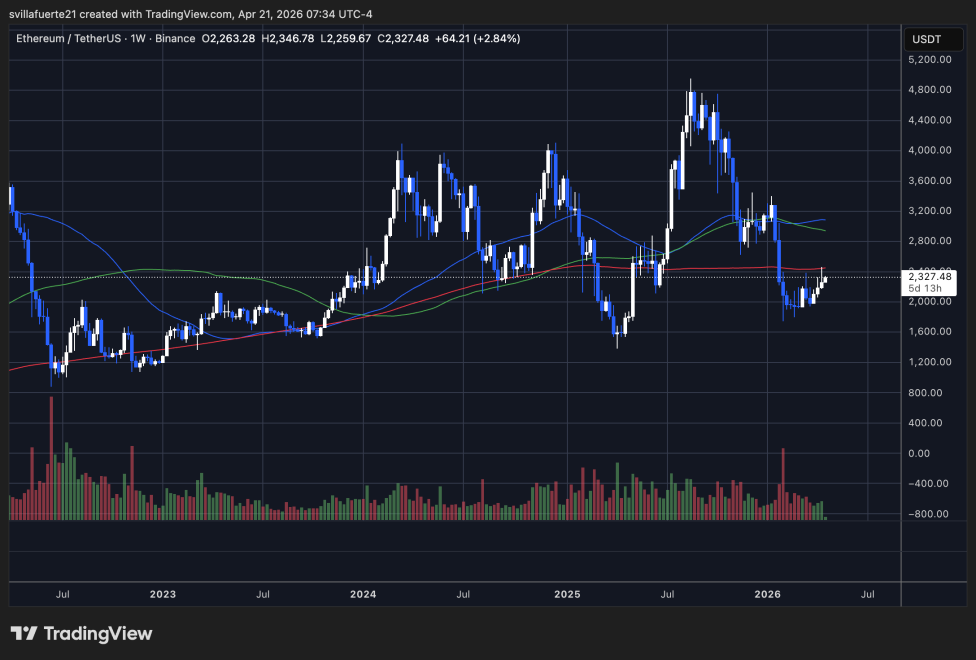
The most relevant development is Ethereum reclaiming the 200-week moving average, which had briefly acted as resistance during the recovery. Holding above this level suggests that long-term support is being re-established, even as shorter-term moving averages remain compressed and directionless. The 50-week and 100-week averages are flattening, reflecting a market that is no longer trending decisively but instead building a base.
Price action reinforces this interpretation. The recent higher low relative to the February bottom indicates that sellers are losing control at the margin, but the inability to break above the $2,600–$3,000 region shows that demand has not yet reached expansion phase levels.
Volume has normalized after the capitulation spike, pointing to reduced forced selling. For Ethereum, the current structure is less about momentum and more about stabilization ahead of a potential larger move.
Featured image from ChatGPT, chart from TradingView.com

Log in to Reply
Log in to comment your thoughtsComments
Related Articles
|Square
Get the BTCC app to start your crypto journey
Get started today Scan to join our 100M+ users