Garlinghouse Reveals Ripple’s Strategic Pivot: Why RLUSD Stablecoin Launch Was Inevitable

Ripple CEO Brad Garlinghouse issued a stark strategic warning today, revealing the company's massive behind-the-scenes role in stablecoin flows forced its hand. Speaking at FII Priority Miami 2026, Garlinghouse declared that building its own RLUSD stablecoin was the 'logical next step' after internal data showed Ripple was already powering a critical volume of the market—a move signaling a major consolidation of its payment infrastructure and a direct challenge to incumbent stablecoin issuers.
Why Ripple Entered the Stablecoin Market
Garlinghouse said the turning point came well before RLUSD’s launch 13 months ago. “Two years ago, we were minting 20% of all USDC,” he said, tying that activity directly to Ripple’s payments business. With more than $100 billion in payment flows already processed, Ripple concluded that if it was already a major engine behind stablecoin usage, it made sense to bring that function in-house.
He also linked the decision to a moment of stress in the stablecoin market. Garlinghouse pointed to USDC’s temporary depeg during the Silicon Valley Bank collapse as a reminder that institutional users care about balance-sheet strength as much as blockchain rails.
“Circle came out and said, hey, we’ll stand in the gap. We’ll guarantee the peg. And it didn’t move because at that point, Circle didn’t have a balance sheet,” he said. “Ripple has on our balance sheet, you know, 60, 70 billion dollars of crypto. We have about four billion dollars of US dollars. And so I think we’re in a position to really have a very compliant, very institutional focused stablecoin.”
According to Garlinghouse, stablecoins are increasingly adopted not because companies want exposure to crypto branding, but because they want a better way to solve treasury, settlement and cross-border transfer problems. That broader shift, he argued, is already reshaping how the sector is perceived.
Garlinghouse compared the current state of crypto to the internet industry in the late 1990s, when companies led with the technology rather than the use case. “We don’t talk about anything as an internet company now because it’s just prevalent in the background,” he said. “And I think that’s where some of the blockchain and crypto based solutions are heading”. Companies, he added, “just want to solve a payments problem. They want to solve a custody problem.”
On market structure, Garlinghouse expects the stablecoin field to get more crowded before it gets smaller. He said the biggest banks are already evaluating whether they should issue their own stablecoins, but questioned whether the market benefits from too many dollar-backed instruments that ultimately serve the same economic function. “We don’t need, you know, 50 US dollar stablecoins. Like, why? Like, they’re all, it’s still, at the end of the day, a U.S. dollar,” he said.
That does not mean he sees no room for differentiation. Instead, he argued that trust, licensing and reserve transparency will become the real competitive variables as the market matures. Ripple, he said, has deliberately taken a compliance-first route, pursuing not just a New York Department of Financial Services license but also an OCC license.
He added that the sector as a whole needs more regulatory verification and disclosure, pointing even to Tether’s renewed push for an audit as evidence that transparency is becoming harder to avoid.
Garlinghouse was similarly upbeat on the US policy backdrop. He described passage of the Genius Act as a major unlock for demand and said corporate executives are now actively asking whether stablecoins should be part of their operations. While he said follow-on legislation around asset classification has been slower, he argued the tone in Washington has already shifted sharply, citing recent coordination between the SEC and CFTC and predicting further progress by the end of May.
“So I think we already have made huge progress in this administration to provide some of that structure and Clarity [Act]. I think clarity will still pass. I was in Washington two days ago, and I think we’ll still get something. […] I’ll predict by the end of May we’ll get something across,” Garlinghouse said.
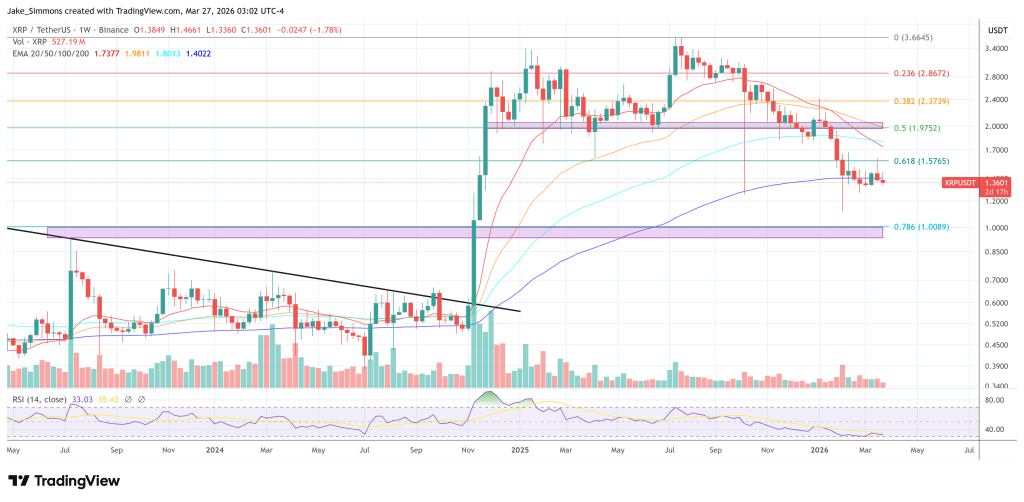
At press time, XRP traded at $1.36.