NYDIG Warns: Bitcoin’s STRC Flywheel Faces 10% Correction Risk as Market Misunderstands Strategy’s $1.2B Surge

NYDIG has issued a stark warning that Strategy's rapidly expanding STRC issuance—a $1.2 billion surge in the past week alone—faces a potential 10% correction, arguing the market is dangerously misreading the structure. The firm contends the preferred-stock complex should be viewed not as traditional credit but as a fragile, bitcoin-backed liability system whose viability hinges entirely on volatile capital markets access and investor confidence.
NYDIG Breaks Down The Bitcoin Flywheel
NYDIG’s central point is that STRC and SATA are “not well understood through the lens of traditional credit or equity.” Instead, the firm wrote, “they are best viewed as actively managed, capital markets–dependent liability structures backed by a reserve asset, bitcoin.” That framing runs through the entire note.
The report argues these securities differ materially from conventional debt. They sit junior to debt but senior to common equity, are unsecured, and come with variable, fully discretionary dividends and limited governance rights. Most importantly, NYDIG says issuers are actively trying to keep them trading near par, usually around $100, through signaling, dividend management and periodic adjustments to dividend rates.
In NYDIG’s view, that means the real constraint is not operating cash flow. “These instruments are not funded by operating cash flow, nor are they designed to be serviced through corporate earnings,” the firm wrote. “Instead, they function as capital markets vehicles in which preferred securities are the core funding product, and the corporate balance sheet, anchored by bitcoin holdings, is constructed to support ongoing issuance.” In that setup, traditional metrics like EBIT-to-interest coverage are not the right tool for judging sustainability.
The note also pushes back on the idea that a bitcoin decline would automatically force liquidations across the structure. Strategy’s debt, NYDIG says, is generally unsecured and carries limited financial covenants unless explicitly specified. Default is “primarily triggered by payment failure or bankruptcy, not mark-to-market declines in asset values,” and that logic extends in important ways to the preferred layer as well. There are no hard triggers tied directly to bitcoin price moves or coverage ratios, even if preferred holders remain more exposed to management discretion and subordination risk.
That leads to the “flywheel” at the center of the report. When preferreds like STRC and SATA trade near par, issuers can raise capital efficiently. That capital is then used to buy bitcoin, expanding the asset base and, in NYDIG’s telling, strengthening balance sheet support. If common equity also trades above NAV, stock issuance becomes accretive on a bitcoin-per-share basis, reinforcing the cycle.
NYDIG describes it as a reflexive loop in which “capital access funds bitcoin purchases, which strengthens the balance sheet and sustains investor confidence, allowing continued issuance.” But it also stresses that the mechanism is conditional rather than permanent. “As long as preferreds remain anchored near par, equity trades above the NAV, and capital markets stay open, the flywheel drives ongoing bitcoin demand,” the report said.
The reverse is also true. If bitcoin falls, confidence weakens, or preferreds slip below par, issuance becomes harder or uneconomic. That can stall the system without requiring insolvency. NYDIG says the burden of adjustment then shifts toward the preferred layer through dividend deferrals, rate changes or deeper subordination as new claims are added.
The firm even frames STRC through an options lens, saying it resembles being short a put on bitcoin asset coverage, with yield earned in exchange for downside risk if bitcoin weakens and erodes the asset cushion. But unlike a standard option, there is no fixed strike or maturity, and outcomes depend heavily on management decisions.
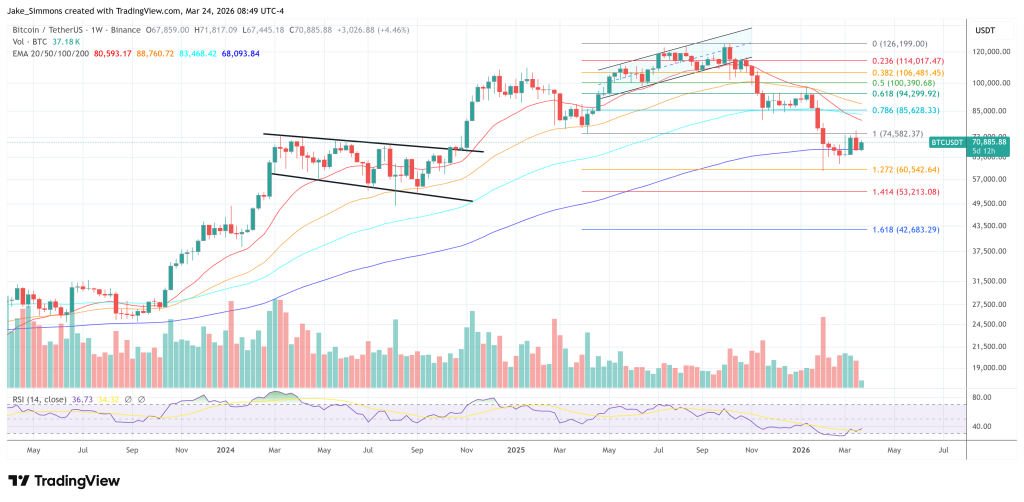
At press time, BTC traded at $70,885.