BREAKING: Ripple Founder Larsen’s Hidden XRP Treasury Control Exposed in Explosive Report

A new Protos investigation reveals Ripple co-founder Chris Larsen holds disproportionate influence over Evernorth—an XRP treasury firm planning a Nasdaq listing—creating severe conflicts for public investors. The report details how Larsen's nonprofit RippleWorks invested $500,000 plus 211 million XRP into the deal's sponsor vehicle, securing majority control while raising red flags about governance and shareholder transparency ahead of the public offering.
Ripple Founder Larsen’s Role
The formal control structure runs through Arrington XRP Capital Fund’s general partner, an LLC managed by Michael Arrington. But the filing described by Protos says that control is constrained by contract. Under an October 17, 2025 agreement, the fund must “consult with RippleWorks on any decisions directly related to the disposition or voting of Evernorth Holdings Inc. Stock” and “to vote such shares as directed by RippleWorks.”
That arrangement is what gives the report its edge. Protos highlights language from the SEC Form S-4 filed on March 18 that does not mince words about the misalignment. “The economic interests of the Sponsor diverge from the economic interests of holders of the Public Shares,” the filing states. It goes further: “This structure may create potential conflicts of interest between Mr. Larsen’s duties to Ripple, his influence over RippleWorks’ investment in Arrington XRP Capital Fund, and the interests of Evernorth Holdings Inc. and its stockholders.”
Those concerns are amplified by the other entities feeding XRP into the transaction. Protos reports that the Larsen Lam Children’s Remainder Trust will contribute 50 million XRP in exchange for 1,832,454 Evernorth shares, giving Larsen another line of influence in the soon-to-be-public company. Ripple itself is also contributing 126,791,458 XRP to the same deal, meaning a nonprofit Larsen co-founded, a company he co-founded, and a trust tied to his family are all participating in the same Nasdaq-bound structure.
The filing, as quoted in the report, acknowledges a limit to Larsen’s direct authority. It says he “does not have direct control over RippleWorks’ voting or investment decisions with respect to Arrington XRP Capital Fund.”
Yet Protos argues that this caveat does little to reduce the broader concern, because Larsen sits on RippleWorks’ board, helped create the nonprofit, and remains executive chairman of Ripple.
In another passage cited by the report, the SEC disclosure says Larsen’s “dual roles and affiliations could give rise to situations where his interests as an executive of Ripple differ from or conflict with the interests of Armada Acquisition and holders of Armada Acquisition Class A Common Stock.”
The financial backdrop makes the governance question more striking. IRS filings cited by Protos show RippleWorks held $1.4 billion in assets for fiscal year 2024. The report says Larsen contributed most of those assets, and that 89% of RippleWorks’ revenue in 2024 came from selling some of them. It also notes that CEO Doug Galen earned $845,945 that year, while Larsen was listed as secretary/treasurer with zero compensation.
Protos also points to deal terms that could further benefit RippleWorks and Ripple if XRP rises before closing. Under a closing adjustment, both can receive bonus shares in Evernorth if the token appreciates, while still retaining shares priced on fixed contractual terms even if XRP does not rally. That asymmetry is central to the report’s thesis: Larsen-linked entities may be positioned to capture upside in a public-market vehicle while ordinary shareholders absorb a governance structure already flagged in the filings themselves.
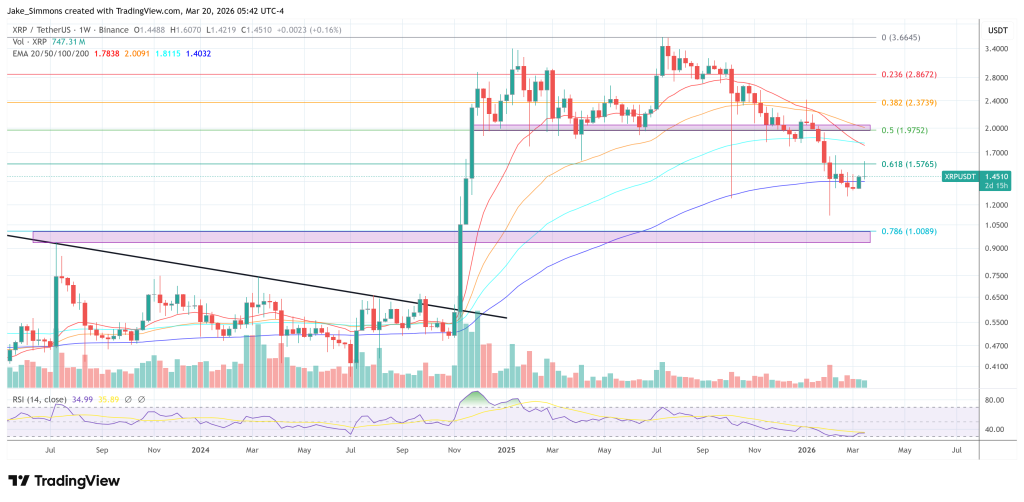
At press time, XRP traded at $1.45.