Saylor’s Bold 2026 Prediction: Bitcoin Poised for Massive Win as AI Shatters Traditional Corporate Moats

NEW YORK, March 18, 2026 – MicroStrategy Executive Chairman Michael Saylor issued a stark warning today, declaring Bitcoin could become the primary financial beneficiary if artificial intelligence systematically destroys long-term corporate value. His statement responds directly to venture capitalist Chamath Palihapitiya's provocative thesis that AI will compress corporate 'terminal value,' forcing a brutal repricing of equities and potentially triggering a 10%+ market correction as investors abandon long-dated growth assumptions.
Bitcoin Could Surge as AI Destroys Traditional Moats
Saylor’s response was brief and reiterated his previous public stance. “If AI compresses terminal value and makes every moat temporary, capital will rotate to assets with no disruption risk,” he wrote. “Bitcoin is Digital Capital – scarce, neutral, and impervious to AI disruption. $BTC should be the primary beneficiary of this shift.”
That exchange quickly turned to a familiar fault line in Bitcoin debates: quantum risk. Palihapitiya answered that Bitcoin “would need to be quantum resistant by then,” prompting Saylor to push back. “Your AI thesis assumes the digital world is quantum-resistant. If quantum breaks cryptography, it breaks AI, cloud infrastructure, banks, and the internet—not just Bitcoin. The entire stack upgrades together.”
Palihapitiya was unconvinced. “No. A store of value has to be 100% hacking resistant. It’s an existential feature,” he wrote. “For other industries it will be important but less binary/existential.”
Others in crypto added nuance. BitGo CEO Mike Belshe said both sides were partially right, arguing that Bitcoin is likely the “low-hanging fruit” for quantum attackers even if other systems would also be affected. He added: “It’s just too easy relative to other efforts. Similarly, Bitcoin also has the easiest job to be Quantum Resistant – it’s a clean solve technically, suffering only from lack of governance and decisiveness. The banking solution(s) to Quantum will be much harder with a much longer tail of work, but at least the centralized decision making is easier.”
Helius Labs CEO Mert Mumtaz made a similar distinction from another angle: “Those systems can detect, mitigate, and fix against a quantum threat infinitely faster than bitcoin in a non-messy way. That is the cost of decentralization. An EC2 machine getting hacked (won’t happen anyway) is nowhere near the severity of your entire financial getting drained.”
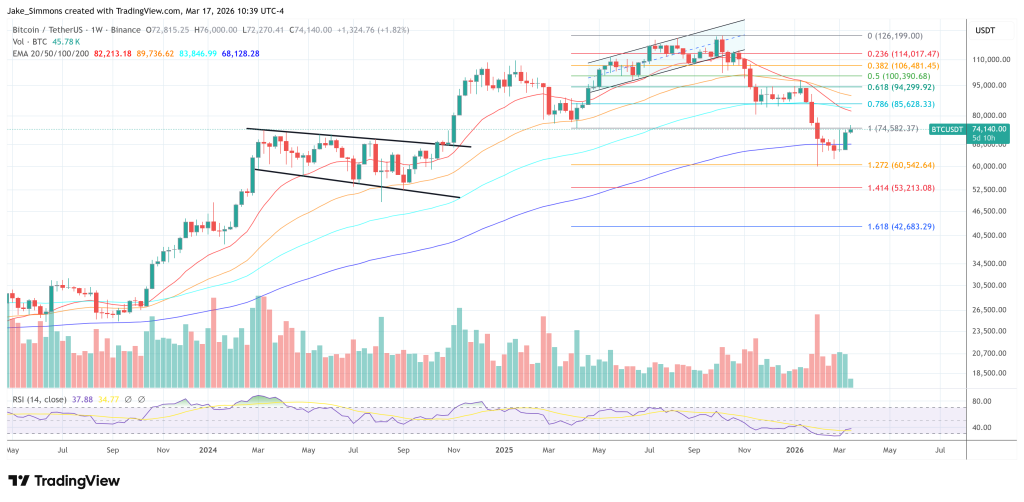
At press time, Bitcoin traded at $74,140.