Ethereum Leverage Climbs After Historic Liquidation Event – Is This the Start of a New Bull Cycle?

A dramatic surge in leverage positions on Ethereum derivatives platforms is raising alarms among analysts, signaling a potential 10% correction may be imminent despite recent price gains. The warning follows a historic liquidation event that wiped out over $300 million in leveraged bets, as ETH reclaims the $2,300 level amid renewed speculative frenzy. Market data reveals open interest in ETH perpetual swaps has climbed 22% in the past 48 hours, creating what analysts describe as a 'powder keg' scenario where a minor price dip could trigger cascading liquidations.
Ethereum Leverage Recovers After Historic Liquidation Reset
A recent analysis from CryptoQuant highlights how the Ethereum derivatives market has undergone a significant structural reset following the dramatic liquidation event that occurred on October 10. According to the report, the flash crash triggered one of the largest deleveraging events in the history of the cryptocurrency market.
During that event, the Ethereum Estimated Leverage Ratio (ELR) on Binance dropped sharply from 0.56 to 0.41, representing a 27% contraction in market leverage. The “10/10” event is now widely recognized as the largest 24-hour liquidation cascade in crypto history, with more than $19 billion in leveraged positions forcibly liquidated across the market.

Since that reset, leverage levels have gradually rebuilt as confidence returned. The report notes that Ethereum’s ELR has climbed to approximately 0.69 in mid-March, signaling that traders are once again increasing their use of leverage as sentiment improves.
The Estimated Leverage Ratio is calculated by dividing open interest by the amount of ETH reserves held on exchanges. In practical terms, it measures how aggressively traders are using leverage relative to the collateral available in the system.
Higher ELR readings typically indicate growing risk appetite and increased speculative positioning, which can amplify both upward price momentum and market volatility.
As sentiment improves, Ethereum and Bitcoin continue to act as high-beta risk-on assets, while more defensive investors may rotate toward tokenized gold instruments such as PAXG and XAUT.
Ethereum Attempts Trend Reversal After February Capitulation
The Ethereum chart shows the asset attempting to build bullish momentum after a prolonged corrective phase that dominated the market since late 2025. On the daily timeframe, ETH is currently trading around $2,310, following a strong rebound from the sharp selloff that occurred in early February.
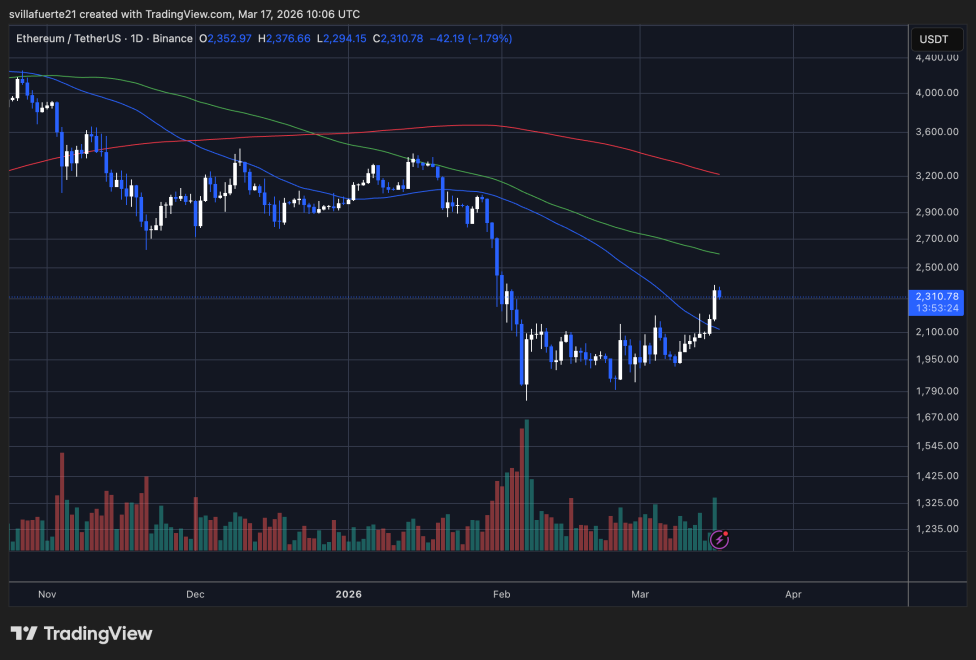
That decline pushed Ethereum toward the $1,800 region, where a clear spike in volume indicates a capitulation event and aggressive buyer absorption. Since that low formed, price action has gradually stabilized, with Ethereum constructing a higher base between $1,900 and $2,100 before initiating the current upward move.
Technically, ETH has now reclaimed the short-term moving average, which had acted as dynamic resistance throughout the downtrend. This development suggests that short-term momentum is shifting back in favor of buyers. However, the broader market structure remains cautious, as price still trades below the longer-term 100- and 200-day moving averages, which continue to slope downward.
The $2,300–$2,400 zone now represents a critical resistance region. This level previously acted as support before the February breakdown and is likely to attract significant sell-side liquidity.
If Ethereum manages to consolidate above $2,300, it could open the door for a continuation toward $2,600 and $2,900, where the next major technical barriers and moving averages converge.
Featured image from ChatGPT, chart from TradingView.com
