Bitcoin Hashrate Plummets 12% From March Peak As Miners Capitulate

Bitcoin's network security is flashing a critical warning sign as its hashrate has plunged nearly 12% from its March high, data shows, signaling a potential miner exodus that could precede a significant price correction. The sharp drop in computational power—a key health metric for the world's leading cryptocurrency—points to mounting pressure on miners as profitability wanes, raising alarms for investors about near-term volatility.
Bitcoin Hashrate Has Seen Its 7-Day Average Value Plummet Recently
The “Hashrate” refers to an indicator that tracks the total amount of computing power that’s currently attached to the Bitcoin network. Its value is measured in terms of hashes per second (H/s) or the more practical exahashes per second (EH/s).
Miners connect computing power to the cryptocurrency network to solve certain mathematical puzzles that allow them the chance to add the next block to the chain. This computing power, however, never works as a collective. Rather, miners compete against each other over the block reward using their individual mining facilities.
While the total Hashrate doesn’t work in tandem, its measure is still relevant for the network, representing the interest from validators toward the cryptocurrency. When the value of the metric rises, it means new miners are joining the network and/or existing ones are expanding their facilities. Such a trend can be a sign that the chain is looking lucrative to the validators.
On the other hand, the indicator going down suggests some of the miners have decided to disconnect their mining rigs, potentially because they are no longer able to break even on their operations. Now, here is a chart from Blockchain.com that shows the trend in the 7-day average value of the Bitcoin Hashrate over the past year:
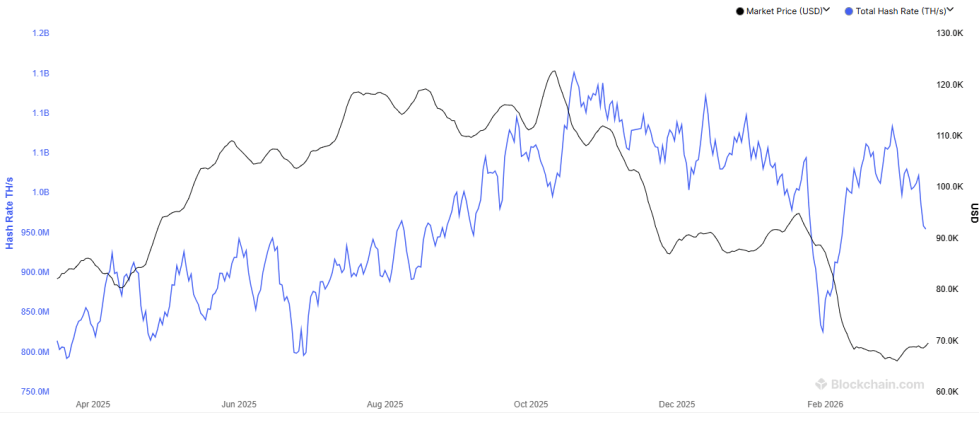
As displayed in the above graph, the 7-day average Bitcoin Hashrate flew up to a peak of about 1,083 EH/s on March 1st. This high came as the network recovered from the disruption caused by the US snowstorm. In the days that have followed this top, however, the metric has reversed course, with its value today sitting at 954 EH/s. This represents a decrease of nearly 12%, which is a significant figure.
The exodus from the miners could potentially be linked to the recent price trend that Bitcoin has faced. Miners make the majority of their income via the block subsidy, which involves a fixed BTC-denominated value and is given out at a more-or-less constant rate of time, leaving the cryptocurrency’s USD rate as the only variable related to it.
In the chart, the relationship between miner revenue and the price is visible. First, the Bitcoin Hashrate set its all-time high (ATH) as the asset’s spot price itself set a peak in October. Then, as the cryptocurrency observed a bearish shift, the indicator also moved to an overall downtrend.
BTC has recently been stuck in consolidation, so it’s possible that the lack of a bullish return has pushed some miners toward the exit, leading to the drop in the Hashrate.
BTC Price
Bitcoin has observed some recovery over the past day as its price has jumped to the $73,200 level.
