BREAKING: Bitcoin Cycle Pattern Shattered as Critical LTH-to-STH Supply Transfer Fails to Materialize

A critical warning signal has flashed across Bitcoin's blockchain as its current market cycle breaks from historical precedent, with the anticipated large-scale transfer of supply from Long-Term Holders (LTH) to Short-Term Holders (STH) failing to occur. This fundamental shift in on-chain dynamics threatens to disrupt typical bull market momentum and could precede a sharp correction, with analysts now eyeing a potential 10% pullback despite Bitcoin's current hold above $73,000. The failure of this key capitulation event leaves the market structure untested and vulnerable, reshaping the short-term trajectory for the flagship cryptocurrency.
A Key Change In Bitcoin’s Market Structure?
Bitcoin’s price is showing bullish strength once again, recovering above the $73,000 level during the weekend. However, on-chain market data reveals that the way supply is shifting between long-term BTC holders (LTHs) and short-term BTC holders (STHs) throughout the current cycle is clearly changing.
Darkfost, in a post on X, highlighted that this transfer of supply between the two groups has not occurred in the ongoing cycle the same way it did in previous cycles. As prices rise, long-term investors have historically transferred their holdings to more recent market players during significant bull market periods.
This trend suggests a major reset in the initial market structure of Bitcoin, where supply is equally controlled by short-term and long-term holders. Moving on, the expert stated that the first key thing to remember in the current cycle is that long-term holders still hold the majority of the BTC supply.
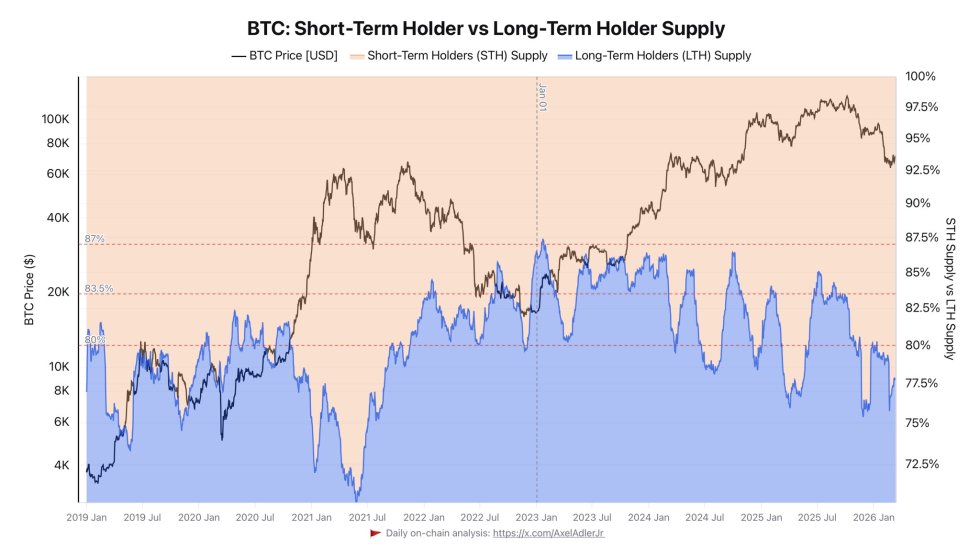
Rather than witnessing a rapid decline in LTH-held supply as Bitcoin nears the conclusion of its cycle, this time the process took a different turn. As of Sunday, these key investors represent roughly 79% of the total BTC supply.
The development is similar to that of the 2021 cycle, where the share of supply held by long-term holders fell from 82% to 70% in a space of 6 months. A major trigger is the insufficient liquidity from short-term holders to absorb the selling pressure from long-term investors.
The Movement Of BTC In 6 Separate Waves
During the current cycle, Darkfost reports that this transfer occurred in 6 waves. Meanwhile, STHs were observed swooping in to absorb the supply at every stage. These investors eventually turned into LTHs over time. After examining the coin movement within the 6 waves, Darkfost has underscored two major observations.
One is that liquidity appears to have been substantial during this cycle, and this allowed LTHs to steadily discover counterparties while Bitcoin’s price action extends. Secondly, speculation seems to have been stronger than before, with some short-term holders offloading their stash shortly after holding their BTC for more than 6 months in order to quickly realize profits.
Another key development observed in the market is the arrival of new participants via the Exchange-Traded Funds (ETFs) and Digital Asset Treasuries (DATs). Such a trend points to renewed capital and demand for the flagship asset from institutional investors who are confident about its long-term prospects. According to Darkfost, all of these factors are adding to a changing market structure for Bitcoin.
At the time of trading, Bitcoin’s price was trading at $73,815, following a more than 3% bounce over the last 24 hours. Its trading volume has followed suit, spiking by over 77% within the past day.
