Cardano Founder Demands Insider Recusal In Explosive Liqwid Governance Dispute

Cardano founder Charles Hoskinson has issued a stark warning about trust erosion in DeFi governance, intervening directly in the Liqwid protocol dispute by demanding insiders recuse themselves from a revote on contested asset distribution. His unprecedented public call cuts to the core of DAO legitimacy, questioning whether founding teams should vote on outcomes that directly benefit them, following what he described as broken '100% of assets' commitments made to token holders last October.
Cardano Founder Urges Second Liqwid Vote
According to Hoskinson, the team later ran into a governance and legal problem inside the DAO structure itself. “I guess that team did not have, according to the user agreement of their DAO, legal authorization to do so,” he said. “It somehow violated the terms of how they’ve set things up.” Even granting that point, he argued, the more troubling issue was how the matter was then handled.
His proposed fix was straightforward: rerun the vote, but on narrower and cleaner terms. “If you have to go to the DAO for a vote, two things should be done,” Hoskinson said. “First and foremost, those who are insiders should recuse themselves if they’re going to be direct beneficiaries of a governance action of this nature. Second, the question should have been, should we honor our marketing commitments, yes or no?”
That framing goes to the heart of his criticism. In Hoskinson’s telling, users deposited funds into the relevant smart contracts on the understanding that the prior commitments would be respected. “Commitments were already made, people put money into the contracts understanding those terms and conditions and had no reasons to believe that such things would be violated,” he said. “People in a position of trust and people in a position to maintain this type of software, they frankly speaking should be a little bit better.”
Hoskinson repeatedly returned to legitimacy, not just procedure. DAOs, he said, do not derive credibility from the mere existence of a vote. They derive it from broad participation and confidence that the process is not tilted by a small cluster of insiders. “DAOs require legitimacy and the legitimacy comes from participation,” he said. “If the belief is that participation is only controlled by a small group of insiders, there’s no path forward for a DAO to have governance legitimacy.”
His recommendation was for insiders associated with the protocol’s core entities to publicly declare their holdings, recuse themselves, and let holders vote only on whether the October commitments should be honored. If the answer is yes, then the protocol should simply follow through. If the answer is no, then the community could move to a second-stage debate over alternative allocations.
Hoskinson was equally clear about the stakes if that does not happen. He said he has no special powers to reverse the outcome, no control over assets already distributed into smart contracts, and no formal authority over the Cardano ecosystem. But he warned that perception alone could do lasting damage.
“It is my belief that this violation of public trust or at least the perception of it will badly damage the protocol’s ability, Liqwid’s ability to grow and thrive in the future,” he said. “Simply put, if people can’t trust what the core accounts are saying and when votes are taken, people don’t trust those votes, it creates a reality where people will just simply move to other options.”
Overall, if Liqwid wants to restore credibility, he argued, the path is still open. But it runs through disclosure, recusal and a cleaner vote.
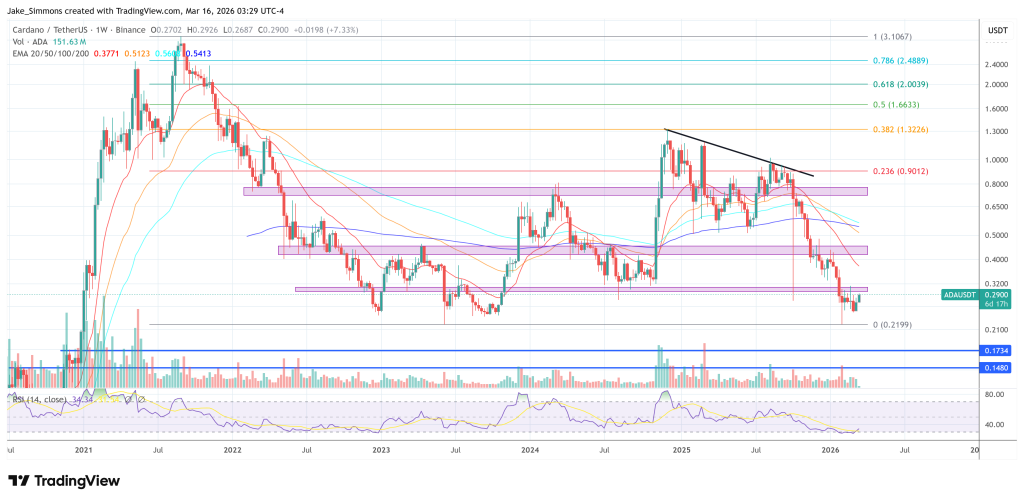
At press time, Cardano traded at $0.29.