JPMorgan Faces Major Lawsuit Over Alleged $328 Million Crypto Ponzi Scheme Involvement

JPMorgan Chase is now facing a major lawsuit alleging the banking giant helped sustain a massive $328 million cryptocurrency Ponzi scheme, with one plaintiff claiming losses of $650,000 including retirement savings. The legal action, representing over 2,000 investors, targets the bank's role in facilitating transactions for Florida-based Goliath Ventures, which prosecutors accuse of operating a fraudulent crypto investment operation.
JPMorgan Named As Sole Financial Institution For Goliath
A proposed class action filed Tuesday in the US District Court for the Northern District of California accuses JPMorgan of letting Goliath use its banking infrastructure to pull in investor funds while ignoring warning signs that something was wrong.
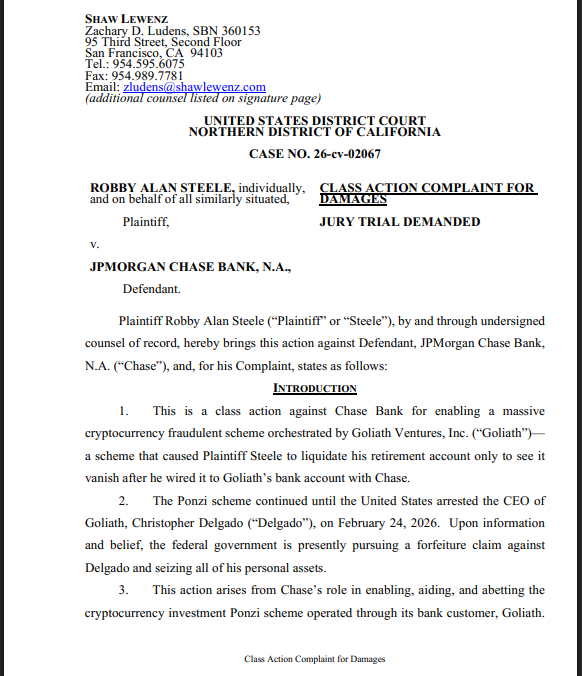
According to the complaint, JPMorgan was the only bank holding Goliath’s accounts from January 2023 through mid-2025 — the bulk of the scheme’s run.
During that stretch, roughly $250 million passed through a single JPMorgan account linked to Goliath. About $123 million of that was sent to Goliath’s wallets held at Coinbase.
Investors Accuse JPMorgan Chase of Aiding $328M Ponzi Scheme https://t.co/vGgkEt5Yu9
— The Recorder (@RecorderTweets) March 11, 2026
Attorneys say the sheer volume moving through one account should have triggered scrutiny under federal banking rules that require institutions to know who their customers are and what those customers do with their money.
“Chase, by virtue of its Know Your Customer obligations, actually knew that Goliath was acting as a private equity cryptocurrency pool operator investing money for investors, without being licensed at all to sell these investments,” the complaint states.
Goliath, originally called Gen-Z Venture Firm, operated from January 2023 until January 2026, based on court documents. CEO Christopher Delgado was arrested on Feb. 24 by the US Attorney’s Office for the Middle District of Florida.
He faces wire fraud and money laundering charges. If convicted on all counts, he could spend up to 30 years in federal prison.
Bank Of America Also Appears In Federal Case
A separate federal criminal complaint names Bank of America as well. Prosecutors say Delgado was a co-signatory on a BOA business account used by Goliath, with at least one investor directed to that account by company representatives.
Investor funds, based on the government’s account, were routed through the JPMorgan account, the BOA account, or sent straight to Goliath’s Coinbase wallets — all controlled by Delgado.
The civil lawsuit was filed by attorneys from Shaw Lewenz, Sonn Law Group, and Schwartzbaum. Lead attorney Jordan Shaw said more complaints are coming as the team continues to identify people believed to be involved in the scheme.
Featured image from Unsplash, chart from TradingView
