Bitcoin’s Civil War: Nervous Sellers Exit While Long-Term Holders Refuse To Budge - Who’s Winning the Battle for Control?

Bitcoin's market is splitting into two camps—and the divide reveals who really believes in the digital gold thesis.
The Panic Sellers vs. The Stone-Handed Holders
Short-term traders are dumping positions at the first sign of volatility, creating predictable sell-pressure that's become almost algorithmic. Meanwhile, wallets holding coins for years aren't moving—their resolve turning Bitcoin's circulating supply into something resembling digital bedrock. This isn't just market behavior; it's a philosophical showdown between speculative capital and true believers.
The Supply Shock No One's Talking About
Every coin that leaves an active trader's wallet for a long-term holder's vault effectively disappears from the trading pool. The math is simple: fewer coins available + sustained demand = upward pressure that ignores traditional market signals. It's creating a market structure where dips get shallower and recoveries accelerate—classic hodler dynamics playing out in real-time.
When Conviction Outlasts Volatility
The real story isn't price action—it's ownership concentration. While headlines chase daily percentage moves, the underlying shift toward diamond-handed accumulation continues uninterrupted. These holders treat Bitcoin like digital real estate, not a trading vehicle, creating a foundation that's increasingly resistant to traditional market panics. Their time horizon isn't measured in quarters, but in technological epochs.
The Institutional Parallel
Watch traditional finance institutions stumble into this dynamic—they're buying the asset while misunderstanding its psychology, treating Bitcoin like just another risky asset class rather than a monetary paradigm shift. Their spreadsheets can model volatility but can't quantify conviction, creating the perfect setup for underestimating what happens when an asset's strongest hands refuse to play by traditional rules.
So while nervous sellers exit stage left, long-term holders aren't just holding—they're defining the market's new normal. And in this civil war, time itself is the ultimate weapon. After all, what's more cynical than watching hedge funds try to trade an asset designed to make their entire industry obsolete?
Short-Term Holders Cashing Out Into Strength
Bitcoin barely twitched above $70,000 for only a few days before the exits started filling up. Data highlighted by crypto analyst Darkfrost on CryptoQuant shows that short-term holder selling pressure is beginning to stand out.
Notably, more than 27,000 BTC in profit was reportedly sent to exchanges by short-term holders within a space of 24 hours, a figure that places current activity among the highest profit-realization readings seen in recent months. As shown in the chart below, the last time more BTC in profit was sent to crypto exchanges was in early January 2026.
That matters because short-term holders tend to be the market’s most reactive participants. They usually respond quickly to price swings. The chart tracking short-term holder profit and loss to exchanges shows a spike in profit-taking as Bitcoin attempted to regain footing above $70,000.
Interestingly, the cohort currently in profit are addresses who bought Bitcoin between one week and one month ago, with a realized price around $68,000. That places them in a position where even the recovery is an opportunity to de-risk. Everyone else in the short-term cohort is either at breakeven or underwater.
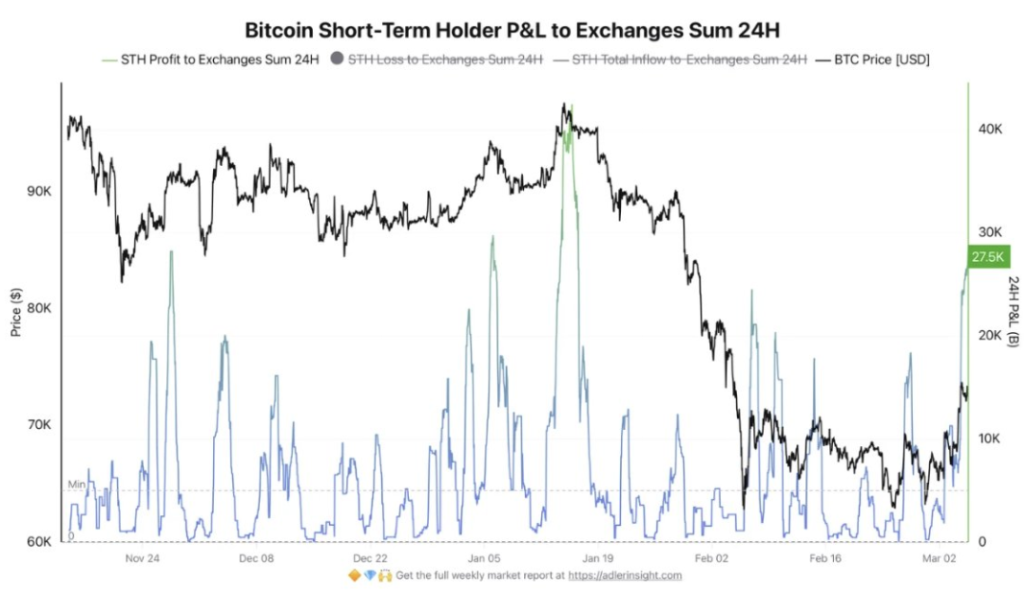
Bitcoin Short-Term Holder P&L To Exchanges. Source: CryptoQuant
Long-Term Holders Sending A Different Message
Long-term holders (LTHs), the cohort defined by holding Bitcoin for more than 155 days, are exhibiting a level of inactivity that matches conditions associated with bear market lows. According to the Coin Value Days Destroyed (CVDD) metric, which measures not just when long-held coins are moved but how much economic weight those movements carry, the current reading sits around 0.34.
To put that in context, market tops have historically formed when CVDD exceeded 2.0, which shows that LTHs are selling heavily. At 0.34, the market is nowhere near that territory. Therefore, long-term holders are, by and large, choosing to sit still and not contribute to selling pressure.
As shown in the metric chart below, the last time long-term holders had high selling activity was in early January 2026. This matters because LTHs aren’t just a passive footnote in the Bitcoin narrative.
They are always the crypto industry’s most strategically minded participants. Right now, they appear to be waiting either for higher prices to sell into or for the price action to deteriorate enough to accumulate more.
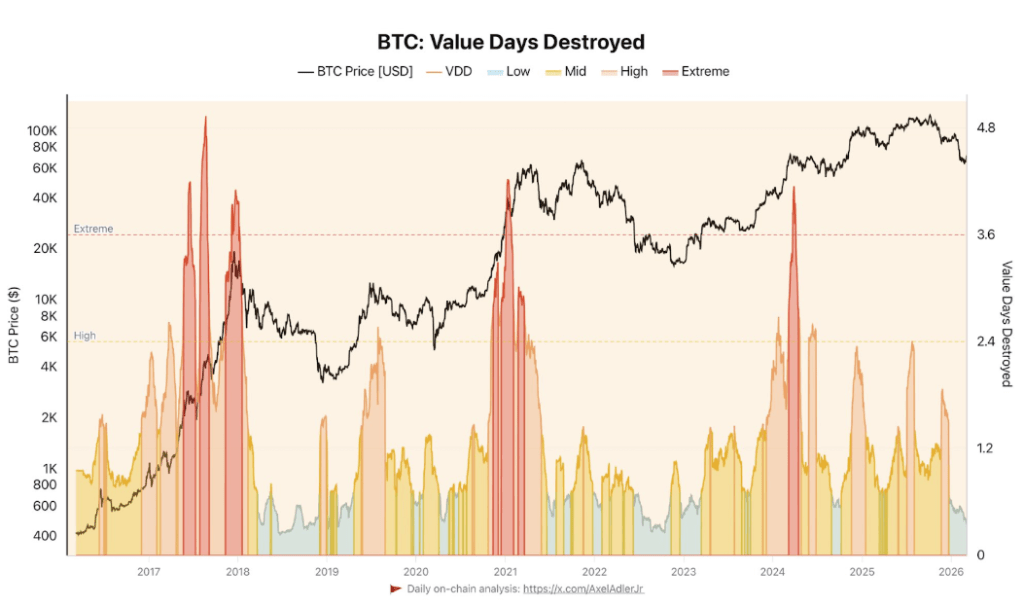
BTC: Value Days Destroyed. Source: @Darkfost_Coc On X
Featured image from Unsplash, chart from TradingView
