The 24/7 Takeover: How Crypto’s $130B TradFi Surge Is Devouring The Global Commodities Trade

Forget closing bells. The real action now runs on blockchain time.
The old guard of finance—with its bankers' hours and paper trails—is getting a brutal wake-up call. A $130 billion tidal wave of traditional capital is crashing into crypto markets, and it's not just chasing digital gold. It's systematically dismantling the entire architecture of global commodities trading.
From Warehouse Receipts to Wallet Addresses
The playbook is simple: bypass the middlemen. Why wait weeks for a shipment confirmation or deal with legacy settlement systems when a smart contract executes instantly? Tokenized oil, wheat, and metals aren't just digital twins—they're superior assets. They're liquid, divisible, and tradeable 24/7 from any smartphone. The physical supply chain hasn't gone away, but its financial representation is being ruthlessly optimized on-chain.
The Infrastructure Flip
This isn't speculation. It's infrastructure replacement. Decentralized exchanges are becoming the new trading floors. Oracles pull real-time data from ports and silos, cutting out the bloated reporting agencies. The result? Price discovery that's faster, more transparent, and brutally efficient. It exposes the fat margins that have propped up the old system for decades—the kind of margins that buy a lot of yacht fuel.
A New Liquidity Sun
The flow is irreversible. That $130 billion surge is just the initial down payment. As institutional frameworks solidify, the pipes get bigger. We're watching the birth of a parallel financial system that operates at the speed of the internet, with global reach and unprecedented accessibility. It doesn't ask for permission; it just offers a better product.
The commodities trade, once the exclusive domain of giants and insiders, is being democratized. Whether the old guard adapts or gets liquidated is their problem. The market has voted with its capital, and the verdict is in: legacy systems are legacy. The future trades around the clock.
TradFi Perpetual Futures See Rapid Growth On Crypto Exchanges
The report also highlights the rapid expansion of trading activity in Binance’s TradFi perpetual futures market. Since launch, cumulative trading volume across these contracts has surpassed $130 billion, with more than 90 million trades recorded. Notably, total volume exceeded $100 billion by February 24, just two months after the product’s introduction, underscoring strong demand from traders seeking continuous exposure to traditional assets through crypto-native platforms.

Binance’s TradFi perpetual futures allow users to trade a wide range of instruments, including precious metals and major equities. Available contracts include gold, silver, palladium, and platinum, alongside stocks such as AMZN, COIN, CIRCL, HOOD, INTC, MSTR, PLTR, and TSLA. These products replicate the economic exposure of traditional derivatives while benefiting from the global accessibility and near-continuous trading environment of crypto exchanges.
Precious metals dominate activity within this segment. Daily trading volume is heavily concentrated in gold and silver contracts, which reached approximately $3.77 billion and $3.75 billion, respectively, on March 3. Trading tends to accelerate during strong price trends in metals markets. For example, record daily volumes of roughly $4 billion in gold and $7 billion in silver were observed on January 30, 2025.
High participation levels further illustrate this momentum. TradFi perpetual futures recently recorded around 4.4 million daily trades, with gold accounting for roughly 2.0 million and silver for 1.9 million transactions.
Total Crypto Market Cap Tests Key Support After Correction
The weekly chart of the total cryptocurrency market capitalization shows the market stabilizing near $2.37 trillion after experiencing a sharp correction from the late-2025 highs. Following a strong rally that pushed the total market cap close to the $4 trillion region, the broader crypto market entered a consolidation phase marked by declining momentum and increased volatility.
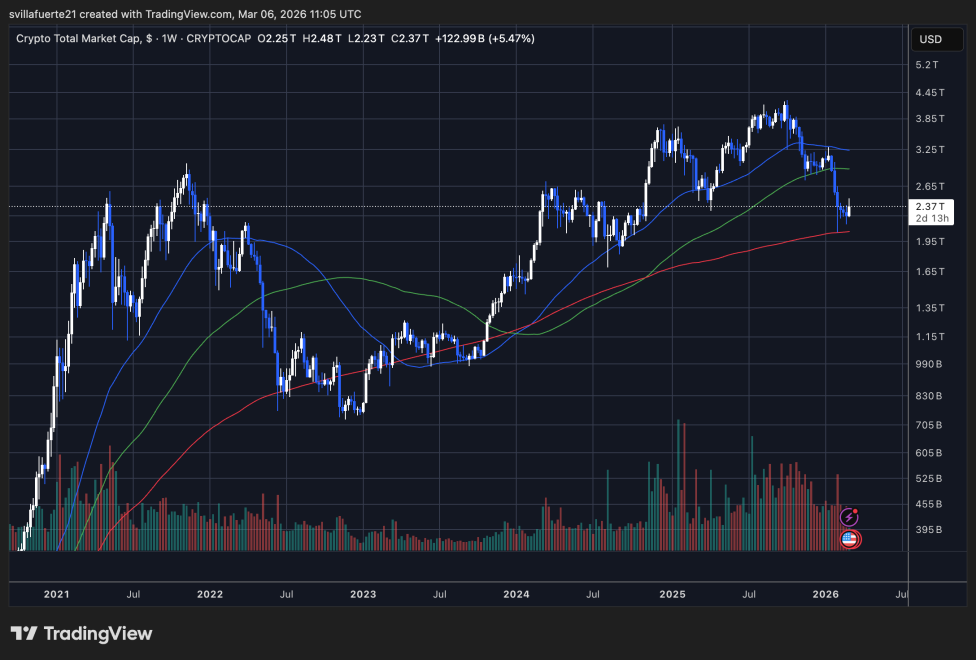
From a structural perspective, the recent decline has pushed the market below the 50-week moving average, a level that previously acted as dynamic support during much of the 2024–2025 expansion. The market is now attempting to stabilize around the $2.3 trillion zone, which is emerging as an important short-term support level.
Below the current price, the 100-week moving average sits near the $2.1 trillion region, while the 200-week moving average continues to trend upward around $2 trillion. These long-term averages form a significant support cluster that historically plays a key role during mid-cycle corrections.
Despite the recent pullback, the broader structure still reflects a macro uptrend that began in early 2023. The current phase appears consistent with a corrective retracement following an extended rally rather than a full structural breakdown.
If total market capitalization manages to hold above the $2.3 trillion area, the market could attempt to rebuild momentum and challenge resistance near the $2.8–$3 trillion range in the coming months.
Featured image from ChatGPT, chart from TradingView.com
