Bitcoin Bears Lose The Lead: Negative Funding Is The Only Thing Stopping A Structural Breakout

Bears just got their claws clipped. The market's momentum has shifted, leaving one stubborn barrier standing between Bitcoin and a full-blown price surge.
The Last Line of Defense
Forget the macro fears and regulatory noise. The single biggest headwind right now isn't a whale selling or bad news—it's the mechanics of the derivatives market itself. Negative funding rates across major exchanges are acting like an anchor, dragging against the building bullish pressure.
This persistent negativity tells a clear story: short sellers are still paying longs to hold their positions. It's a classic contrarian signal, often flashing right before a major move. The structure wants to break higher, but this financial friction is holding it back—for now.
When the Dam Breaks
Watch that funding rate. The moment it flips and turns positive, the last major resistance evaporates. It's the equivalent of removing the emergency brake while the engine is already revving. The ensuing squeeze could be violent, catching an army of overconfident shorts completely off guard.
All the classic breakout ingredients are simmering. Sentiment is thawing, accumulation patterns are solidifying, and the bears have visibly lost their strategic advantage. The market is coiled, waiting for one final catalyst.
So we sit at the precipice, held back by what is essentially a technicality—a quirk of leveraged betting that Wall Street would probably package into a complex ETF and sell to retirees. When this last barrier falls, the path of least resistance points decisively upward. The countdown has begun.

In the current cycle, however, the recovery has occurred in approximately 25 days. As of March 4, the indicator has climbed back to around +0.98, signaling a potential transition away from the recent bearish regime.
Structural Indicators Align As Bitcoin Tests Key Resistance
Adler further notes that price-based structural signals are now aligning with regime indicators, reinforcing the significance of Bitcoin’s recent recovery above $70,000. One of the key metrics highlighted in the report is the Structure Shift Composite, a fast signal designed to capture short-term changes in market structure.
The Structure Shift Composite ranges from -1 to +1 and incorporates several elements of price behavior, including momentum, the sequence of price movements, and the asset’s position relative to its exponential moving averages. At the same time, the Donchian Channel provides a framework for identifying current technical boundaries, placing resistance near $73,698 and support around $62,981.

Earlier in the cycle, the relationship between these indicators followed a different pattern. In January, the Structure Shift signal crossed above zero in a single sharp move—from -0.05 to +0.57—on January 2, but only after the Regime Score had already been firmly in bullish territory for several days. That confirmation was followed by a rally that eventually pushed Bitcoin toward the $97,000 region.
The current transition has developed differently. Between March 2 and March 4, both Structure Shift and the Regime Score crossed into positive territory simultaneously. With Structure Shift now near +0.56 and Regime Score at +0.98, this synchronized shift suggests that the recent move toward $73,000 may represent a broader structural transition rather than a temporary short squeeze.
Bitcoin Attempts Recovery Above Long-Term Support
The weekly chart shows Bitcoin trading near $72,800 after staging a rebound from the sharp correction that pushed the asset below the $65,000 region earlier in 2026. Following a prolonged rally that carried BTC above $110,000 in late 2025, the market entered a corrective phase marked by lower highs and increasing volatility.
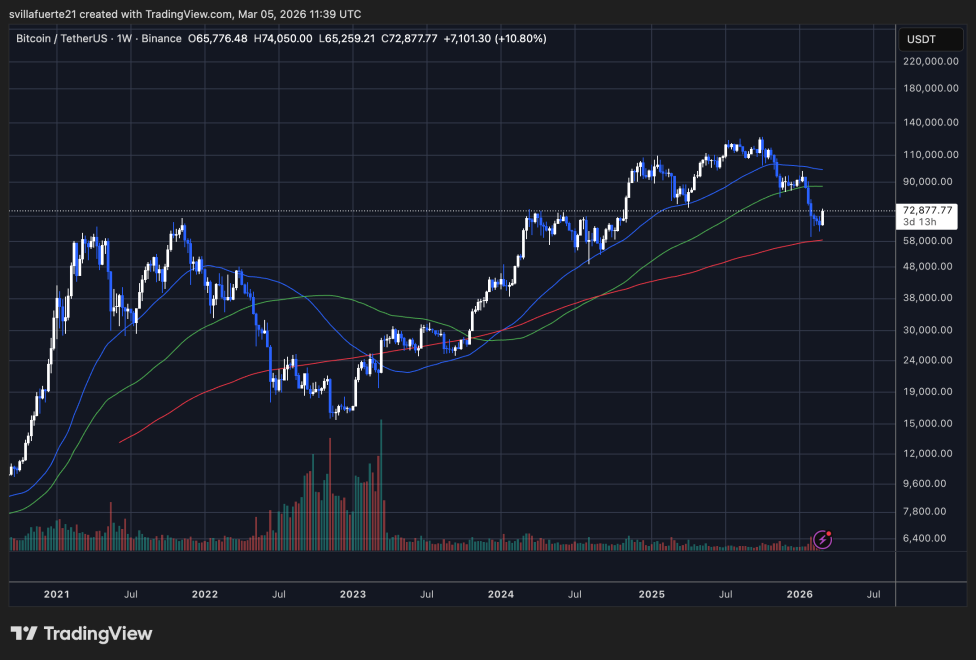
The recent decline briefly forced Bitcoin below its 50-week moving average, a level that had previously acted as dynamic support throughout much of the bull cycle. However, the latest weekly candle suggests that buyers are attempting to reclaim this level, which now sits near the $70,000 region. Holding above this area is technically significant, as it often serves as a structural pivot during mid-cycle consolidations.
Below the current price, the 100-week moving average is positioned around the mid-$60,000 zone, while the 200-week moving average continues to trend upward near the high-$50,000 region. These levels form a broader long-term support cluster that could help stabilize the price if volatility returns.
From a structural perspective, Bitcoin remains within a macro uptrend despite the recent correction. The market is now attempting to form a higher low relative to the 2024–2025 advance.
If BTC successfully consolidates above $70,000, the next resistance region could emerge near $85,000, where the previous breakdown accelerated earlier this year.
Featured image from ChatGPT, chart from TradingView.com
