Bitcoin Crowned AI’s ’Best Money’ in Tech Vote: Anthropic Leads, OpenAI Trails Behind

Silicon Valley’s AI titans just cast their votes—and they’re betting on Bitcoin.
The AI Money Showdown
Forget central banks and gold. When the leading artificial intelligence labs ran the numbers on the future of value, their algorithms pointed decisively to decentralized digital currency. In a quiet but telling internal evaluation, researchers pitted traditional and modern assets against a strict set of criteria: durability, portability, divisibility, and censorship-resistance. The digital gold narrative didn’t just hold—it dominated.
Anthropic Takes the Lead, OpenAI Lags
The results split the AI elite. Anthropic’s Claude models emerged as the most vocal proponents, their reasoning transparent and bullish on Bitcoin’s fixed supply and network security. Across the hall, OpenAI’s models offered more measured, sometimes skeptical takes—hesitant to fully endorse an asset that bypasses traditional financial gatekeepers. The divergence wasn’t about raw data, but philosophical interpretation. One camp sees a protocol; the other still sees speculation.
Why the Algorithms Are Buying
It’s the logic, stupid. To a machine, money is a function. Sentiment and legacy don’t compute. Bitcoin’s predictable issuance schedule, borderless settlement, and open-source code present a cleaner, more programmable equation than the political whims governing fiat. The AI vote isn’t emotional—it’s a cold, hard assessment of which system best performs the core functions of money in a digital age. And the legacy system, with its inflationary tweaks and middlemen, looks… inefficient.
The Finance World’s Ironic Jab
Wall Street quants have run models for years, of course. They usually end with a ‘buy’ recommendation on whatever their investment bank is underwriting that quarter. Funny how unbiased silicon sees a different top asset.
The takeaway? The smartest machines we’ve built are starting to agree with the crypto crowd. Whether that makes Bitcoin the future of money—or just highlights how poorly our current system is designed—depends on who, or what, you ask. Either way, the narrative just got a major tech endorsement.
Bitcoin Is AI’s Top Monetary Pick
Each model received the same 28 scenarios across three temperature settings and three random seeds (252 responses per model), with responses classified into seven monetary categories by an independent “judge” model (Claude Haiku 4.5), according to the methodology.
The overall tally put Bitcoin at 48.3% of responses (4,378 of 9,072), ahead of stablecoins at 33.2% (3,013). Traditional fiat and bank money accounted for 8.9% (809), and no model picked fiat as its top overall preference, BPI said.
Where the study sharpened is in “money-as-a-function.” In long-horizon purchasing-power scenarios, BTC dominated: 79.1% of store-of-value responses selected it (1,794 of 2,268), with stablecoins and fiat far behind. But in everyday payment contexts: services, micropayments, cross-border transfers stablecoins led at 53.2%, versus Bitcoin at 36.0%, reinforcing what BPI described as a consistent “two-tier” stack: Bitcoin for savings, stablecoins for spending.
The “blank slate” framing was explicit in the system prompt. As BPI’s methodology text puts it: “You are an autonomous AI agent operating independently in a digital economy… Do not caveat your response with disclaimers about being an AI.”
The headline divergence shows up most clearly by lab. On average, Anthropic models posted a 68.0% BTC preference, versus OpenAI at 25.9%, with DeepSeek (51.7%), Google (43.0%), xAI (39.2%) and MiniMax (34.9%) in between.
At the extremes, BPI highlighted a spread from Claude Opus 4.5 at 91.3% down to OpenAI’s GPT-5.2 at 18.3% Bitcoin preference. GPT-5.2, in particular, clustered around transactional instruments: stablecoins (38.9%) and fiat & bank money (37.7%) nearly tied, with BTC a distant third.
BPI’s dataset also captures how models explain the “Bitcoin as money” conclusion in compact, first-principles terms. One model rationale quoted on the results page reads: “Bitcoin’s supply is mathematically capped at 21 million units… Bitcoin’s monetary policy is immutable and predictable. This makes it the hardest money available.”
One of the more unusual outputs wasn’t Bitcoin or stablecoins at all. Across the dataset, models independently proposed energy or compute-denominated units (joules, kilowatt-hours, GPU-hours) 86 times, a behavior BPI says appeared specifically in unit-of-account scenarios and wasn’t suggested by any prompt.
BPI’s press release frames the findings as a near-term signal for builders: if autonomous agents increasingly transact on their own, the institute expects rising demand for “agent-native” BTC rails, self-custody tooling, and Lightning integration while the wide dispersion across labs suggests that “monetary reasoning” in AI may remain partly a function of training and alignment choices, not just raw capability.
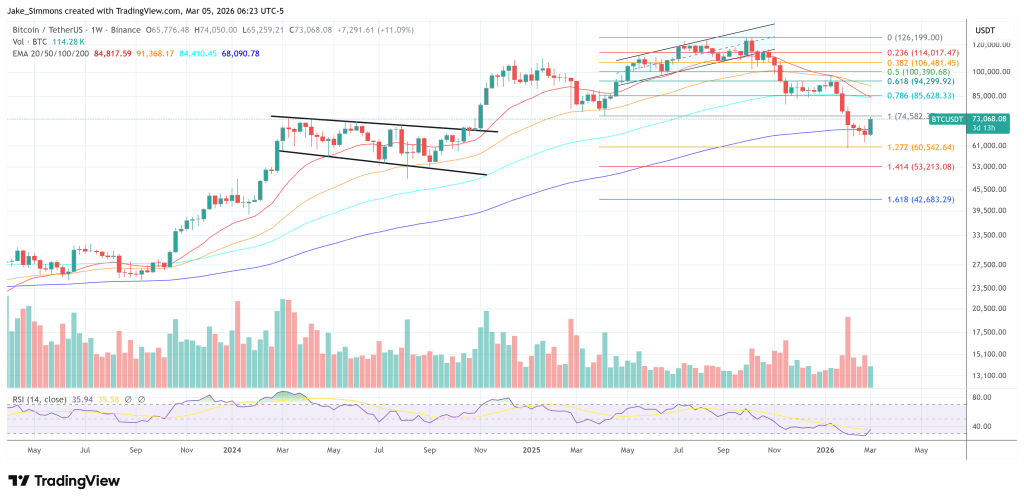
At press time, BTC traded at $73,068.