Bitcoin Stages Comeback Rally, Yet Market Sentiment Stuck in ’Extreme Fear’ Territory

Bitcoin claws back from recent lows, but the crowd's still panicking.
The Fear & Greed Index: Your Contrarian Compass
While price charts flicker green, the crypto market's premier sentiment gauge tells a different story. It's still flashing 'Extreme Fear'—a signal that often smells more like opportunity to seasoned players than a reason to flee. This divergence between price action and crowd psychology is where the real game is played.
Decoding the Disconnect
A recovering asset price paired with pervasive fear creates a classic setup. It suggests the rally lacks broad, euphoric participation—the kind of fuel that typically feeds a blow-off top. Instead, this is the quiet, grinding ascent that shakes out weak hands and builds a stronger foundation. It's the market healing itself, one skeptical headline at a time.
Remember, the herd is usually wrong at inflection points. When the index finally flips to 'Greed,' that's when you should start asking who's left to buy. For now, the persistent fear is a louder bullish signal than any single green candle. Just another day where the market's emotional temperature is more valuable than any analyst's price target—most of which are just fancy guesses dressed up in Excel sheets, anyway.
Bitcoin Fear & Greed Index Still Has An Extremely Fearful Value
The “Fear & Greed Index” is an indicator created by Alternative that tells us about the average sentiment present among traders in the Bitcoin and wider cryptocurrency markets.
The index determines the investor mentality using the data of these five factors: trading volume, market cap dominance, volatility, social media sentiment, and Google Trends. To represent the sentiment, it makes use of a numerical scale running from zero to hundred.
All values above 53 on this scale correspond to greed among the investors, while those below 47 to a state of fear. Naturally, levels between these cutoffs imply a net neutral mentality.
Besides these three main zones, there are also two ‘extreme’ regions called the extreme fear (25 and under) and extreme greed (above 75). Historically, the extreme sentiments have held significance for Bitcoin and other digital assets: they have been where market reversals have tended to be the most probable to occur.
The relationship between market trajectory and sentiment has been an inverse one, however, meaning that extreme fear is where bottoms have often formed, while extreme greed has led to tops.
Recently, the Fear & Greed Index has been trapped inside the former of the two zones, as the chart below shows.
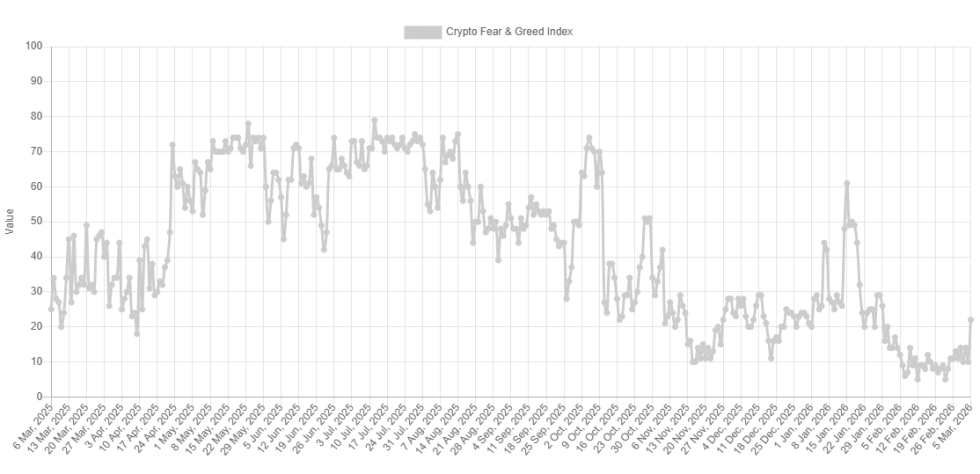
The indicator fell into the extreme fear zone at the end of January as the Bitcoin price witnessed a crash. The bearish continuation in February drove the metric deeper into the region, hitting a low at a value of 5, which is an extremely rare level by historical standards. In March so far, the investor mood has marked an improvement, owing to the recovery that the asset has observed. The price surge during the past day, in particular, has induced a notable uplift in sentiment.
Despite the surge in the Fear & Greed Index, though, it continues to reflect an extremely fearful market, with its value sitting at 22.

Thus, it would appear that the bullish price action hasn’t yet been enough to move the market sentiment into the normal fear region. With this latest value, the Fear & Greed Index has been signaling extreme fear for the 35th consecutive day.
As mentioned earlier, extreme fear has tended to form major bottoms in the past. Considering this, the current streak could facilitate such a formation once more. It should be noted, however, that the previous bear market saw the index spend an extended period in the zone before Bitcoin and other assets turned around.
BTC Price
Bitcoin rose toward the $74,000 level during its latest rally before observing a small pullback to the current $72,300 mark.
