Ethereum’s February Crash vs. Cold-Storage Exodus: Why Price Plunged While Security Soared

Ethereum's network just staged a financial paradox—price tanked while long-term conviction skyrocketed. A record-breaking migration of ETH flooded into cold storage during February's market downturn, creating a bizarre split-screen moment for the world's second-largest blockchain.
The Great Migration: When Paper Hands Become Diamond Vaults
While traders panicked over red candles, a silent army of holders executed the ultimate HODL maneuver. Billions in ETH bypassed exchanges entirely, finding permanent homes in hardware wallets and deep-freeze storage solutions. This wasn't just profit-taking—it was a wholesale rejection of short-term volatility in favor of generational holding strategies.
Infrastructure Over Speculation
The surge reveals Ethereum's maturation beyond pure speculation. Developers kept building through the noise, deploying contracts and upgrading networks while prices gyrated. Real utility—DeFi protocols, NFT platforms, layer-2 solutions—didn't pause because of a market correction. The plumbing, as engineers call it, kept flowing even when the price charts looked clogged.
The Institutional Whisper
Follow the money, and you'll find it's increasingly moving off-exchange. Whale wallets swelled during the downturn, suggesting sophisticated players used the dip to accumulate positions too large for hot wallets. They're playing chess while day traders play checkers—and their moves involve multi-signature vaults, not margin calls.
Market Psychology in Reverse
Traditional finance preaches 'buy low, sell high.' Ethereum's cold-storage surge suggests crypto natives have invented a new axiom: 'buy low, lock away forever.' The very mechanism designed to protect assets during rallies—cold storage—became the go-to move during a crash. It's like installing a vault during a burglary rather than after.
Price is a lagging indicator for what really matters—where the assets actually live. While Wall Street analysts hyperventilate over percentage drops, the real story unfolded in hardware wallet sales and blockchain transfer data. The smart money isn't timing the market; it's removing itself from the timing game entirely. After all, what's more cynical than watching traders chase 10% gains while you quietly secure assets that could 100x—or go to zero in glorious, decentralized fashion?
Binance Leads Massive Outflows as Exchange Supply Tightens
The report further highlights that the majority of February’s exchange withdrawals were concentrated on the largest trading platforms. Binance recorded the most significant outflow, with approximately 14.45 million ETH leaving the exchange during the month. This represents nearly half of the total withdrawals and confirms that activity is heavily centered on the platform that holds the deepest liquidity in the Ethereum market. Such concentration is common during periods of structural shifts, as large investors typically move assets through the exchanges that can handle substantial transaction volumes.

OKX ranked second in terms of withdrawals, with around 3.83 million ETH leaving the platform. This indicates that the trend was not isolated to a single venue but reflected broader investor activity across major exchanges. Kraken followed in third place, recording approximately 1.04 million ETH in withdrawals and securing a position among the top platforms by outflow volume during this period.
The aggregate figure—exceeding 31 million ETH—represents a notable signal within Ethereum’s supply dynamics. Rising exchange outflows are often interpreted as coins being transferred into cold storage or private custody solutions, which reduces the amount of ETH immediately available for trading.
When such movements occur near sensitive price levels, they can signal strengthening holding conviction or strategic portfolio repositioning. If withdrawals persist, exchange liquidity could tighten further in the months ahead.
Ethereum Tests Key Resistance
Ethereum’s 4-hour chart shows the asset attempting to regain upward momentum after a prolonged period of consolidation and volatile price swings. At the time of the chart, ETH is trading around $2,050, pushing slightly above the $2,000 psychological level that has acted as a key pivot throughout recent market activity.
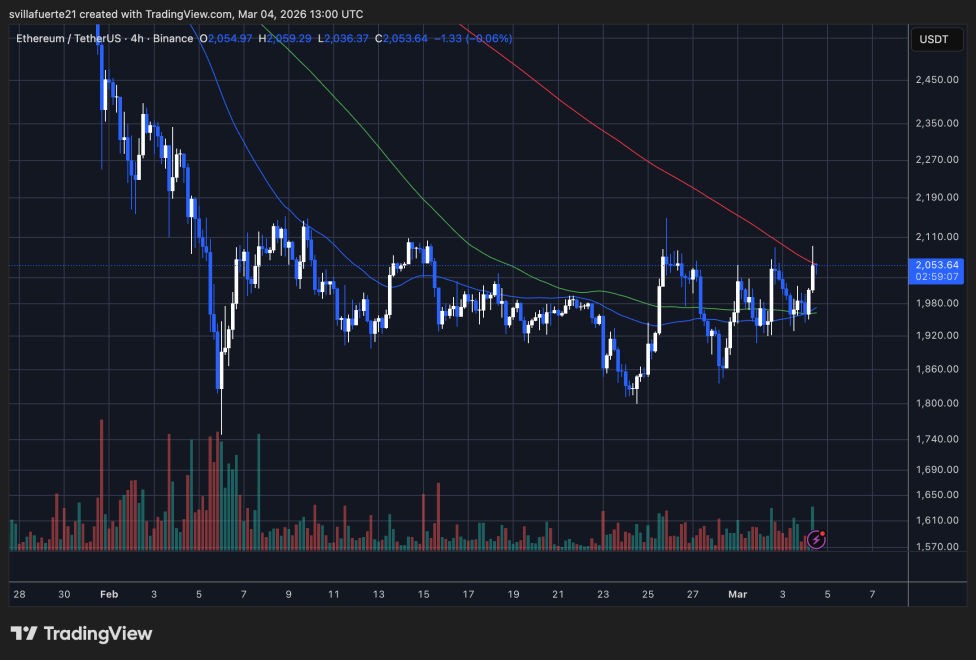
Price structure suggests that Ethereum has been forming a broad range between roughly $1,850 and $2,100 since mid-February. Within this range, multiple rebounds from the $1,850–$1,900 zone highlight the presence of buyers defending lower levels, while repeated rejections near the $2,100 region confirm that sellers remain active at higher prices.
From a technical perspective, ETH has recently reclaimed the short-term moving averages, including the 50-period and 100-period lines, which now sit just below the current price. This development indicates that short-term momentum has begun to shift in favor of buyers after several weeks of downward pressure.
However, the 200-period moving average remains above the market, acting as a dynamic resistance level near the current price zone. For Ethereum to confirm a stronger recovery phase, bulls would likely need to secure a decisive break and consolidation above this level.
If ETH can maintain support above $2,000, the next technical target could emerge near $2,150. Conversely, losing the level may reopen downside toward the $1,900 support area.
Featured image from ChatGPT, chart from TradingView.com
