XRP Velocity Crashes 97% on Binance: From 240B to 7B - What’s Paralyzing the Trading Giant?

XRP's trading engine just seized up. Volume on the world's largest exchange has plummeted from a staggering 240 billion to a mere 7 billion—a collapse so severe it's rewriting the liquidity playbook.
The Great Slowdown
Forget a dip; this is a nosedive. The velocity—the lifeblood of any asset—has evaporated. It's a stark reminder that in crypto, liquidity can vanish faster than a trader's profits during a margin call. The numbers don't lie: 240B to 7B. That's not a correction; it's a system failure playing out in real-time.
Decoding the Paralysis
What grinds a major asset's trading activity to a near-halt? Regulatory headwinds, shifting market structure, or just the collective yawn of institutional money? The usual suspects are lined up, but the sheer scale of the slump points to something deeper—a fundamental reassessment of utility in a post-speculation landscape. It’s the kind of chart that makes even the most bullish analyst reach for the antacid.
Binance's Quiet Crisis
The exchange itself becomes part of the story. When a titan like Binance sees activity for a top-tier asset freeze, it signals a market-wide chill. It's a liquidity crisis in miniature, exposing how fragile the connective tissue between price and volume really is. The platform's mechanics are sound, but the traffic? Gone.
A provocation to close: This isn't just an XRP story. It's a stress test for the entire digital asset thesis. If a veteran token with a clear use case can see its trading velocity fall off a cliff, what does that say about the market's maturity? Perhaps the 'future of finance' still spends a little too much time napping. After all, what's the point of a decentralized revolution if the trading volume is centralized in... nowhere?
XRP Liquidity Collapse Signals Cooling Market Participation
The report further contextualizes the evolution of XRP liquidity on Binance by highlighting the strong expansion phase observed between 2022 and 2024. During that period, the 30-day liquidity index surged, at times exceeding a reading of 3. This acceleration coincided with a dramatic rise in turnover, with monthly trading volumes approaching 180–240 billion XRP. Such levels reflected an environment of intense activity, where speculative participation and high transaction velocity supported deep liquidity across the platform.

Those conditions began to change during 2025. As the year progressed, the turnover rate started to decline markedly, and the liquidity index slipped below the neutral threshold of 1 before gradually falling toward its current near-zero readings. This contraction signals that trading activity has slowed significantly relative to the available XRP supply held on the exchange.
Structurally, a declining liquidity index does not automatically imply immediate downside pressure on price. Instead, it indicates that the velocity of supply within the platform has decreased. When fewer coins circulate actively in trading flows, the market can enter periods of reduced participation and lower turnover.
However, low-liquidity environments often make price action more sensitive to sudden capital movements. Under these conditions, a resurgence in turnover could rapidly alter XRP’s short-term price dynamics.
Price Struggles Below Key Moving Averages
On the 3-day timeframe, XRP remains locked in a clear corrective structure following the sharp rejection from the $3.30–$3.50 region during the previous cycle peak. The chart shows a persistent sequence of lower highs and lower lows, confirming that momentum has shifted decisively to the downside since mid-2025.
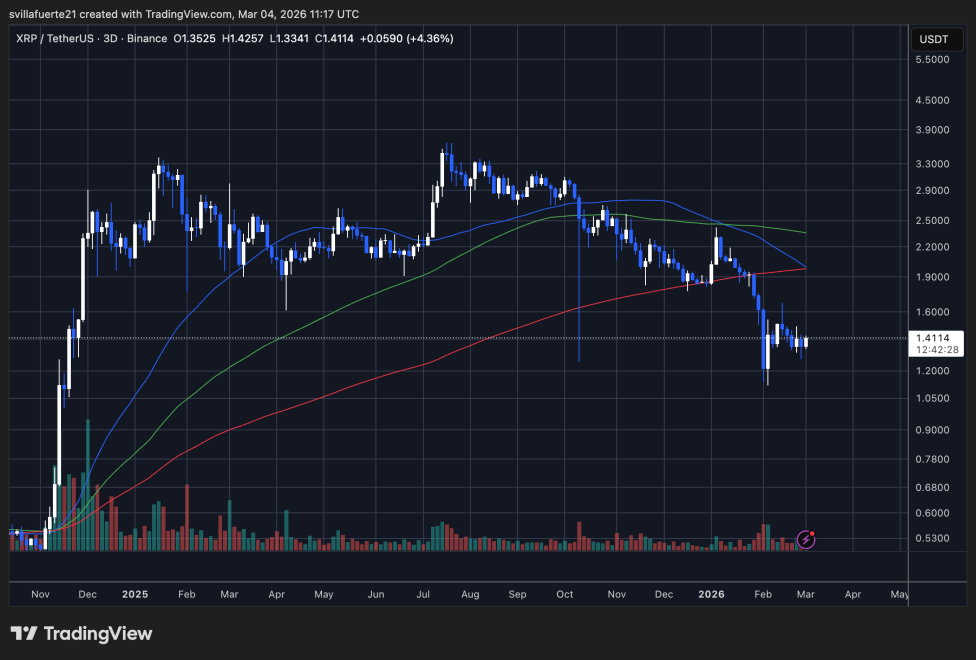
Currently trading near $1.41, XRP is positioned well below the 50-period (blue) and 100-period (green) moving averages, both of which are trending downward. This alignment reflects sustained bearish pressure and signals that medium-term momentum remains weak. The 200-period moving average (red), located around the $1.90–$2.00 zone, has now transitioned into a major resistance level after previously acting as structural support during the earlier stages of the uptrend.
The sharp liquidation wick seen in early February briefly pushed price toward the $1.10 area before buyers stepped in, producing a reactive rebound. However, subsequent price action has lacked follow-through, suggesting that the recovery is corrective rather than the start of a new bullish impulse.
From a structural perspective, the $1.30–$1.35 region now represents immediate support. A breakdown below this zone could expose XRP to further downside toward the psychological $1.00 level. Conversely, reclaiming the $1.80–$2.00 range would be necessary to challenge the broader bearish trend.
Featured image from ChatGPT, chart from TradingView.com
