Korea Softens 20% Crypto Exchange Stake Ban as Regulators Hunt for Governance ’Middle Ground’

South Korean regulators just backed off a hardline stance—and crypto exchanges are breathing a sigh of relief.
The 20% Rule Gets a Reality Check
Remember that proposed ban on any single entity owning more than 20% of a crypto exchange? It's getting a major rewrite. The Financial Services Commission (FSA) isn't scrapping it entirely but is now actively seeking a compromise. The goal? A "middle ground" that prevents market dominance without strangling legitimate investment and innovation. Think governance guardrails, not a full blockade.
Why the Sudden Pivot?
Pressure from the industry played a role, for sure. Exchanges argued the original rule would scare off capital and freeze development. But look deeper: this is a classic regulatory dance. Authorities want oversight and consumer protection—they don't actually want to kill a booming sector that's filling state coffers. It's the eternal struggle between control and growth, playing out with a digital asset backdrop.
The Bigger Picture: Maturity or Maneuvering?
This shift signals a move from reactive crackdowns to nuanced framework-building. Korea is trying to craft rules that last, not just make headlines. For investors, it reduces the 'regulatory surprise' risk that's been a constant shadow over Asian crypto markets. It suggests a future where exchanges can plan beyond the next bureaucratic decree.
Of course, cynics might say it's just regulators doing what they do best: creating a complex problem, then selling you the solution—with plenty of compliance fees along the way. The final rules will tell the real story. For now, the path forward looks less like a ban and more like a negotiated settlement. Watch this space.
From A Strict Proposal To Compromise
After months of friction, the Financial Services Commission (FSC) and the Democratic Party’s digital asset task force have finally converged on a 20% cap for major shareholders, the Korea Herald reports.
South Korea’s 20% cap is the culmination of a long‑running push by FSC, the top financial regulator, to curb founder control at the country’s biggest crypto exchanges. Regulators initially floated a stricter 15–20% range for major shareholders at the leading platforms, a proposal that sparked outrage and fierce opposition from the industry. The backlash was led by the Digital Asset Exchange Alliance (DAXA), a self‑regulatory body representing South Korea’s five major exchanges, including, of course, Upbit and Bithumb.
The Deal Terms
The agreement on a 20% cap and a generous grace period looks like an attempt to find middle ground and defuse tensions. The FSC and the ruling party have endorsed a three‑year grace period to enforce the major shareholder stake restriction, giving Upbit and Bithumb, which together command roughly 90% of the domestic market, some breathing room to start trimming their stakes to meet the new threshold.
Smaller exchanges that do not meet the estimated 20% market‑share bar, such as Coinone, Korbit and GOPAX, will get an even longer runway. South Korean authorities have agreed to grant them an additional three‑year grace period, giving these platforms up to six years in total to prepare for full enforcement of the cap.
ExceptionsThe FSC has also carved out narrow exceptions via enforcement decree, allowing stakes of up to 34% only for new businesses, not for existing exchanges. According to The Korea Herald, this threshold appears to mirror the Commercial Act’s 33.3% veto line for general shareholders’ meetings, effectively giving qualified new investors blocking power without restoring full control
The Final Details On The Digital Asset Basic Act
The ruling party’s policy committee is expected to hammer out the final details after a closed‑door meeting with the Financial Services Commission on the morning of the 5th, according to Hankyung. The ownership cap will be folded into a broader Digital Assets Basic Act, an umbrella bill that packages a wide range of crypto policy measures, from stablecoin rules to crypto exchange‑traded funds.
However, the bill’s passage is far from guaranteed. The Korea Herald notes that not only is the opposition party pushing back, but some lawmakers also object to strict limits on major shareholder stakes, casting doubt over whether the cap will clear the National Assembly in its current form.
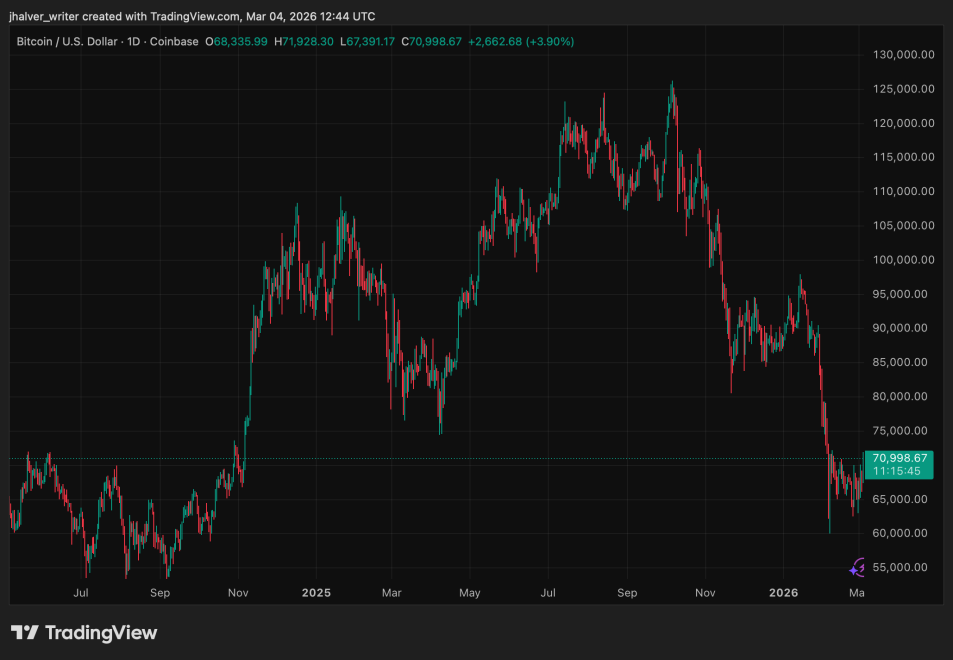
Cover image from ChatGPT, BTCUSD chart from Tradingview
