Blockstream’s Quantum-Resistant Bitcoin Signing Demo On Liquid: The Future-Proof Security Move

Blockchain just got a quantum shield. Blockstream's latest demo on the Liquid sidechain shows Bitcoin signing that laughs in the face of tomorrow's supercomputers—while Wall Street still struggles with two-factor authentication.
The Unbreakable Signature
Forget everything you know about cryptographic vulnerability. This isn't an upgrade; it's a complete architectural bypass. The demo implements a post-quantum cryptographic scheme directly into Bitcoin's signing process, creating signatures that would take a quantum computer longer than the universe's lifespan to crack. It turns theoretical defense into working code.
Liquid's Silent Advantage
The choice of Liquid Network isn't accidental. As a Bitcoin sidechain built for institutional assets and confidential transactions, it provides the perfect testing ground. The infrastructure already handles complex financial instruments—adding quantum resistance becomes another layer in its security stack, not a rebuild from scratch. It demonstrates how future-proofing can integrate with existing financial rails.
Why This Cuts Through the Noise
While other projects promise quantum resistance 'someday,' Blockstream delivers a working demo on a live network. The timing couldn't be more provocative—just as traditional finance institutions pour billions into 'blockchain research' that rarely leaves PowerPoint slides. This demo exposes the gap between crypto-native innovation and legacy financial theater.
Quantum computing threatens every digital asset, but Bitcoin just got its first practical defense. The real question isn't whether the technology works—it's whether traditional finance can implement anything this sophisticated before their current encryption becomes museum-grade security.
How Blockstream Tackles Bitcoin Quantum Threat
Blockstream framed that as the key breakthrough. “The traditional approach to adding post-quantum signatures WOULD require consensus changes across the network—a slow, careful process involving all stakeholders,” the research note said. “But Simplicity, Blockstream’s smart contract language on Liquid, offers a different path.”
The verifier is based on SHRINCS, a compact hash-based post-quantum signature design that Blockstream Research says it developed specifically for blockchain environments. The system includes a stateful mode intended for normal use, which produces smaller signatures, and a stateless fallback mode designed for recovery scenarios so users can still access funds even if they lose state. That dual-track design speaks to a practical problem in post-quantum cryptography: theoretical safety is not enough if the system is too cumbersome for real-world wallet behavior.
Just as important, Blockstream says this is not a lab simulation. The team broadcast two live transactions on Liquid mainnet, one using the stateful mode and another using the stateless fallback. Those transactions secured real value, and Blockstream said the approach works not only for Bitcoin on Liquid but for any asset issued on the network.
The note also highlighted a more symbolic detail. Because Liquid requires transaction size to scale with computational budget, the team had to fill excess space in the post-quantum transactions. “Rather than padding these transactions with zeros, Blockstream filled the extra space with the Bitcoin whitepaper—a nod to the cypherpunk roots of this work.”
Still, the company was careful not to oversell what has been shipped. “This verifier does not make Liquid fully quantum-resistant,” the post said. “Several critical components remain classically secured,” including the Bitcoin peg, Confidential Assets commitments and Liquid’s blocksigning consensus protocol. In other words, this is a meaningful first building block, not a full-stack answer to a future quantum threat.
That distinction matters for how the development should be read. The research note repeatedly stresses that cryptographically relevant quantum computers do not exist today and may not arrive for years or decades. But it argues that waiting until such machines are close would be a mistake, especially for Bitcoin-like systems whose security assumptions are deeply tied to classical ECDSA and Schnorr signatures.
“What we’ve done on Liquid—building, testing, and deploying post-quantum solutions on production systems—is how we prepare Bitcoin infrastructure for the future,” Blockstream wrote. That may be the clearest takeaway here: not that Bitcoin has solved the quantum problem, but that one credible path is beginning to MOVE from theory into production-grade experimentation.
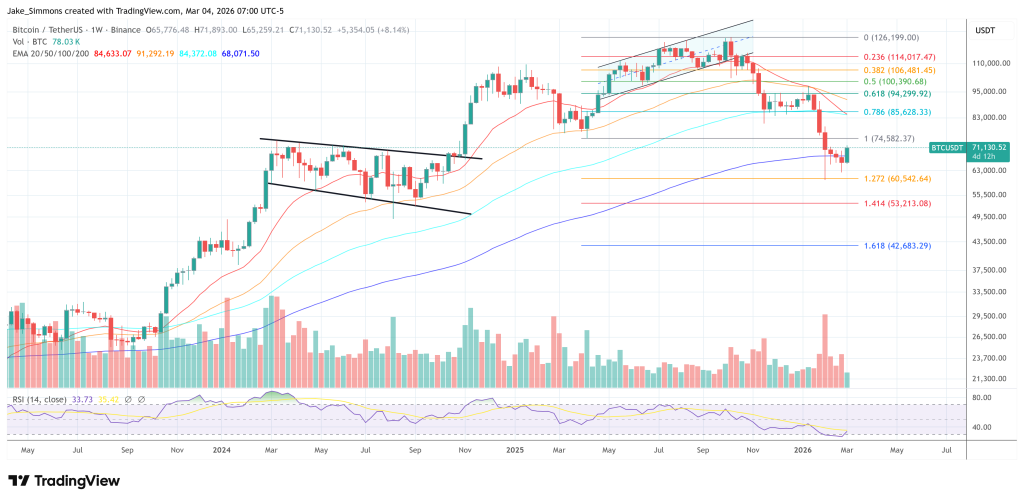
At press time, BTC traded at $71,130.