Paraguay’s State-Run Bitcoin Mining Project: A Bold Move That Could Reshape Crypto’s Future

Paraguay just threw a lightning bolt into the crypto-mining landscape—announcing plans for the world's first state-operated Bitcoin mining operation. This isn't just another private farm scaling up; it's a sovereign nation putting its energy and political capital directly on the blockchain's ledger.
The Hydro-Powered Advantage
Forget speculative hype. Paraguay's play is built on a concrete, almost unfair advantage: massive surplus hydroelectric power. The Itaipu Dam, one of the planet's largest generators, sits on its border, producing far more energy than the country consumes. Mining Bitcoin becomes less about volatile asset speculation and more about monetizing stranded, renewable megawatts—turning water into digital gold.
A Sovereign Stamp on Proof-of-Work
This move cuts through the regulatory fog. By launching its own project, the Paraguayan state isn't just tolerating miners; it's becoming one. That sends a powerful signal to other nations sitting on the fence. It legitimizes the entire proof-of-work model at a governmental level, potentially creating a blueprint for resource-rich countries to follow. Suddenly, mining looks less like a niche tech hobby and more like a strategic national industry.
The Finance Skeptic's Corner
Of course, the traditional finance crowd will scoff—calling it a desperate gamble by a developing nation. They'll point to Bitcoin's price swings and whisper about 'taxpayer money down a digital drain.' But that's the old guard talking. This isn't about betting the treasury on a coin flip; it's about leveraging a fixed, underutilized asset (energy) to acquire a new, globally recognized asset (Bitcoin). It's a hedge against currency devaluation and a direct stake in the future of digital value—something your average sovereign wealth fund, still clinging to negative-yielding bonds, might finally start to envy.
Paraguay isn't just mining Bitcoin. It's mining for influence, economic sovereignty, and a front-row seat in the next financial system. Watch closely—other nations are sure to start digging.
Seized Bitcoin Miners Enter The Conversation
While Morphware’s statement did not publish deployment numbers, the MoU language about “redeploying” miners arrives amid an enforcement backdrop: Paraguay has been seizing ASIC hardware tied to alleged illegal operations. Trabing told Bitcoin Magazine that ANDE is exploring turning seized equipment into Paraguay’s first government-run Bitcoin operation in partnership with Morphware.
According to Trabing, the Paraguayan government is currently holding around 30,000 seized Bitcoin miners, many of them taken from facilities accused of electricity theft or tariff fraud.
“They’re literally stacked to the ceiling,” Trabing told Bitcoin Magazine, describing government warehouses filled with idle ASIC machines. “They have no experience mining Bitcoin. Our role is an advisory role.”
Morphware’s proposal, now formalized in the memorandum with ANDE, is to redeploy those machines at utility-controlled sites rather than leaving them idle. The initial phase WOULD reportedly involve around 1,500 confiscated miners, installed near existing electrical substations where infrastructure already exists to handle large energy loads.
Under the structure being discussed, ANDE would retain ownership of the machines and operate the sites directly, while Morphware would provide technical guidance and training for utility staff. The company’s role, according to Trabing, is primarily operational support rather than revenue participation. “This is about regulated, utility-controlled sites,” he said. “Not people hiding in the countryside.”
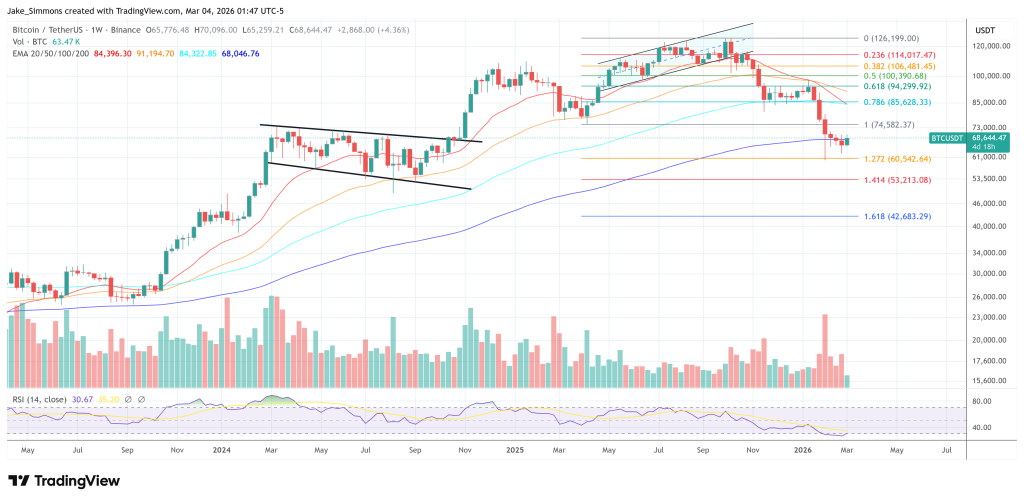
At press time, BTC traded at $68,644.