Beyond Capitulation: Why Bitcoin’s Short-Term Holders Refuse To Blink Amid Iran Escalation

Geopolitical tremors rattle markets—Bitcoin's newest cohort holds the line.
The Unshaken Cohort
While traditional assets flinch at headlines from the Middle East, a specific segment of the Bitcoin network displays remarkable resilience. Short-term holders, often the first to exit during volatility, aren't budging. This isn't blind faith; it's a calculated stance against the old financial playbook where fear dictates flow.
Decoding the Resilience
The behavior defies classic capitulation models. These holders, having entered the market at specific price points, are choosing to weather the storm. Their collective inaction creates a foundational support, a silent buffer against panic-driven sell-offs. It suggests a maturation in market participant psychology—or perhaps a hardened cynicism towards the legacy system's crisis-driven cycles.
The New Risk Calculus
For this group, geopolitical risk is being priced differently. The digital asset's narrative as an uncorrelated, borderless store of value is being stress-tested in real-time. Their refusal to blink signals a bet that Bitcoin's long-term thesis outweighs short-term headline risk. It's a quiet rebellion against the traditional 'risk-off' switch that sends capital scrambling for 'safe' government debt—the same debt that's being printed into oblivion, but that's a jab for another day.
This isn't just hodling; it's a strategic hold. The market watches, waiting to see if this defiance marks a new phase of stability or merely the calm before the next wave. One thing's clear: the old rules of engagement are fading faster than a banker's promise.

During the February 5–6 capitulation episode, STHs sent approximately 89,000 BTC to exchanges at a loss within a single 24-hour window — a clear signal of panic-driven distribution. However, the dynamics have since evolved. Following that event, loss-driven inflows have steadily declined.
This suggests that immediate sell-side pressure from recent buyers is diminishing. The data indicate that acute panic has subsided. What remains is not aggressive accumulation, but a gradual transition from forced liquidation to relative exhaustion — a subtle yet important structural development.
Short-Term Holders Show Restraint As Geopolitical Stress Fails To Trigger New Capitulation
The granular view of the Short-Term Holder P&L to Exchanges metric adds nuance to the broader picture. Even amid the recent geopolitical escalation involving Iran — an event class that has historically triggered reactive risk-off flows — exchange inflows from short-term holders did not materially expand. As bitcoin probed the $63,000–$64,000 zone, there was no corresponding spike in realized-loss transfers. For a cohort typically hypersensitive to volatility, this restraint is notable.

This behavior suggests a shift from reflexive panic to conditional holding. In prior stress episodes, similar price shocks produced visible surges in exchange-bound coins as weak hands rushed to de-risk. The absence of that pattern now implies that a meaningful portion of forced selling may already have occurred during the early-February capitulation phase.
Markets tend to stabilize only after marginal sellers are exhausted. The progressive decline in loss-driven transfers supports the thesis that liquidation pressure is being absorbed rather than re-accelerating.
Going forward, the signal to monitor is persistence. If short-term holder inflows remain muted, it WOULD reinforce the case for seller fatigue and base-building conditions. Conversely, a renewed spike in realized-loss transfers would indicate that capitulation is incomplete, reopening the path for further downside volatility.
Bitcoin Hovers Near Long-Term Support As Weekly Structure Remains Fragile
On the weekly timeframe, Bitcoin is attempting to stabilize near the $66,000 region after a decisive rejection from the $90,000–$100,000 zone. The broader structure shows a transition from expansion to correction: following the late-2025 highs, price printed lower highs and eventually lost the 50-week moving average (blue), which had acted as dynamic support throughout much of the prior uptrend.
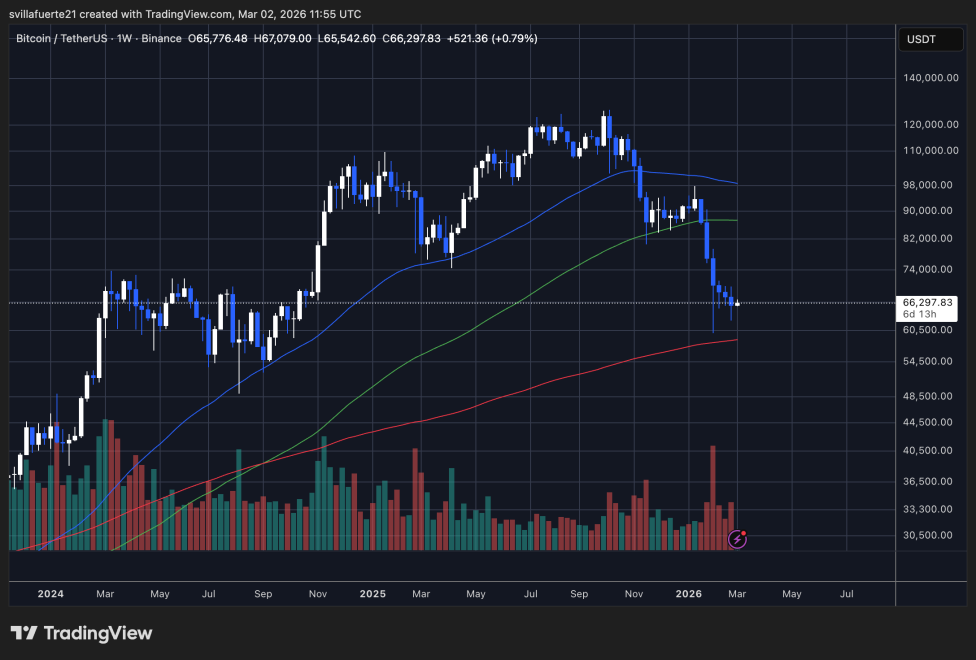
The breakdown accelerated once Bitcoin slipped below the 100-week moving average (green), triggering a fast move toward the mid-$60Ks. That area now represents a critical inflection point. While the 200-week moving average (red), rising NEAR the low-$60Ks, remains intact, price is hovering uncomfortably close to this long-term trend baseline. Historically, sustained closes below the 200-week average have signaled deeper macro weakness.
Volume expanded notably during the sharp weekly selloffs, suggesting forced unwinds and liquidation-driven pressure rather than gradual distribution. However, recent candles show smaller bodies and reduced downside momentum, indicating short-term equilibrium.
Technically, $69,000–$70,000 now acts as immediate resistance, aligning with prior support turned overhead supply. A weekly reclaim of that zone would be the first signal of structural recovery. Conversely, failure to defend the $62,000–$64,000 region could open the path toward a broader macro retracement.
Featured image from ChatGPT, chart from TradingView.com
