Bitcoin’s Rebound Still Elusive — Short-Term Holders Dig In At A Loss

Bitcoin's bounce-back moment keeps getting postponed. The market's looking for a spark, but short-term holders are stuck holding the bag—and they're not letting go.
The Psychology of the Red
When your portfolio's bleeding, instinct screams to cut losses. Yet, a stubborn cohort of recent BTC buyers is doing the opposite. They're hunkering down, absorbing the pain, and waiting for a tide that hasn't turned. It's a classic case of loss aversion meeting diamond-handed hope—a volatile cocktail that keeps supply locked but pressure building.
The Waiting Game
Every sideways day tests resolve. Without a clear catalyst, this holding pattern becomes a war of attrition. Are these holders displaying conviction, or are they simply refusing to book a loss on a digital spreadsheet? In traditional finance, they'd call that 'bagholding'—but in crypto, we prefer the more dignified term 'accumulation'.
Where's the Catalyst?
Markets move on narrative and numbers. Right now, the dominant story is one of patience, not panic. This creates a fragile equilibrium. The lack of mass capitulation can be read as bullish resilience... or it can signal that the real flush-out is still ahead. One cynical take? It's the financial equivalent of refusing to sell your beachfront property during a hurricane because the brochure promised sunshine.
The standoff continues. Short-term holders are betting their losses are temporary. The market hasn't proven them right—yet.
Bitcoin Short-Term Holders Hold Losing Positions
Bitcoin’s price performance continues to exert pressure on traders and investors across the leading network. During this bearish action in the price of BTC, Darkfost, a market expert and verified author at CryptoQuant, reported that short-term holders are still holding at a loss even with the cryptocurrency trading at around $66,000.
This implies that despite several attempts to stabilize the market, it has been on edge due to bearish pressure, and momentum is still poor. The absence of a clear rebound has led to a greater emphasis on short-term investors, many of whom still have unrealized losses.
According to the expert, these investors presently have an average unrealized loss of 26.3%, which is a comparatively big amount. While the metric is positioned at 26.3%, the most important level to watch out for is the 25% mark. Typically, periods where the average unrealized losses exceed 25% are most often linked to an advanced bear market phase.
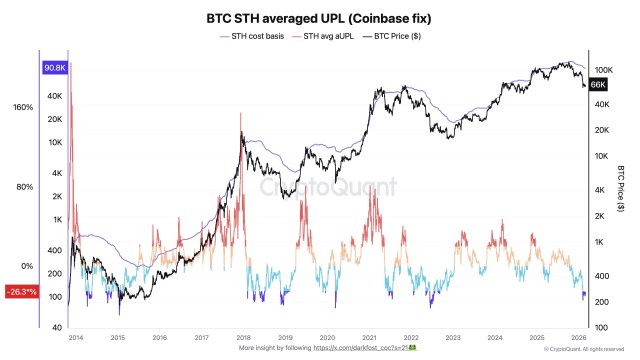
As this chart makes evident, these stages, when short-term holders start to carry significant losses, have traditionally been favorable chances for long-term investors to accumulate through DCA. Darkfost noted that the relationship between price dynamics and profitability is another intriguing aspect. When the average unrealized profit of STH moves back above 0%, bullish trends have generally been able to emerge. However, this remains intact only to a certain point.
During periods of highly elevated short-term holder profits, usually around 20% in this cycle, the risk of a trend reversal increases significantly. In the meantime, the expert considers the trend to be largely bearish, with short-term holders holding historically high levels of losses. Nonetheless, these are also classified as periods where building exposure is a logical move.
Pressure Building On The BTC Spot ETFs
Even after several weeks, the Bitcoin Spot Exchange-Traded Funds (ETFs) are still experiencing bearish action and steady capital outflows. In a post on X, Crypto Tice, an investor, highlighted that the leading funds have been underwater for the past 25 consecutive days, suggesting weakening conviction in the asset’s prospects.
The persistent waning performance of the funds is more painted as pressure building rather than speculative noise. When passive incomes stall and holders are positioned in drawdown, it often leads to weak hands rotating out or strong hands accumulating quietly. Crypto Tice added that sustained ETF pain is typically followed by volatility expansion.
Currently, the trend is triggering questions in the market about whether the investors are losing or whether it will lead to supply exhaustion. This is due to the fact that 25 days of unrealized losses flip positioning psychologically fast.
