Bitcoin Plunges on Geopolitical Shock—Again. Here’s How History Says This Could Unfold

Another geopolitical flashpoint, another Bitcoin sell-off. The pattern is becoming a grim ritual for crypto markets.
The Knee-Jerk Reaction
News hits the wires, and digital assets tumble. It's the classic 'risk-off' playbook, where traders ditch anything perceived as volatile for the safety of traditional havens. Bitcoin, despite its 'digital gold' narrative, often gets caught in the initial crossfire.
What the Charts Remember
History doesn't repeat, but it often rhymes. Past shocks have typically triggered sharp, high-volume dumps—panic selling at its purest. The critical phase follows: a period of consolidation where the market digests the fear. This is where the real story gets written.
The Bounce-Back Blueprint
More often than not, the sell-off proves to be a liquidity grab. Once the headline panic fades, capital starts trickling back. The recovery isn't usually a straight line up; it's a messy process of reclaiming key levels, shaking out weak hands, and rebuilding conviction. It's the market's way of separating short-term noise from long-term signal.
The Cynical Take
Watching traditional finance pundits cite Bitcoin's volatility during these events—while ignoring the trillion-dollar deficits and monetary printing happening in the background—is a special kind of irony. It's almost as if the old system prefers you to focus on the new asset's stumbles rather than its own structural cracks.
So, while the short-term charts look bloody, the historical script suggests this is more about narrative than fundamentals. The dip might just be another chapter in the volatile, defiant, and relentless story of crypto.
War Headlines And The 20%-40% Rally Pattern
Recent geopolitical tensions are coming at an already fragile period for the crypto market. Bitcoin is already down 48% from its all-time high and is on track to close its fifth consecutive red monthly candle. The leading cryptocurrency has also recorded its worst start to the first two months of a year, falling 24% since January. February closed 14.8% below its open, making it the third-worst February in Bitcoin’s history. The only weaker Februarys were in 2025, when Bitcoin closed 17.5% below its open and in 2014, when the monthly close was 33% below its open.
Crypto analyst Ted Pillows shared a weekly chart depicting how Bitcoin behaved during previous diplomatic escalations. In February 2022, when Russia attacked Ukraine, Bitcoin dropped before rallying approximately 40% in the months that followed. In June 2025, after Israel attacked Iran, Bitcoin was initially sold off again, but it later recovered about 25%.
Now, following US strikes on Iran on Saturday, Bitcoin has once again reacted to the downside. The question raised by Pillows is whether the same post-shock recovery pattern will play out again.
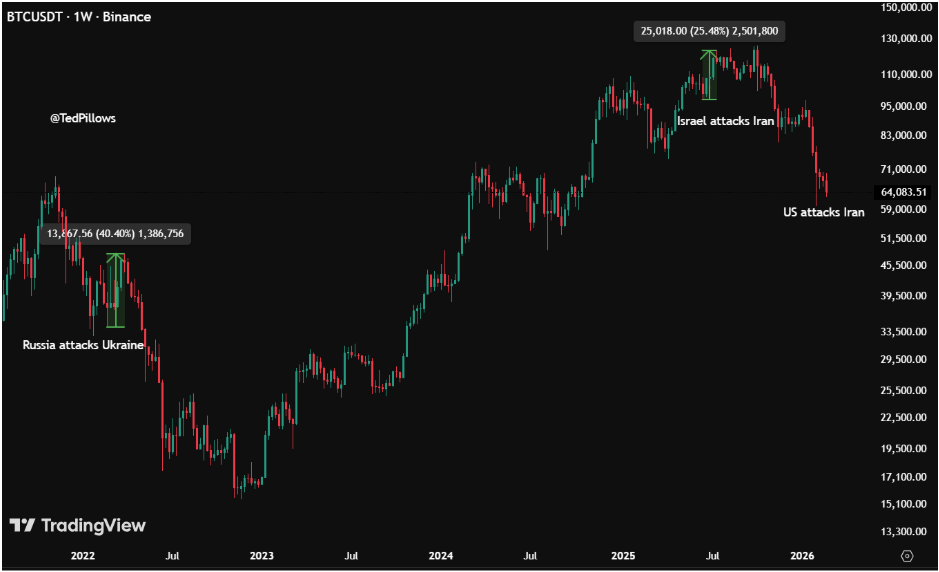
Bitcoin Price Chart. Source: @TedPillows On X
Another analyst, Sherlock, focused on shorter-term reactions. He noted that during past US or Israeli strikes on Iran, Bitcoin typically fell sharply over the weekend and recovered within 24 to 48 hours.
In April 2024, after Iran struck Israel, Bitcoin dropped 8% overnight and recovered within two days. In October 2024, a 3% drop was erased within 24 hours.
In June 2025, US strikes led to a 6% decline that was recovered by Sunday, followed by a 62% rally over the next two months to new all-time highs in October. Interestingly, the initial MOVE lower in each case occurred before traditional financial markets reopened.
Market Already Deeply Corrected
It is important to note that the current setup is different from prior episodes because Bitcoin was already in a strong uptrend during the 2025 geopolitical shock. Today’s market structure looks very different, as Bitcoin has been in a prolonged drawdown for five months.
Bitcoin’s weekly RSI is currently at the lowest level in its history. The Fear & Greed Index has also been in extreme fear for 22 consecutive days. Furthermore, Leveraged positions have been heavily reduced, with open interest at low readings.
Panic selling in previous instances followed the geopolitical event itself. This time, however, much of the forced selling and deleveraging appears to have occurred before the strike. Based on this caveat, weak hands have largely exited and excess leverage has already been cleared. Therefore, Bitcoin may not sustain prolonged downside from the tensions and could stabilize sooner than in previous episodes.
Featured image from Unsplash, chart from TradingView
