Citi’s 2026 Bitcoin Integration: Making the Unbankable Bankable

Citi just declared war on the old financial guard—by drafting Bitcoin into its ranks. The banking titan's 2026 roadmap doesn't just dabble; it plans to weave crypto's flagship asset directly into the fabric of traditional finance.
The Mainstream Pipeline
Forget side projects and experimental divisions. This is core infrastructure. Citi's move signals a tectonic shift: treating Bitcoin not as a speculative outlier, but as a legitimate, programmable layer within global capital markets. It’s building the pipes to let institutional money flow in—without the usual crypto chaos.
Cutting Out the Middlemen
The plan bypasses the patchwork of crypto-native custodians and exchanges. Instead, Citi aims to offer clients direct exposure through familiar, regulated channels—turning Bitcoin into just another asset class on a Bloomberg terminal. It’s a play for trust, wrapped in a veneer of boring, old-school banking.
Why 2026? The Regulatory Clock
The timeline isn't arbitrary. It’s a bet on regulatory clarity finally catching up to technology. By 2026, Citi anticipates a landscape where compliance isn't a guessing game, allowing them to deploy at scale. They're waiting for the rulebook to be written so they can be the first to mass-produce it.
A cynical take? It’s the ultimate co-optation. Wall Street spent a decade dismissing crypto as a toy for anarchists. Now, seeing the fees they’ve missed, they’re rushing to institutionalize it—sucking out the rebellion and selling it back to you with a management fee attached.
This isn't an endorsement of Bitcoin's philosophy. It's a calculated absorption. Citi isn't betting on a revolution; it's building the vault to store the spoils once the revolution is over.
Citi To Integrate Bitcoin Into Traditional Finance
On Thursday, Nisha Surendran, Citi’s head of digital asset custody development, revealed that the bank will introduce infrastructure to integrate Bitcoin and traditional finance in 2026.
Speaking at Strategy World 2026 in Las Vegas, the executive highlighted the need for a 24/7 dollar or digital money as the world adapts round-the-clock assets like Bitcoin and transitions into 24/7 systems and processes.
Surendran shared Citi’s “one big idea” to “make Bitcoin bankable.” As she explained, the baking giant plans to launch its own infrastructure that integrates BTC into traditional finance later this year, although no specific date was disclosed.
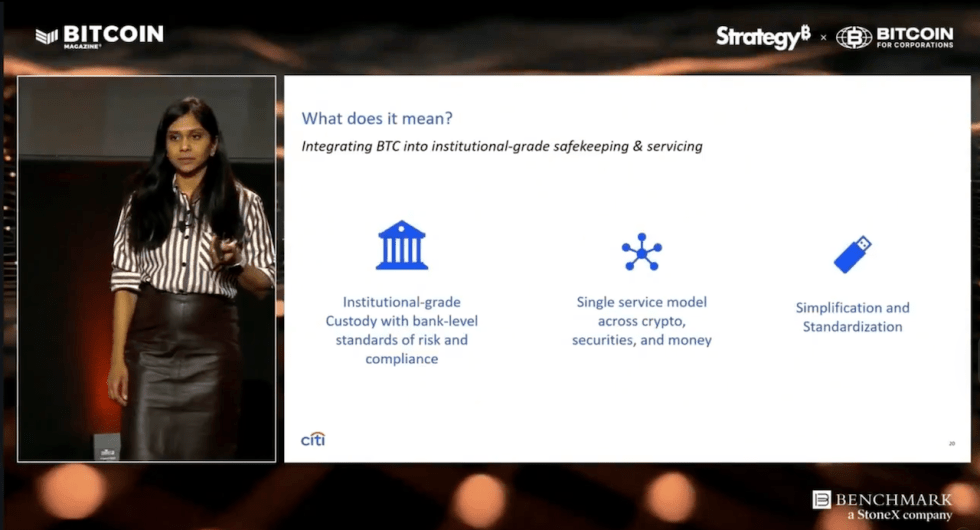
To achieve this, Citi will focus on three key areas: Core custody and safekeeping capabilities, institutional-grade key management, and wallet infrastructure. This will enable clients to hold and manage Bitcoin positions alongside traditional assets.
“We will also be bringing Bitcoin into the fold of the $30 trillion traditional assets that our clients entrust to us today. It will be the same framework that’s applied now, brought to Bitcoin,” Surendran stated.
Notably, the bank is set to offer its clients a “single service model across crypto, securities, and money,” extending the same reporting channels, compliance frameworks, and tax workflows that traditional assets fall into to BTC.
In addition, Citi will focus on simplification and standardization, noting that its clients won’t have to deal with wallets, keys, and one-time addresses as it will “take care of those problems” through its infrastructure.
Morgan Stanley Joins Institutional Push
Citi’s initiative follows broader efforts to make BTC accessible within traditional finance. On Wednesday, banking giant Morgan Stanley revealed that it is preparing to expand its BTC and crypto offerings beyond simple access.
Also at Strategy World 2026, Amy Oldenburg, Morgan Stanley’s head of digital asset strategy, shared the bank’s plan to MOVE toward native custody and an internal exchange stack, while also exploring yield and lending services backed by the flagship cryptocurrency.
Morgan Stanley will first allow E-Trade clients to buy and sell spot crypto assets through a partnership before moving to a native custody and exchange platform over the next year, the executive affirmed.
Oldenburg suggested that this WOULD put Morgan Stanley in a position to be the first major bank to offer that combination in-house. She shared that the firm must build its own platform before introducing BTC offerings to ensure its clients’ security.
“We really need to build this out internally. We can’t just primarily rent the technology to do this. People expect Morgan Stanley, they trust our brand, to be no-fail. And when you sit in that position, you have a significant responsibility to your clients to make sure that you’re delivering that in any level of technology,” the executive stressed.
Additionally, she confirmed that it is exploring crypto yield and lending products, but noted that the bank is still in the early design stage of those products. Earlier this year, Morgan Stanley filed for a registration statement for an ethereum Trust with the US Securities and Exchange Commission (SEC).
In October 2025, the bank also expanded its access to crypto fund investments for all clients, moving away from its previous customer restrictions. This shift allowed financial advisors to present crypto funds to any client, including those with retirement accounts.