The 2.4 Million Ethereum Anchor: How Binance’s Illiquid Supply Is Absorbing ETH’s February Volatility

Binance just locked down 2.4 million Ethereum—and the entire market felt the squeeze. That's not a typo. While retail traders panic-sold through February's price swings, the world's largest exchange quietly pulled a massive chunk of ETH out of circulation. This isn't just a big number; it's a structural shock to Ethereum's supply dynamics.
The Illiquidity Playbook
Exchanges typically hold assets to facilitate trading. Liquid supply equals price volatility. But when a behemoth like Binance decides to park over two million ETH in what analysts call 'cold storage' or deep reserves, the game changes. That supply becomes inert—an anchor. It can't be sold on a whim, it can't be lent out for short attacks, and it certainly can't fuel a flash crash. The available liquid supply for daily trading thins out, making the remaining ETH more sensitive to buy pressure and less prone to catastrophic dumps. It's a classic case of artificial scarcity, engineered not by a protocol upgrade, but by a custody decision.
Absorbing the Shockwaves
February's volatility tested every asset. For Ethereum, the sell-side pressure met an unexpected buffer: Binance's vault. With millions of coins sidelined, the natural market sell-off lacked the ammunition to push prices as low as traditional models predicted. The volatility was absorbed by absence—by coins that simply weren't there to be traded. This creates a fascinating, if unsettling, precedent. Price discovery now hinges not just on open market buys and sells, but on the opaque inventory management of a few key custodians. It's the ultimate 'trust us' market dynamic, wrapped in blockchain's veneer of decentralization.
Finance's old guard loves to mock crypto's volatility—right before they quietly replicate its most manipulative tactics, just without the public ledger. The closer you look, the more traditional finance and decentralized finance start to mirror each other, flaws and all.
So, what's the endgame? A more stable ETH, propped up by centralized vaults? Or a market where true price is forever obscured by the strategic illiquidity of its biggest players? One thing's clear: when an exchange holds the anchor, every ship in the harbor feels the pull.
Liquid vs. Illiquid Supply Signals A Fragile Equilibrium
The current reserve composition on Binance suggests Ethereum is operating within a structurally balanced environment rather than an immediate distribution phase. With illiquid supply accounting for the majority of the 3.57 million ETH held on the platform, a substantial portion of coins appears relatively dormant. Illiquid balances are typically associated with longer holding horizons or reduced trading frequency, which tends to dampen immediate sell-side pressure.

This matters at a time when ETH is hovering near $2,000. A dominant illiquid share implies that most holders are not actively positioning for a rapid exit. In previous cycles, sharp increases in liquid supply often preceded volatility spikes, as coins became readily available for market execution. That dynamic is not yet evident at scale.
By contrast, liquid supply historically expands during speculative phases, when traders rotate capital aggressively or prepare for directional exposure. The absence of a pronounced expansion suggests that, for now, speculative intensity remains contained.
The relatively stable gap between liquid and illiquid supply indicates equilibrium between holding behavior and active trading. However, this balance is conditional. A meaningful shift toward higher liquid supply WOULD increase the probability of renewed volatility. Conversely, sustained illiquid dominance could help absorb price shocks and moderate downside acceleration.
Ethereum Tests Long-Term Support As Downtrend Accelerates
Ethereum remains under structural pressure as price hovers near the $2,000 region following a sharp breakdown from the $3,200–$3,400 zone. The weekly chart shows a clear loss of bullish structure, with lower highs forming since the late-2025 peak and momentum decisively shifting to the downside.
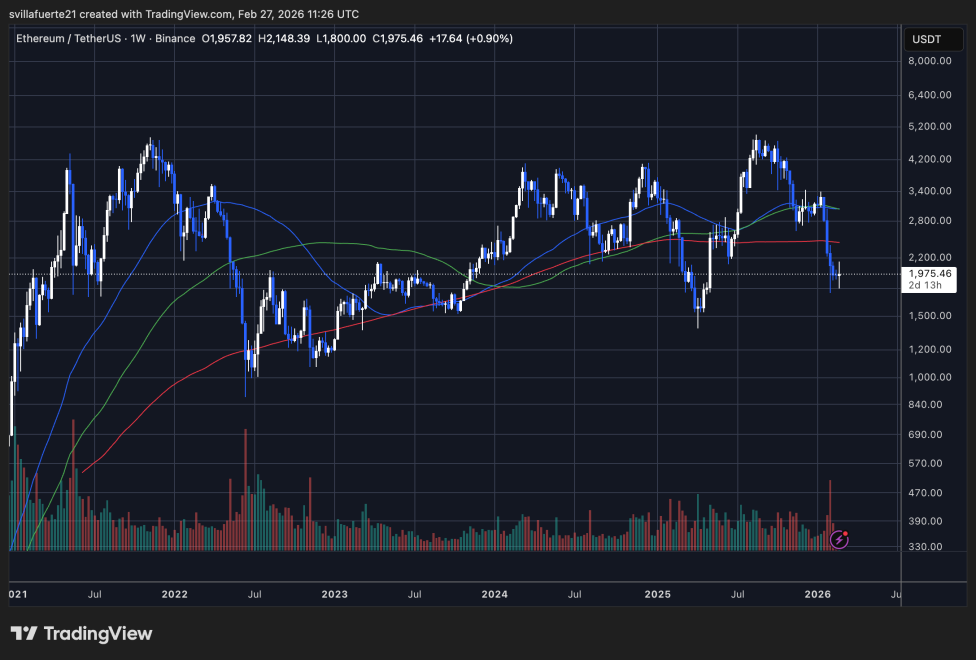
Price is now trading below the 50-week and 100-week moving averages, both of which are beginning to flatten or slope downward. This configuration typically signals weakening intermediate momentum and a transition into a corrective phase. Notably, Ethereum briefly tested levels near $1,800 before bouncing, suggesting the presence of reactive demand in that liquidity pocket. However, the recovery remains limited and has not yet reclaimed key moving averages.
The 200-week moving average, positioned lower on the chart, remains upward sloping, indicating that the broader macro trend has not fully reversed. Historically, this level has served as strong structural support during deeper cycle corrections. If downside pressure resumes, this zone could become a critical area to monitor.
Volume expanded significantly during the recent selloff, reflecting forced positioning adjustments rather than gradual distribution. Since then, activity has moderated, pointing to temporary stabilization.
Featured image from ChatGPT, chart from TradingView.com
