Ripple’s Game-Changer: Institutional Digital Asset Trading Whitepaper Drops

Wall Street's crypto whisper just got a whole lot louder.
Ripple, the blockchain giant long focused on cross-border payments, just fired a shot across the bow of traditional finance. Its newly unveiled whitepaper isn't about retail speculation—it's a blueprint for the big leagues. We're talking about the trillion-dollar institutional market, where pension funds, asset managers, and sovereign wealth funds are still dipping cautious toes into digital waters.
The Institutional On-Ramp, Demystified
The document lays out a framework that tackles the very barriers keeping traditional money on the sidelines: custody, compliance, and liquidity. It proposes a standardized architecture for trading digital assets that doesn't just ask institutions to adapt to crypto—it adapts crypto to them. Think regulated counterparties, clear audit trails, and settlement speeds that make T+2 look like a relic from the stone age.
Why This Isn't Just Another PDF
This isn't academic musing. Ripple's network of bank and payment provider partners gives this whitepaper real-world weight. It's a signal that the infrastructure for mass institutional adoption is being built, not just dreamed about. The playbook suggests leveraging existing financial rails where it makes sense and building new, blockchain-native ones where they don't.
A Nod to the Regulators—And a Jab at the Old Guard
Compliance isn't an afterthought; it's the cornerstone. The framework emphasizes working within regulatory perimeters, a clear pitch to risk-averse institutional legal teams. It's a pragmatic approach that acknowledges you can't disrupt a multi-trillion dollar system by pretending the rules don't exist. Of course, watching traditional finance try to 'innovate' into blockchain is like watching a giraffe try to ice skate—ambitious, awkward, and you're just waiting for the inevitable, costly fall.
The bottom line? The digital asset market is maturing fast. Ripple's latest move isn't about pumping a token price; it's about providing the plumbing for the next wave of capital. The institutions are coming. The question is no longer if, but how. And Ripple just handed them a detailed map.
Ripple Targets Crypto Market Fragmentation
The whitepaper, titled The Blueprint for Institutional Digital Assets Trading, frames today’s OTC crypto market as structurally inefficient compared with foreign exchange. Ripple argues that institutions are still forced to operate across fragmented venues where execution, custody and credit are bundled together, collateral is siloed, and firms must maintain multiple bilateral relationships. The paper identifies three main frictions: multiplied credit risk, trapped capital and fragmented asset risk.
Ripple’s Core claim is that crypto should borrow more directly from FX market structure. “This paper explains why digital asset markets require a prime brokerage–style model that features centralized credit intermediation, netted T+1 settlement, and the unbundling of execution, custody, and credit into clearly defined roles,” the paper says. It adds that the Digital Prime Broker, or DPB, should function as “core shared infrastructure” that can be tuned to different client requirements rather than forcing everyone into a single rigid model.
Under that framework, a client WOULD execute one master agreement with a prime broker, while trades done with approved liquidity providers and market makers would be given up to that broker. Ripple argues this replaces a web of bilateral exposures with a single contractual counterparty, simplifying legal, compliance and settlement workflows while reducing failure risk across venues.
The paper leans heavily on capital efficiency. Ripple says the current market still relies on gross settlement or full prefunding, which forces repeated intraday asset transfers and leaves collateral stranded across exchanges. In one example, it says a client buying 100 BTC and selling 80 BTC during the same cycle would only need to settle 20 BTC net under a T+1 model, cutting gross fund movements by roughly 89%.
It also argues that the existing system hides financing costs rather than removing them. Ripple says offshore exchanges and bilateral liquidity providers often apply default swap rates of around 11%, roughly 7% above the risk-free rate, implying a daily funding cost of about 1.92 basis points, or $192 per $1 million per day. In Ripple’s telling, a DPB model would make those costs explicit instead of embedding them in spreads or subsidizing them through interest-free client collateral.
The paper also includes outside support from XTX Markets COO Mike Irwin, who writes: “A Digital Prime Brokerage model will enable institutional participants, including retail aggregators, to reduce operational risk, unlock trapped capital, and scale growth. As clients increasingly favor net-settled, prime-based structures, liquidity providers and venues will have to adapt. Adoption, however, will depend on prime brokers supporting specific client needs and constraints rather than enforcing a rigid, one-size-fits-all model.”
XRP is present, but not as the main story. Ripple says the XRP Ledger could support early settlement through onchain credit lines that fund obligations ahead of the standard T+1 net settlement cycle, with funding costs charged transparently to the party requesting early liquidity. That makes XRP part of the proposed plumbing, but the whitepaper’s main thesis is broader: institutional crypto still needs better market structure before it can look more like mature finance.
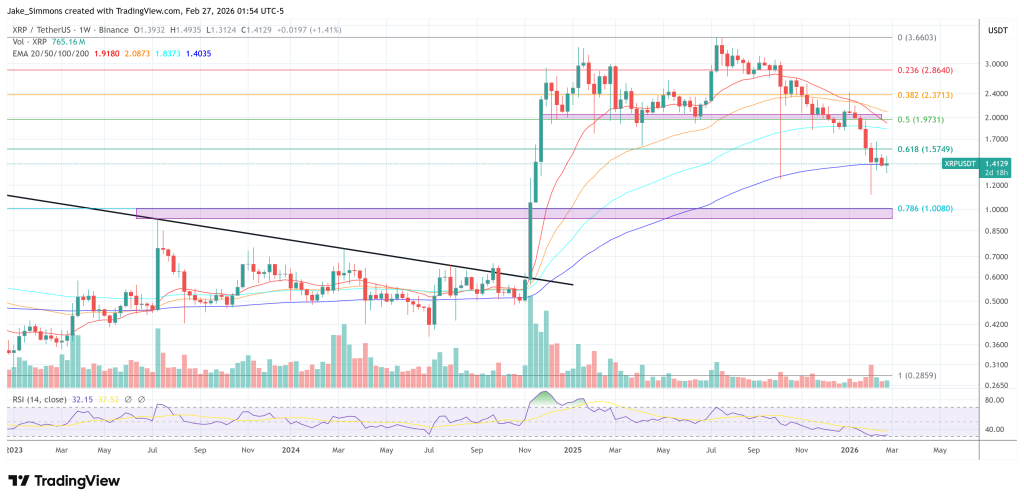
At press time, XRP traded at $1.4129.