Bitcoin Holds Firm at $68K: Institutional Fund Flows Hit a Wall—What’s Next?

Bitcoin's price action flatlines. After a volatile climb, the benchmark cryptocurrency has parked itself at the $68,000 mark. The real story, however, isn't on the chart—it's in the capital pipelines.
The Big Money Pause
Institutional fund flow ratios have slammed into neutral. The data shows a dramatic slowdown in fresh capital from ETFs and dedicated crypto funds. It's not a retreat, but a collective holding of breath—a standstill that speaks louder than any rally.
Decoding the Stall
This isn't retail FOMO fading. This is the smart money hitting the pause button. Analysts point to a classic consolidation phase: institutions are digesting gains, reassessing macro risks, and waiting for the next regulatory shoe to drop (always a favorite Wall Street pastime). The $68,000 level has become a line in the sand, a test of conviction for the whales who moved the market on the way up.
A Fork in the Road
History suggests these pauses precede the next major move. Does the institutional hesitation signal a top, or is it merely a pit stop before a fuel-up? The stagnant fund flows create a tension that must eventually break. One cynical take? The suits are just waiting for their quarterly reports to print before making the next play—because nothing drives innovation like a good bonus cycle.
The standoff is clear. Bitcoin holds its ground at $68,000 while the capital engines cool. The next signal won't come from a tweet; it'll come from a treasury manager's mouse click. The market waits.
Spot Volume Contraction Signals Market Caution
The ongoing decline in spot trading activity provides a useful lens for understanding current Bitcoin market dynamics. Darkfost notes that participation across major exchanges has fallen markedly since the October peak, with aggregate spot volumes roughly halved. Binance’s monthly volume has dropped from about $198 billion to $75 billion, Gate.io from $53 billion to $25 billion, and Bybit from $41 billion to roughly $20 billion. The fact that this pattern spans multiple leading venues suggests a systemic shift rather than exchange-specific behavior.

From a market-structure perspective, shrinking spot volumes typically indicate reduced conviction. When liquidity thins, price moves can become less reliable because they are driven by smaller capital flows. This environment often coincides with consolidation phases, where both buyers and sellers adopt a wait-and-see approach rather than aggressively positioning.
Importantly, weaker spot participation can delay trend formation. Sustained bullish recoveries historically require expanding spot demand, as derivatives-driven rallies alone tend to lack durability. Conversely, declining spot flows may also reflect capital rotation toward other asset classes amid macro uncertainty.
The key variable will be whether spot participation stabilizes or begins to recover. A meaningful rebound in volumes WOULD signal renewed confidence, whereas continued contraction would reinforce the current defensive market posture.
Bitcoin Consolidates Below Key Moving Averages
Bitcoin’s daily chart shows a market attempting to stabilize after a decisive breakdown from the $90,000–$95,000 consolidation zone. The sharp selloff into the low $60,000s was accompanied by a notable spike in volume, suggesting forced liquidation and aggressive distribution rather than orderly rotation. Since then, price has rebounded toward the $68,000–$69,000 area, which now acts as near-term resistance.
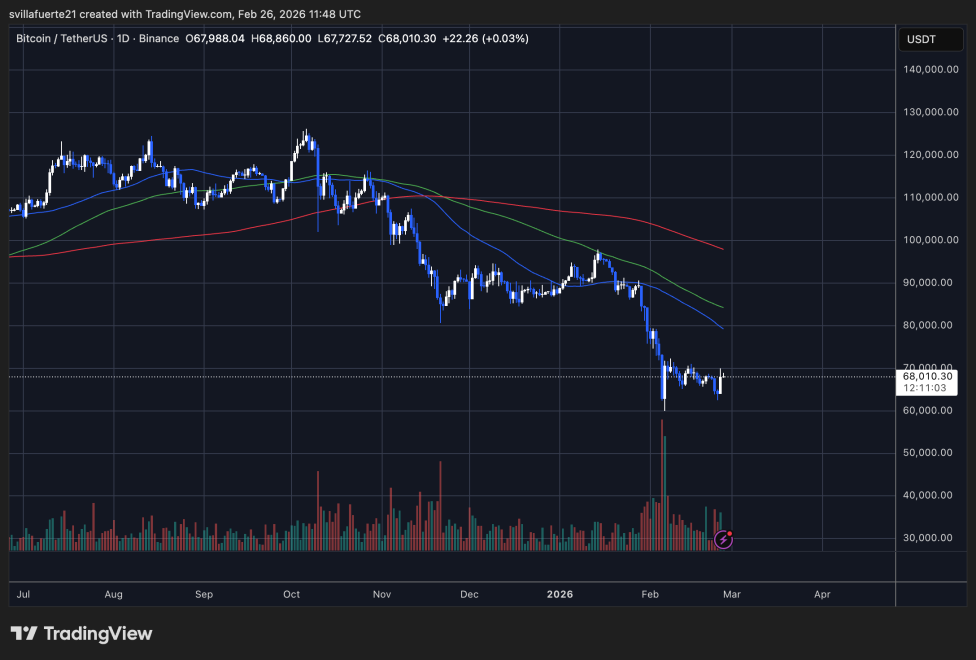
Technically, BTC remains below the 50-day, 100-day, and 200-day moving averages, all of which are trending downward. This alignment confirms a bearish momentum structure. The 50-day average has crossed below the 100-day, reinforcing short-term weakness, while the 200-day sits significantly above the current price, signaling that longer-term trend recovery is not yet underway.
The recent sideways movement NEAR $68,000 appears corrective within a broader downtrend. Higher lows have not yet been established on a structural basis, and upside attempts lack expanding volume support.
For a meaningful shift in sentiment, Bitcoin would need to reclaim the $72,000–$75,000 zone and close above declining moving averages. Until that occurs, rallies are likely to face selling pressure, with downside risk remaining toward the $60,000 support cluster if momentum weakens again.
Featured image from ChatGPT, chart from TradingView.com
