Ethereum Exchange Deposits Just Hit A Six-Month High: Is This A Panic Sell-Off Or A Strategic Reset?

Ethereum deposits to centralized exchanges just spiked to their highest level in half a year. The data flashes a warning sign—or does it? The market's immediate reaction is to brace for a sell-off. But seasoned players know the on-chain story is rarely that simple.
The Whale Watch: Who's Moving What?
Not all deposits are created equal. A tidal wave of ETH hitting exchange wallets could signal a herd heading for the exits. Or it could point to major players repositioning—shuffling assets between cold storage, DeFi protocols, and trading desks. The key is in the sender addresses. Are they retail wallets or institutional vaults? The distinction separates panic from portfolio management.
Liquidity vs. Leverage: The Real Market Pulse
High exchange balances boost immediate liquidity. That can grease the wheels for large trades but also increase potential selling pressure. It's a double-edged sword. Meanwhile, look at derivatives data. Are these deposits fueling leveraged long positions, or are they pre-funding short sells? The answer often lies not in the deposit amount, but in what happens next on the perpetual swaps markets.
The Structural Shift Narrative
Forget panic. What if this is just efficiency? As Ethereum's ecosystem matures, capital moves faster. Large holders might be centralizing assets briefly to execute complex strategies across CeFi and DeFi—a reset, not a retreat. It's the crypto version of rebalancing a quarterly portfolio, just with less paperwork and more network fees. (A process still baffling to traditional finance suits who think 'blockchain' is a HR scheduling tool.)
The six-month high isn't an alarm bell—it's a data point. In a market driven by narrative, the real move is deciding which story to believe. Panic sells headlines. Structure builds fortunes. The chain shows the movement; the context reveals the motive.
Exchange Deposits Surge As Price Correction Deepens
The report highlights that this metric breakout has occurred alongside a severe price correction. Ethereum has declined sharply from its October peak NEAR $4,900 to roughly the $1,900 region. The simultaneous drop in price and surge in exchange deposit addresses suggests two primary on-chain interpretations that merit careful consideration.

The first scenario points to retail capitulation. A rapid increase in unique depositing addresses often reflects panic behavior among smaller investors. Participants who held through earlier stages of the decline may now be transferring assets to exchanges to exit positions, reinforcing short-term sell-side pressure.
The second interpretation relates to derivatives market positioning. With ETH trading below the $2,000 threshold, some deposits likely represent collateral replenishment. Traders facing liquidation risk may be adding margin to maintain Leveraged long positions rather than outright selling their holdings.
In the near term, increased deposits elevate potential supply on exchanges, which can intensify volatility if selling materializes. However, historically, extreme spikes in deposit activity have frequently appeared during late-stage corrective phases. Such conditions sometimes precede seller exhaustion.
Monitoring exchange outflows, spot volume absorption, and derivatives positioning will be critical to determine whether this activity signals continued downside risk or the early formation of a local market bottom.
Ethereum Tests Structural Support As Downtrend Persists
Ethereum continues to trade under sustained pressure, with the weekly chart showing a clear loss of bullish momentum following the rejection near the $4,800–$5,000 region. Price has now retraced toward the $1,900 area, a zone that previously acted as consolidation support during earlier cycle phases. The inability to hold above the mid-cycle moving averages suggests that sellers still maintain structural control.
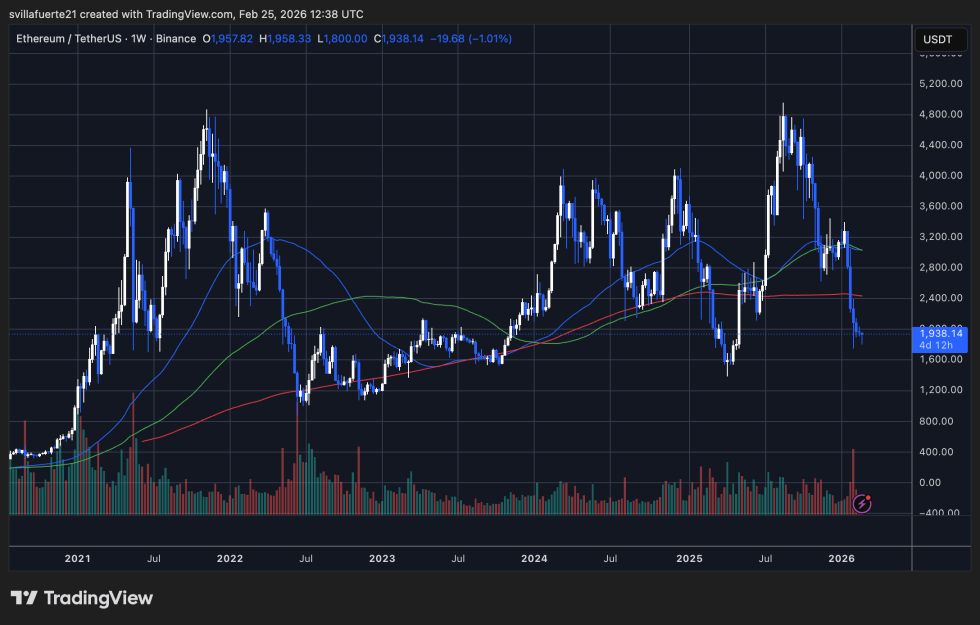
The 50-week moving average has rolled over and now acts as overhead resistance, while the 100-week average appears to be flattening. Meanwhile, price is approaching the longer-term 200-week moving average, a level historically associated with major cyclical support. A decisive breakdown below this region could expose deeper downside, whereas stabilization here may encourage medium-term accumulation.
Volume patterns indicate intermittent spikes during declines, which typically reflect distribution rather than sustained buying interest. This reinforces the interpretation of a defensive market phase rather than a confirmed recovery trend.
Despite the weakness, volatility compression near long-term averages sometimes precedes transitional periods. Confirmation, however, WOULD require sustained closes above reclaimable resistance levels and improving participation metrics. Until then, Ethereum remains in a fragile technical posture with risk skewed toward continued consolidation or downside drift rather than immediate bullish continuation.
Featured image from ChatGPT, chart from TradingView.com
