Bitcoin’s Quantum Leap: Core Dev Reveals Just 2 Steps to Future-Proof the Network

Forget the hype—Bitcoin's next upgrade isn't about speed or fees. It's about survival.
According to a lead developer, the world's largest cryptocurrency needs only two critical protocol adjustments to become resistant to quantum computing attacks—the kind that could one day crack today's encryption like a stale fortune cookie.
The Two-Step Shield
The first move? Transitioning to post-quantum cryptographic signatures. This swaps out the current digital lock-and-key system for one that even a super-powered quantum computer can't pick.
Step two involves hardening the transaction output model. It's a backend tweak that prevents a quantum adversary from hijacking funds before the owner gets a chance to move them—a preemptive strike against a future heist.
Why This Matters Now
Quantum computers capable of this kind of breach are still years, maybe decades, away. But in crypto, preparing for existential threats a decade early is just called Tuesday. This isn't about fixing a current flaw; it's about ensuring Bitcoin outlives the very technology designed to break it.
The plan underscores a core Bitcoin ethos: relentless, quiet evolution. While speculators chase the next shiny meme coin, the protocol's guardians are engineering its survival into the next century. It’s the ultimate long game—a stark contrast to the quarterly panic cycles of traditional finance.
So, while Wall Street frets over basis points, Bitcoin is methodically building a vault that even tomorrow's computers can't crack. Sometimes, the most bullish move isn't pumping the price—it's ensuring the asset still exists in 30 years.
Corallo’s 2-Step Roadmap For Bitcoin
Corallo repeatedly returned to what he called the Core sequence for Bitcoin’s quantum preparation. “There are only two steps,” he said. “The first relevant step is just adding the ability to commit to a postquantum public key. I think that should be done soon.”
He added that this first phase is increasingly converging around hash-based signatures, with current discussion focused less on whether to do it and more on exact implementation details. Corallo said he sees “pretty strong consensus” around hash-based approaches and pointed to work tied to BIP 360, while also noting debate continues on the precise format.
The second step, in his framing, is the politically harder one: deciding when legacy, quantum-vulnerable spend paths should no longer be accepted. That is the point where old coins that have not migrated — including lost or abandoned coins — become part of a market-driven fork decision, in his view.
Corallo’s argument for moving early on the first step but delaying the enforcement switch rests on cost and wallet behavior. He said wallets can start committing to post-quantum public keys now without immediately paying the size and fee overhead of using large post-quantum signatures on-chain.
“You really want an upgrade path that is free for now,” Corallo said. “The wallets know how to spend it. They know how to build these keys, how to sign with these keys. They just don’t have to use it yet.”
He argued this avoids a scenario where wallets postpone upgrades because post-quantum transactions are larger and more expensive, while still preparing the system for a future enforcement moment.
“Only two steps” required to make Bitcoin quantum-resistant?
In this @Unchained_pod episode, @TheBlueMatt joins me to discuss:
 Why he thinks Nic Carter is wrong about the quantum threat to Bitcoin
 Why he disagrees with Nic on his ranking of Bitcoin’s most influential… pic.twitter.com/2r2g42myJD
— Laura Shin (@laurashin) February 22, 2026
The ‘Nobody Is Working On It’ Narrative
Corallo also disputed the idea that Bitcoin development circles are ignoring the issue. He pointed to research and engineering work at organizations including Blockstream Research and Chaincode Labs, cited Ethan Heilman and co-authors working on BIP 360, and said post-quantum discussion on the Bitcoin developer mailing list has grown steadily.
At one point, he said mailing-list discussion has risen to “30 or 40%” of posts, describing that as evidence of sustained attention rather than neglect.
Corallo did not argue the problem is trivial. He acknowledged migration of active wallets could take years and said critics are right that the social and market consequences of disabling insecure spend paths WOULD be contentious. But his central claim was narrower: Bitcoin does not need a fully finalized end-state today to begin meaningful preparation now.
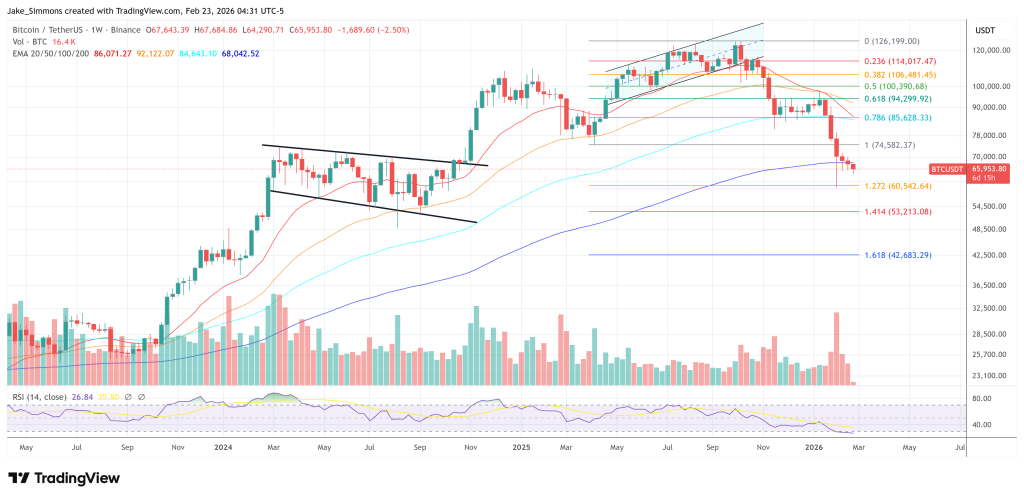
At press time, BTC traded at $65,953.