Bitcoin Hashpower Roars Back: Network Difficulty Posts Biggest Jump In Months

Mining muscle floods back onto the Bitcoin network, forcing its most aggressive difficulty adjustment in months. The gears of the world's largest blockchain just got a lot harder to turn.
The Hash Rate Rebound
After a period of relative calm—or stagnation, depending on your outlook—the collective computing power securing Bitcoin is surging. Miners are plugging in, firing up, and competing like it's 2021. This isn't just a blip; it's a statement of intent from an industry that bets millions on every kilowatt-hour.
Difficulty Catches Up—Hard
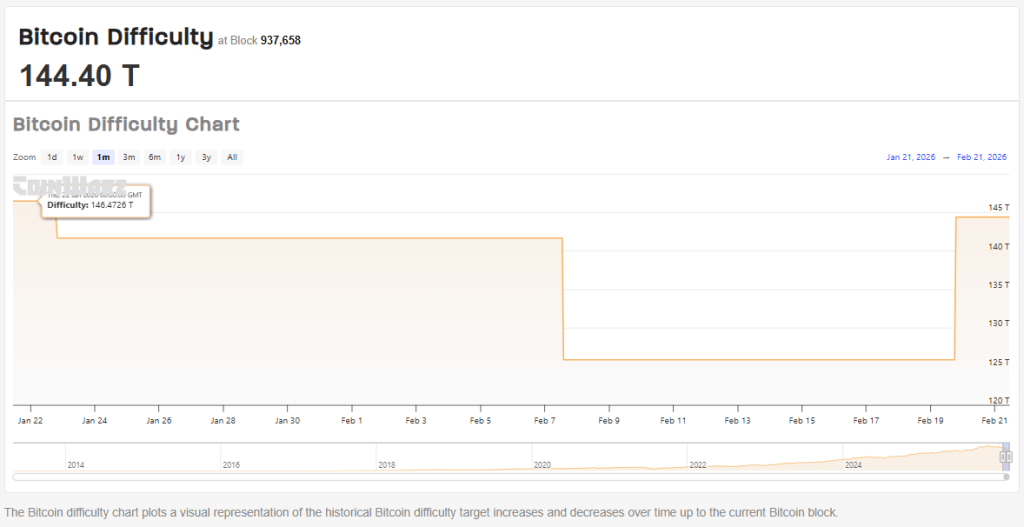
The protocol's built-in thermostat just kicked on. To keep block times steady at roughly ten minutes, Bitcoin's difficulty algorithm has responded with its most significant upward leap in months. Translation: it now takes substantially more raw computational effort to mine a block and earn that 3.125 BTC reward. The network self-corrects, ruthlessly ensuring security stays expensive—a feature, not a bug, unless you're running outdated rigs.
The Miner's Calculus
This move separates the strategic from the speculative. Efficient operations with access to cheap power just saw their relative advantage grow. The less efficient? Their profit margins just got squeezed into a spreadsheet cell they'd rather ignore. It's a brutal, automated efficiency drive that would make any legacy corporate raider blush.
This surge signals deep conviction. Miners are voting with their watts, betting that future Bitcoin prices will justify today's soaring operational costs. It's a high-stakes game of chicken with the electricity meter. While traditional finance frets over P/E ratios, the crypto crowd is too busy calculating joules per terahash—arguably a more honest metric of value, if you ignore the environmental sermonizing. One cynical take? This is what a 'hard asset' rally looks like when the asset is literally hard to produce.
The network gets stronger. The game gets tougher. The stakes, as always, get higher.
Winter Outages And The Bounce Back
Foundry USA’s pool saw a dramatic swing in computing power, falling NEAR 198 EH/s before climbing from roughly 400 EH/s. Reports say that many operators in affected regions shut down temporarily during the winter storms to protect equipment and help grids.
Some of the spaces that host miners coordinated with utilities. Power was conserved. Power was redirected.
Flexible Power Deals Changed The Game
Reports note that several miners did more than pause operations. LM Funding America reported curtailing machines and sending contracted power back to the grid, pocketing curtailment payments that helped offset lost mining time.
Canaan Inc. also said its US sites took part in demand response moves with local partners. These arrangements are part of why many facilities can afford to go offline when the grid needs relief, then restart when conditions improve.
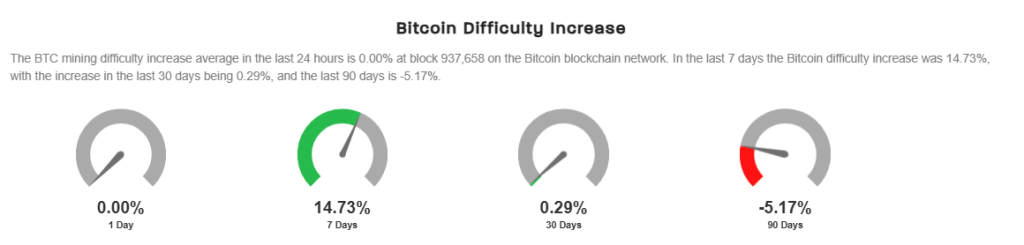
Bitcoin’s difficulty is designed to reset every 2,016 blocks to hold average block times close to the 10-minute target. When more hash power returns, the algorithm raises difficulty. That makes the network harder to attack and raises the work needed to win a block reward.
For miners, higher difficulty reduces the bitcoin earned per unit of compute, squeezing margins for outfits with older rigs or higher electricity bills.
Price Moves Stay Tied To HeadlinesBitcoin traded near $68,000 as markets reacted to rising geopolitical strain, especially between the US and Iran. Trading has felt cautious. Volume is lighter. Prices have bounced and then stalled on headline-driven flows, showing that investor mood still swings with global news.
At the same time, network metrics kept shifting under the surface — a reminder that technical and macro drivers can pull in different directions.
The US now supplies a big chunk of global hash power, according to Cambridge Centre for Alternative Finance. That means regional events, weather, and grid policies in the US matter a lot to global security and miner economics.
Some firms have begun to treat mining as a flexible load that can stabilize grids during stress, creating new income streams beyond pure block rewards.
Politics And Market ToneComments from politicians and geopolitical moves add friction. Mentions of US President Donald TRUMP in recent headlines have been tied to broader market nervousness; geopolitics can pull risk appetite downward and keep crypto prices range-bound.
The difficulty rebound itself didn’t spark a big price jump. Instead, it reinforced a simple truth: the protocol handled the shock, but miners felt the squeeze.
Featured image from Pexels, chart from TradingView
