Basel Banking Standards Vs Bitcoin: Strategy CEO Blasts 1,250% Risk Weight as Outdated and Absurd

Global banking regulators just slapped Bitcoin with a risk weight that makes volatile emerging-market debt look tame. The Basel Committee's 1,250% capital charge isn't just conservative—it's a declaration of war on a new asset class.
The Regulatory Gauntlet
Forget gold's 0% risk weight or even corporate bonds. Under the proposed Basel standards, a bank would need to hold capital equal to the full value of any Bitcoin exposure—plus another 250% on top. It's the financial equivalent of requiring a life jacket, a helmet, and a parachute to cross a puddle. The move effectively tells traditional finance: 'Hold this at your own peril.'
Why Such an Extreme Stance?
The number isn't arbitrary—it's designed to be prohibitive. By assigning a charge that dwarfs even the riskiest traditional assets, regulators aim to keep Bitcoin largely off bank balance sheets. It's a preemptive strike against mainstream adoption through conventional channels, forcing crypto exposure into other vehicles. One cynical observer might note this is how dinosaurs design rules for mammals—by assuming the new thing will fail in the old world's terms.
A Strategy CEO Fires Back
The response from crypto-native executives was swift and scathing. One Strategy CEO blasted the framework as 'regulatory theater' that misunderstands both the technology and its risk profile. The argument? Bitcoin's transparent ledger and immutable settlement actually reduce counterparty risk—the very thing capital requirements aim to mitigate. It's like penalizing digital gold for being too heavy to steal.
The Innovation Chasm
This clash reveals a fundamental rift. Banking regulations operate on historical volatility and institutional trust. Bitcoin's value proposition is built on cryptographic verification and decentralization—concepts that don't fit neatly into legacy risk models. The 1,250% weight isn't just a number; it's a measure of the gap between old finance's playbook and a system that rewrites the rules.
What Comes Next?
Expect pressure from both sides. Banks with crypto ambitions will lobby for nuanced treatment, while purists will see this as proof that Bitcoin must grow outside traditional finance. The real test will be whether regulators adapt their scales or double down on a metric that could become a relic. After all, nothing says 'forward-thinking policy' like using a 19th-century risk framework for 21st-century money.
A Capital Penalty For Bank Bitcoin Exposure
Le framed the issue as structural rather than political, pointing to the way global capital rules Flow into national bank regulation. “The Basel Accords set global bank capital standards and risk-weighting rules for assets. These frameworks materially shape how banks engage with digital assets, including bitcoin,” he wrote. “They are developed by the Basel Committee of central banks and regulators across 28 jurisdictions — the US is just one.”
He tied that directly to Washington’s stated ambitions for crypto leadership. “If the US wants to be the Crypto Capital of the World, our implementation of Basel capital treatment deserves careful review,” Le said.
Jeff Walton, who posted the image Le quoted, summarized the contrast in blunt numbers: “Basel III Risk weights for assets: Gold: 0% Public equity: 300% Bitcoin: 1,250%,” adding that if the US wants to be a “crypto capitol,” “the banking regulations need to change,” because “Risk is mispriced.”
The chart itself presents a ladder of “typical” risk weights across asset classes. Cash and central bank reserves sit at 0%, physical gold at 0%, and sovereign debt such as US Treasuries (USD, U.S. bank) also at 0%. Investment-grade corporate debt is shown in a 20–75% range, unrated corporate debt at 100%, high-yield at 150%, public equity at 250–300%, and private equity at 400%+. Bitcoin is set apart at 1,250%.
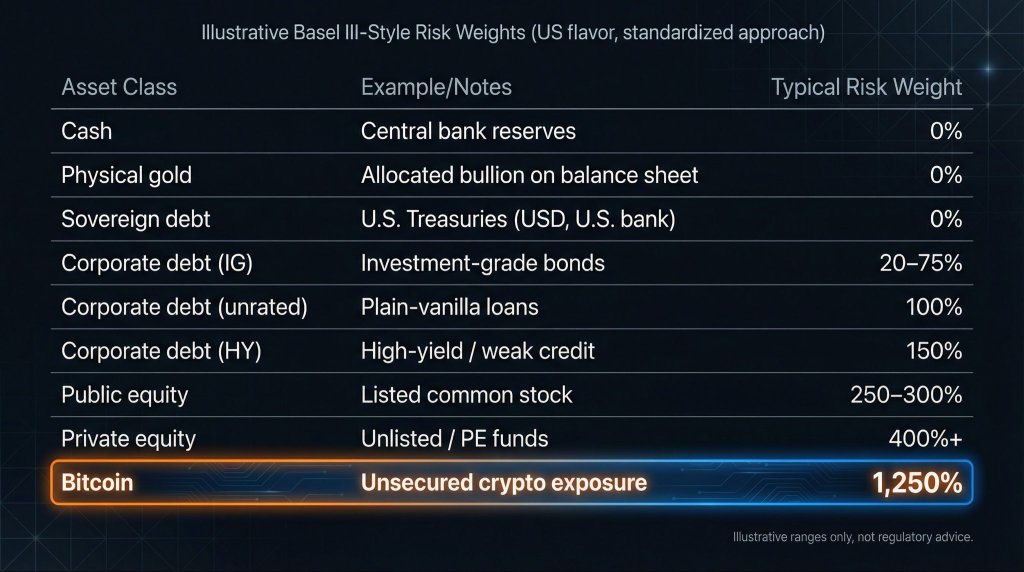
Conner Brown, Head of Strategy at the Bitcoin Policy Institute, argued that the practical effect is to make bank intermediation of bitcoin prohibitively expensive. “It’s hard to overstate how bad of a policy error this is,” he wrote. “Banks are required to set aside capital based on how risky regulators think an asset is. The higher the ‘risk weight,’ the more expensive it is for a bank to hold.”
Brown described the 1,250% figure as translating into a one-for-one capital requirement relative to exposure. In his words, bitcoin’s treatment “means banks must hold $1 in capital for every $1 of Bitcoin exposure,” while gold is treated “the same as cash” with “essentially no capital cost.”
He also pushed back on the premise that bitcoin should be penalized relative to legacy assets, pointing to operational traits he sees as favorable for risk management and market functioning, including continuous trading, fast auditability of holdings, fixed supply, rapid global settlement, and transparent pricing. The result, he argued, is that regulators have effectively discouraged banks from offering custody and related services that corporates and individuals might prefer inside the regulated perimeter.
Brown said the knock-on effects extend beyond bank balance sheets to competitiveness. He argued the framework diverts activity toward “non-bank entities and offshore jurisdictions,” which he characterized as carrying higher risks, and warned that failing to adjust the approach could leave US institutions at a disadvantage globally.
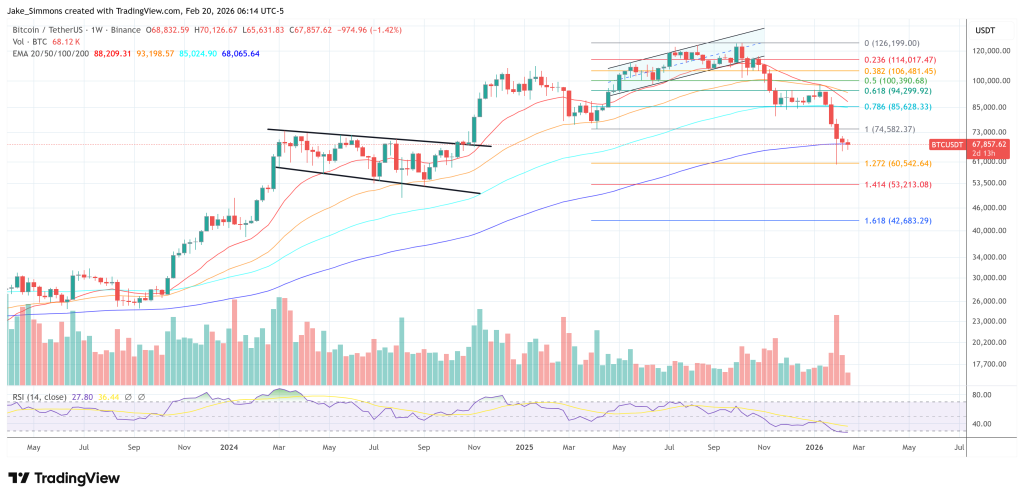
At press time, Bitcoin traded at $67,857.