XRP’s Game-Changer: How the New Permissioned DEX Rewrites the Rules for Users

Forget everything you thought you knew about decentralized trading. A new breed of exchange is emerging—one that blends regulatory guardrails with the core promise of DeFi. For the XRP army, this isn't just another platform; it's a potential paradigm shift.
The Permissioned Gateway: Compliance Meets Control
This isn't your anarchic, anonymous swap site. A permissioned DEX operates with a curated list of participants—often institutions, licensed entities, or vetted users. Think of it as a members-only club with a blockchain-based ledger. For XRP, a digital asset perpetually navigating regulatory crosshairs, this model offers a compelling proposition: deep liquidity and sophisticated trading tools within a framework that traditional finance can actually stomach. It’s the institutional on-ramp that critics said couldn't be built.
What's In It For The XRP Holder?
The immediate win? Access. We're talking about potential bridges to massive, previously walled-off pools of capital. This could mean tighter spreads, larger order sizes, and a level of market stability that purely retail-driven venues struggle to provide. It also signals a maturation—a move from the speculative fringe toward the plumbing of real-world asset movement. Your XRP isn't just a bet; it's becoming a credentialed tool in a regulated toolkit. (A cynical finance jab? It’s about time—most of traditional finance still runs on software older than the interns analyzing it.)
The Trade-Off: Decentralization's New Face
Purists will howl. Permissioned sounds like the opposite of permissionless, the sacred tenet of crypto. And they're not entirely wrong. This model introduces points of control, of gatekeeping. But the trade-off is legitimacy and scale. It doesn't replace the open, permissionless DEXes; it runs in parallel, serving a different master—one in a suit, perhaps, but one with very deep pockets.
The final analysis? This development cuts both ways. It bypasses the old arguments about utility versus speculation by building a compliant utility engine. It validates XRP's use case while simultaneously challenging crypto's foundational ethos. For users, it’s a new, powerful tool. For the ecosystem, it’s a high-stakes experiment in whether crypto can have its cake and eat it too—all under the watchful eye of the regulators it claims to disrupt.
Permissioned Dex Is Bigger Than A Simple Upgrade
Ripple enthusiasts and executives have repeatedly stated that the largest obstacle to institutional adoption of decentralized exchanges is compliance. Without permissioning tools, even Ripple itself could not fully utilize certain XRPL functionalities in regulated environments.
A Permissioned DEX is still a decentralized exchange, but with controlled access. A Permissioned DEX is where anyone can trade freely, but creators of the DEX restrict participation to verified entities. This means that banks, payment providers, and regulated financial institutions can take advantage of a Permissioned DEX to trade, provide liquidity, and settle transactions inside an environment where all participants are known and approved.
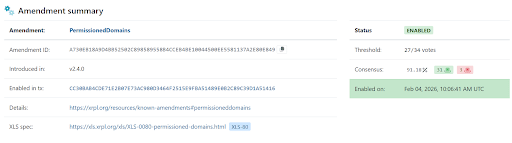
Decentralized networks like the Ledger are permissionless, meaning anyone can participate without authorization or approval from a gatekeeper. However, as nice as that may sound, the reality behind this structure is that traditional financial institutions cannot transact on open systems with anonymous counterparties due to compliance, AML, and regulatory obligations. They must know who they are trading with, maintain audit trails, and prevent exposure to illicit activity. A permissioned environment solves that barrier without removing the decentralized foundation of the ledger itself.
The Ledger already had built-in DEX functionality, fast settlement, low fees, and deterministic execution. The new amendment adds the compliance LAYER that large financial institutions need before deploying huge amounts of capital into the XRP ecosystem.
What Does This Mean For XRP Users?
Therefore, the launch of Permissioned Dex on the XRP Ledger is another obstacle to mass institutionalization that has been removed. According to an enthusiast known as Nick on the social media platform X, once the market structure bill is passed this year, then every other single obstacle to mass institutionalization of the Ledger will be removed.
According to another analyst on X known as Stern Drew, the upgrade is huge because permissioned liquidity unlocks institutional participation, the missing bridge between traditional finance and blockchain rails. This is expected to be reflected in the price action of the altcoin moving forward.
However, the analyst noted that it might take time for institutions to actually deploy liquidity until the CLARITY ACT and DNAOnChain’s zk-credential system go live. Nonetheless, the first permissioned offer has already been created on the XRP DEX.
