Ethereum Shatters Records: Majority of Supply Now Staked – Price Surge Incoming?

Ethereum just flipped the script. For the first time in its history, over half of all ETH in existence is locked up, staked on the network. This isn't just a milestone—it's a fundamental shift in the asset's economic DNA.
The Great Lock-Up
Think of it as a voluntary shortage. When the majority of a circulating asset gets pulled off the sidelines and put to work, basic supply and demand kicks in. Less liquid supply on exchanges often translates to reduced selling pressure and increased scarcity value. It's a mechanic that tends to make traditional commodity traders nod in grim approval.
Network Security on Steroids
This mass migration to staking supercharges Ethereum's security. More staked ETH means an exponentially higher cost to attack the network. Validators have real skin in the game—their own locked capital—making dishonesty a spectacularly expensive proposition. The chain doesn't just get faster; it becomes a fortress.
The Yield Chase Reality
Let's be real—a good chunk of this is driven by yield. In a world of anaemic bond returns, staking offers a digital coupon that actually beats inflation. It's the ultimate 'fine, I'll do it myself' move by investors tired of begging central banks for a decent return. Call it cynical, but financial desperation builds robust networks.
What's next? This level of commitment signals long-term conviction from holders. It transforms ETH from a speculative token into a productive, yield-generating network asset. While short-term price moves are anyone's guess, the long-term trajectory just got a whole lot more interesting—and a whole lot more secure.
Over Half Of All Ethereum Now Staked
Ethereum’s price has fallen below the $2,000 mark once again as Wednesday drew to a close. During the waning price action, the network seems to have reached a historical inflection point, as shown by the massive staking ecosystem growth.
In an X thread, Everstake, a leading and responsible validator, has outlined a crucial landmark for ETH, which could play a role in shaping its future. ETH staking activity just exploded, with more than half of the entire supply being locked away in staking, marking the first time in its history. With the switch to proof-of-stake, Ethereum’s staking participation has increased steadily. However, its economic design enters a new phase when it surpasses the 50% of all supply.
Everstake’s report is solely derived from data from Santiment, a popular on-chain data analytics platform. Data from the platform shows that the proof-of-stake contract on Ethereum now controls 50.18% of the total historical ETH issuance. Beyond just being a remarkable figure, it represents a key milestone in the project’s 11 history. In other words, this implies that the majority of ETH is no longer circulating or active in the market.
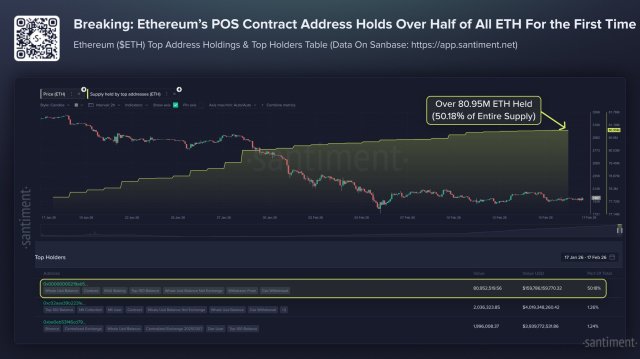
When over 50% of the supply is being locked away in staking contracts, the liquid supply reduces, and fewer coins become available for trading. Such patterns often ignite sentiment as they decrease selling pressure and create a market sensitivity to new demand. At the same time, the development indicates conviction from long-term holders.
Users are determined to secure the network rather than carry out trades in short-term volatility. Everstake remains confident that this is a structural shift for Ethereum. It’s reducing supply coupled with steady or growing demand points to robust price dynamics for ETH over time. “It doesn’t guarantee an immediate pump, but it changes the foundation the price is built on,” the firm stated.
A Market That Has Fallen Into Cold Levels
After an analysis of the MVRV Z-Score, RVT, and NUPL, Alphractal disclosed that the Ethereum market temperature is NEAR cold levels. Specifically, this key metric measures whether the market is overheated or oversold, providing insights into risk-elevated periods and when asymmetry favors long-term positioning.
When it gets close to zero or falls below, it indicates that the market has calmed down. Historically, readings below 0 typically precede a phase where risk and speculative are flushed, increasing the potential for long-term accumulation even as price declines.
These zones underscore periods of reduced unrealized profits, triggering a balanced valuation and removing emotional excess from the market. In the past, major expansion phases have been preceded by extended positions in cold temperature zones, as weaker participants gradually exit and stronger hands progressively accumulate.
