Abu Dhabi’s Sovereign Wealth Funds Seize The Bitcoin Dip: A Strategic Move in Digital Asset Accumulation

While retail investors panic-sell, the deep-pocketed institutions are quietly loading up. Abu Dhabi's sovereign wealth funds—the silent giants of global capital—have just made a decisive move into Bitcoin, buying aggressively during the recent market downturn.
The Sovereign Strategy
This isn't speculative day-trading. It's calculated capital deployment. Sovereign wealth funds operate on decade-long horizons, treating short-term volatility as a discount window rather than a red flag. Their entry signals a fundamental shift: digital assets are now institutional-grade portfolio components.
Market Mechanics & The 'Smart Money' Play
These funds deploy sophisticated accumulation strategies—dollar-cost averaging into weakness, executing through OTC desks to minimize market impact, and securing physical custody. They're not buying the hype; they're buying the network, the scarcity, and the long-term hedge against monetary debasement that Wall Street analysts still pretend to understand.
The New Geopolitical Reserve Asset
Oil-rich nations diversifying into digital scarcity—the irony writes itself. While traditional finance clings to yield-less bonds and inflated equities, forward-thinking sovereigns are building positions in the only asset with verifiable, algorithmically-enforced scarcity. It's a quiet rebellion against the dollar-dominated system they've profited from for decades.
What This Means For The Rest Of Us
Retail gets headlines; sovereigns get allocations. While crypto Twitter debates minute-to-minute price action, the real accumulation happens off-screen, in boardrooms where risk is measured in generations, not hourly charts. Their patience makes hedge funds look jittery and retail traders look downright hysterical.
The bottom line? When entities managing generational wealth start treating Bitcoin like a strategic reserve asset, maybe—just maybe—the 'digital gold' narrative has moved beyond marketing speak and into the cold, hard reality of balance sheet management. Even if it does make those traditional portfolio managers, who still charge 2-and-20 for underperforming the S&P, visibly uncomfortable.
Abu Dhabi Wealth Funds Add Bitcoin On The Dip
Mubadala Investment Company reported owning 12,702,323 shares of IBIT worth $630,670,337 as of Dec. 31, 2025, according to its latest FORM 13F information table filed on Feb. 17. That’s a sharp step up from the 8,726,972 IBIT shares it disclosed in its prior quarter filing, which valued the position at $567,253,180 at the time of that report, a 46% increase in share count quarter-over-quarter.
A separate Feb. 17 filing shows Al Warda Investments reported 8,218,712 shares of IBIT valued at $408,059,051 as of Dec. 31. Combined, the two filings put Abu Dhabi-linked exposure through IBIT at just under 21 million shares at year-end, well over $1 billion.
The setup matters because IBIT has become the cleanest “institutional plumbing” for BTC exposure in US markets: quarterly 13F tables don’t show when a fund bought, only what it held at quarter-end, but they do show who is comfortable wearing the exposure on a regulated wrapper and who is still scaling it.
The timing also lines up with the way BlackRock CEO Larry Fink has been describing sovereign participation in Bitcoin more broadly. Speaking at the New York Times’ DealBook Summit in December, Fink framed the buying as methodical rather than momentum-driven: “There are a number of sovereign funds that are standing by. They’re adding incrementally at $120,000, at $100,000. I know they bought more at $80,000.”
That quote is doing a lot of work in the current market narrative, because it suggests sovereign demand isn’t just a headline event, it’s a laddered allocation process that can keep showing up during stress, even if the public only sees it later through filings.
There’s also a subtle but important distinction in what the filings imply about the process. These are not disclosures of direct BTC custody. They’re disclosures of ETF shares, held alongside traditional equities and other liquid instruments inside a standard reporting framework. In practice, that choice compresses operational friction: custody, execution rails, and governance overhead into a familiar package, which can be decisive for large allocators that MOVE slowly but move size.
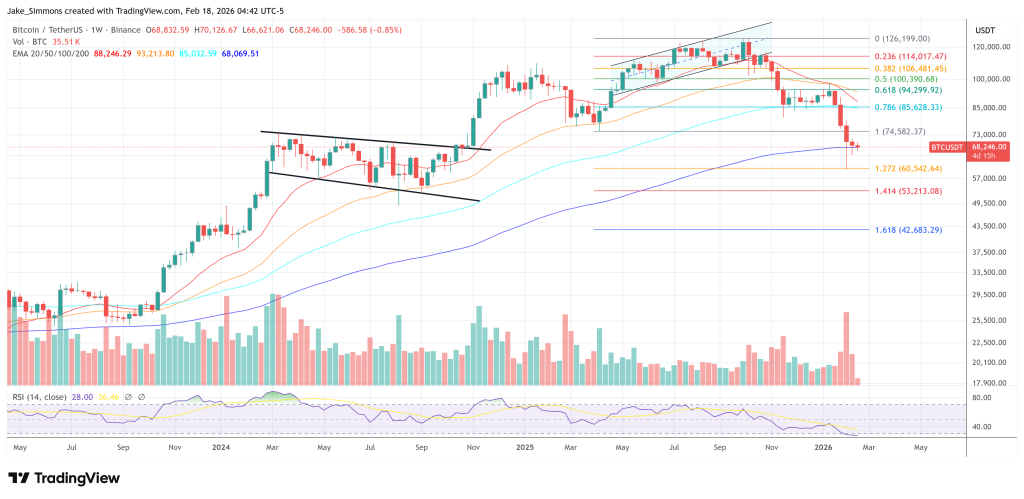
At press time, Bitcoin traded at $68,246.