This Single Chart Reveals When The Next Bitcoin Bull Run Will Ignite

Forget the crystal balls and Wall Street fortune tellers. The signal for Bitcoin's next explosive surge isn't hidden in a Fed statement—it's etched into a pattern playing out right now.
The Setup: Reading the Rhythm
Markets don't move at random. They breathe in cycles of accumulation and distribution, fear and greed. The chart capturing this rhythm for Bitcoin is flashing a sequence that veteran crypto watchers recognize. It's not about predicting a specific day on the calendar; it's about identifying the compression phase that historically precedes a violent expansion.
The Catalyst: More Than Just Halving Hype
While the quadrennial halving event acts as a programmed supply shock, the real fuel comes from the convergence. Institutional plumbing—ETFs, clearer regulatory frameworks—has been laid. Global liquidity tides are shifting. The chart suggests these macro waves are aligning with Bitcoin's internal clockwork, creating a potential energy build-up that rivals pre-2021 levels.
The Trigger: Watch For The Break
The key isn't to buy the rumor. It's to spot the moment the technical structure confirms the narrative. The chart points to a critical threshold: a sustained breakout above a key multi-year resistance band on significant volume. That's the match hitting the tinder—when hesitant capital floods in, chasing the first major green weekly closes.
Of course, traditional finance will claim they saw it coming all along—right after they finish downgrading the asset class for the third time this year. The chart, however, doesn't wait for permission. It just shows the door. Whether you walk through it is, as always, up to you.
What The Bitcoin Chart Tracks — And Why It Matters
In his post, Wedson presented a long-range chart built around the Long-Term Holder Net Unrealized Profit/Loss metric. The indicator measures the average unrealized gains or losses held by investors classified as long-term participants—wallets historically associated with stronger holding behavior and lower sell-side activity.
Related Reading: This Key Bitcoin Metric Signals That The Downside May Persist A Bit Longer
Rather than emphasizing short-term speculation, Wedson framed the metric as a lens into the financial condition of Bitcoin’s most resilient market cohort. According to the data shared, the current reading sits at 0.36. That level indicates long-term holders remain in aggregate profit, meaning their holdings, on average, are valued above acquisition cost.
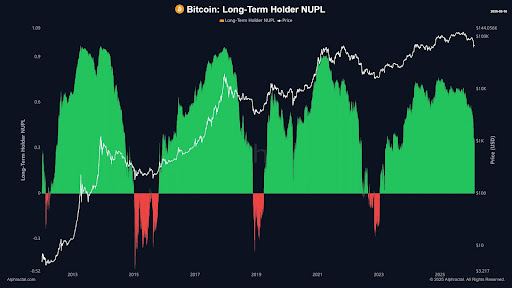
The chart visualizes this positioning through color-coded zones. Green regions represent periods where long-term holders hold unrealized profits. These phases have historically aligned with either late bull market environments or transitional consolidation ranges. The persistence of green, in Wedson’s presentation, signals that deep cycle stress has not yet fully materialized among conviction investors. By contrast, the most consequential signals in the chart appear when the metric shifts below zero.
When The Metric Turns Negative
Wedson’s analysis places primary emphasis on the moments when Long-Term Holder NUPL enters negative territory. In these intervals, even the most historically patient investors hold unrealized losses. The chart marks these periods in red, visually distinguishing them from profit-dominant phases.
Related Reading: Historical Pattern From 2017 Signals bitcoin price Crash To $35,000
Historically, those red zones have coincided with late bear-market conditions—periods characterized by widespread pessimism and compressed valuations. Wedson described this stage as one reflecting maximum market depression, where financial stress extends beyond speculative traders to reach long-term capital.
The chart’s historical mapping shows that these negative phases have preceded every major Bitcoin bull cycle. Each time the metric dropped below zero, it aligned with late-stage capitulation dynamics: seller exhaustion, reduced distribution pressure, and a transfer of coins toward entities with stronger holding capacity.
Within this framework, the red zone functions less as a signal of structural weakness and more as a reset phase. It marks the point where excess leverage and speculative positioning have been cleared, establishing conditions historically associated with cycle bottoms.
Wedson’s interpretation positions opportunity within these depression phases rather than during profit-heavy expansions. As illustrated in the chart, prior bull runs did not begin while long-term holders were comfortably in profit. They emerged after losses had permeated the cohort. With the metric still positive at 0.36, the chart suggests that, based strictly on historical precedent, the final capitulation preceding the next bull run has yet to occur.
