Zashi Reborn as Zodl: Zcash Wallet’s Dramatic Rebrand After Internal Split

Another day, another crypto rebrand—but this one comes with corporate drama baked right in. The Zcash ecosystem just watched one of its key wallets, Zashi, transform into Zodl following what insiders are calling a 'strategic divergence.' Translation? The team couldn't agree on the coffee machine, let alone the roadmap.
Behind the New Logo
Don't let the fresh paint fool you. This isn't some routine facelift. The shift from Zashi to Zodl signals a fundamental pivot in operational philosophy—and likely, a few heated boardroom exits. The wallet's core function remains: shielding your ZEC transactions from prying eyes. But the vision? That got a complete overhaul.
Why It Matters for Privacy Purists
For Zcash holders, a wallet is more than an app; it's a vault. This rebrand throws a spotlight on the fragile balance between development autonomy and ecosystem cohesion. When a key piece of infrastructure splits and reforms, users rightly ask: is my privacy stack still solid?
The move underscores a classic crypto tension—innovation versus stability. One faction pushes for aggressive new features; the other preaches maintenance and security. The result? A new name, a reset roadmap, and a community left parsing blog posts for clues.
Rebrand or Reboot?
Let's be cynical for a second. In traditional finance, a rebrand often follows a scandal or a sinking stock. In crypto, it's just Tuesday. Sometimes it's genuine evolution; sometimes it's a shiny wrapper on the same old tech. The real test for Zodl won't be its app store rating, but whether it can hold the team together long enough to ship its next update.
So, welcome Zodl. You've got the name, the logo, and the internal baggage. Now prove this was more than just corporate theater—because in the privacy game, trust is the only currency that really matters. And that's one thing you can't rebrand.
Zcash Wallet Zashi Renamed Zodl
In a post on X dated Feb. 16, the wallet team said the next app update will rename Zashi to Zodl “without impacting the user experience,” stressing there is “no action required” from users. “It’s a new brand for a new chapter, but everything else stays the same: the wallet, the team behind it, and our commitment to Zcash,” the announcement read. “We’re moving forward with clarity and purpose, and this change reflects the building momentum.”
The post also tied the rebrand to a broader organizational reset. “In January of this year, the entire Electric Coin Company (ECC) team, the original creators of Zcash and Zashi, left ECC and formed a new company,” it said, naming the new entity Zcash Open Development Lab (ZODL) and positioning Zodl as the “Zcash flagship wallet.” The team framed the move as a way to pursue growth “without reliance on the Zcash development fund,” while keeping continuity on shipping and support.
On mission, the wallet team used language that will be familiar to long-time Zcash followers, explicitly anchoring the product roadmap to privacy-first payments. “We envision a world without mass financial surveillance. A world where law-abiding people can transact freely and privately, without fear that their data will be exploited or weaponized,” the post said. “There is no sovereignty without privacy. Our banner has changed, but our mission has not.”
The immediate practical effect for users is limited: the same app is expected to update in place, with branding changes rolling out across channels, including the Discord support presence. The more consequential change is governance and ownership context: the wallet is now explicitly presented as a product of ZODL rather than ECC, after weeks of public dispute about who could control, finance, and potentially commercialize consumer-facing efforts around Zashi.
The Background Story
The break traces back to a late-2025 clash between ECC leadership and Bootstrap, the 501(c)(3) nonprofit that governs ECC. In early January, former ECC CEO Josh Swihart said board actions left the team no viable path inside the existing structure. “Unfortunately, decisions made by four of Bootstrap’s board members forced every person at ECC to exit the company, very quickly,” Swihart wrote on the Zcash Community Forum on Jan. 9. “I wish we hadn’t been forced to MOVE so quickly. But we had no choice. This is a serious matter. It is not a game. And as you see, the consequences, severe.”
Bootstrap, for its part, has argued the flashpoint was a proposed transaction to move Zashi into a for-profit structure and attract outside capital, which it says had to be handled as a related-party deal involving nonprofit-controlled assets.
In a public statement and accompanying timeline, Bootstrap described talks around external investment and “alternative structures to privatize Zashi” intensifying in late October 2025, then accelerating in December amid rushed deadlines, incomplete documentation, and legal constraints tied to nonprofit fiduciary duties. The timeline states that matters “rapidly escalated” around Dec. 20 when the board was presented with a Jan. 1 deadline to approve a deal, followed by leadership departures in early January and the broader team exit shortly after.
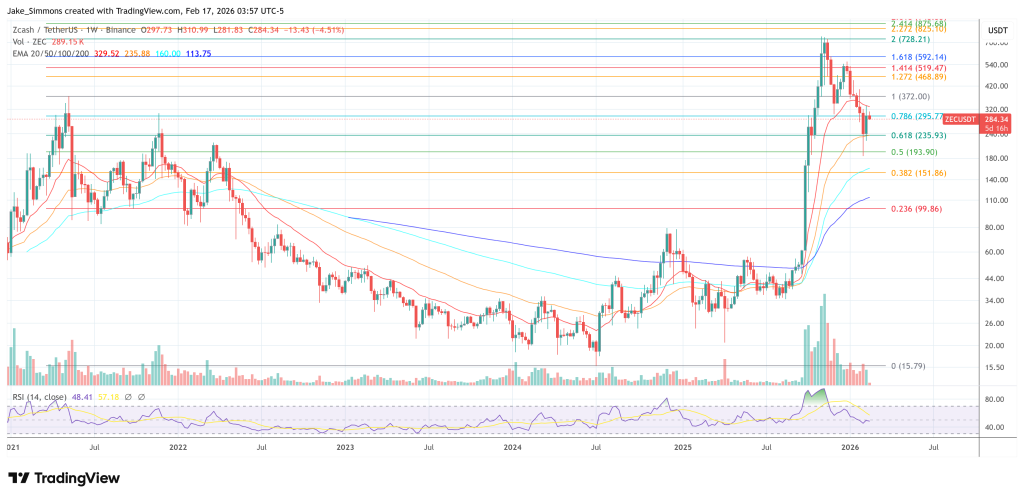
At press time, Zcash traded at $284.34.