Shiba Inu SOU Recovery System Goes Live After Shibarium Hack: The Comeback Protocol

Shiba Inu's new recovery protocol just flipped the script on crypto hacks. The SOU system—now live—isn't just patching holes; it's rebuilding the vault.
From Breach to Blueprint
Forget passive damage control. This framework creates a direct path to reclaim locked or stolen assets, bypassing the usual bureaucratic crawl. It cuts through the post-hack chaos with automated verification and asset redistribution—no committee votes, no multi-year legal tangles.
The Mechanics of Restitution
The system operates on a hybrid model. On-chain verification handles the transparent ledger work, while off-chain governance injects the necessary human judgment for edge cases. It's a technical tightrope walk between automation and oversight, all running on Shibarium's revamped infrastructure.
Why This Isn't Just Another Patch
Most projects slap a 'post-mortem' on a hack and call it a day. Shiba Inu's team built a new limb. The SOU protocol establishes a precedent: the network itself can become the first responder. It turns a point of failure into a core feature—security that actively recovers, rather than just alerting.
The cynical take? It's a brilliant move to restore what Wall Street would call 'investor confidence'—which is just a fancy term for convincing people their money won't vanish into a hacker's wallet. In crypto, sometimes the best marketing is a working safety net.
Final analysis: This launch does more than fix a past problem. It redefines the response playbook for the entire sector. The real test isn't if it works now, but if it sets a new, unforgiving standard that other chains will scramble to meet.
Shiba Inu ‘Shib Owes You’ Goes Live
That warning is now being replaced by a go-live announcement. Via X, the official Shiba Inu account wrote:
In Shib’s documentation, the system is framed as an attempt to make the recovery ledger public, auditable, and mechanically enforced rather than tracked in private databases. “SOU (Shib Owes You) is more than just a name; it is a commitment,” the docs say.“It represents the Shib ecosystem’s dedication to making users whole through a transparent, audited, and on-chain recovery system. Activity Notifications: The system provides a real-time activity feed, notifying the community whenever a new donation is received or a payout is distributed, ensuring complete visibility into the recovery progress.”
The mechanism hinges on two balances: “Original Principal,” the Immutable historical record of what a user lost, and “Current Principal,” which declines as payouts are claimed or contributions flow in. The docs also draw a hard distinction between debt repayment and incentives. “Payout” reduces principal as compensation, while a “Reward” is additive and “No Change” to the owed balance, positioning rewards as bonuses on top of repayment rather than substitutes.
SOU is also designed to be a financial instrument, not just a receipt. Claims can be merged or split to manage position sizing, transferred between wallets, or sold on marketplaces, effectively enabling a market in discounted claims for users who don’t want to wait for recovery flows.
Shib’s docs also describe a funding model that routes ecosystem revenues and community donations into a common pool, with donations applied proportionally across affected claims, and optional creator fees on secondary sales directed back to payouts or rewards.
The backdrop is the September 2025 Shibarium bridge incident, where Shib’s own security update said “unauthorized validator signing power” was used to push a malicious exit through the PoS bridge, enabling withdrawals of multiple assets.
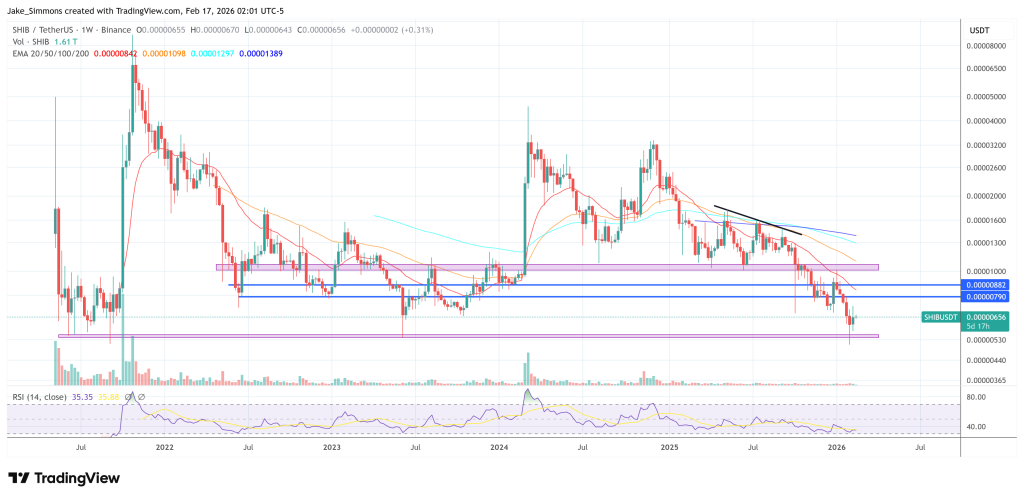
At press time, shiba inu traded at $0.00000656.