Ex-Ripple CTO Schwartz Drops Bombshell on Bitcoin Development – His Answer Will Shock You

Will the architect behind Ripple's tech stack turn his genius to Bitcoin? The crypto world held its breath for an answer—and got a response that cut through the noise like a laser.
The Straight Talk on Protocol Politics
Forget the corporate doublespeak. Schwartz didn't mince words. His stance on diving back into Bitcoin's codebase wasn't a maybe or a polished PR statement—it was a definitive, grounded assessment of where developer energy creates real value versus just headlines.
He bypassed the hype cycle entirely, focusing on the structural innovations that actually move the needle for users. It's a refreshing take in an ecosystem where every other project claims it's the next big thing—usually right before the token unlock.
Why This Matters for the Next Cycle
This isn't just about one developer's career path. It's a signal flare about where the smartest minds are placing their bets. When a builder of that caliber speaks, it's worth listening to what he's *not* saying about chasing legacy glory.
The real innovation, he hinted, isn't in rehashing old battles. It's in building the next layer—the infrastructure that makes digital assets seamless, secure, and stupidly simple to use. The kind of tech that makes traditional finance's clunky systems look like a museum exhibit.
So, will Schwartz develop Bitcoin again? The answer turned heads precisely because it reframed the question. The future isn't about worshipping the original prototype; it's about building what comes next. And sometimes, the most bullish move is to stop looking backward. After all, Wall Street still thinks a blockchain is something you buy at a hardware store.
Ex-Ripple CTO Schwartz Calls Bitcoin A ‘Tech Dead End’
Schwartz jumped in with a comparison that redirected the argument toward Bitcoin. “Bitcoin had at least two incidents that showed way more centralization than this incident did,” he wrote, “especially since the decision in this incident was not to make any coordinated changes and just live with it.”
That claim drew a follow-up from X user, who floated SegWit as a candidate for what Schwartz meant, an example of coordinated protocol change. The ex-Ripple CTO pushed back on that framing: “I wasn’t because I don’t really think of adding new features as showing centralization,” he replied. “But I think you could make a good argument that it does. The biggest one I was thinking of was the coordinated 2010 rollback.”
The thread’s tone shifted on Feb. 10 when X user Khaled Elawadi asked the question that put Schwartz’s own priorities in the spotlight: since co-creating the XRPL, had he worked on or even considered developing Bitcoin again?
“Not really,” Schwartz answered. Then he went further, sketching an argument that Bitcoin’s dominance owes less to the evolution of its base-layer tech than to social and monetary inertia. “I think bitcoin is largely a technological dead end for the same reason the dollar is,” he wrote. “The technology just doesn’t seem to matter all that much to its success, at least not at the blockchain layer.”
For XRP supporters, Schwartz’s comments served two purposes at once: a defense against charges that XRPL’s early history implies unique centralization, and a reminder that Bitcoin’s “hands-off” mythology also has had real-world exceptions in its early days.
What’s hard to miss is where the ex-Ripple CTO draws the line. Bitcoin’s success can persist even if base-layer technical progress slows, because the network’s strength increasingly behaves like a monetary standard rather than an engineering project. Schwartz is pursuing a different strategy for the XRP Ledger. After stepping down as Ripple CTO, he announced that he would pursue his own projects on the XRP Ledger.
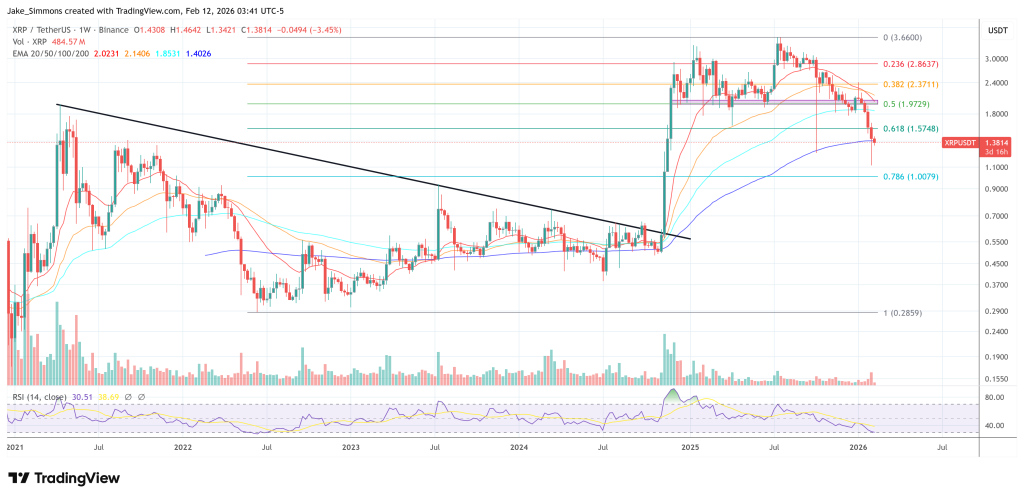
At press time, XRP traded at $1.38.