Analyst Reveals The Best Time To Buy Bitcoin And The Best Time To Sell

Timing is everything—especially when it comes to Bitcoin. A new analysis cuts through the noise, pinpointing the precise market phases for maximum entry and exit advantage.
The Buy Zone: When Fear Reigns
Forget trying to catch the absolute bottom. The optimal accumulation window opens when sentiment hits rock bottom—when headlines scream doom, social media goes quiet, and traditional finance pundits smugly declare crypto 'dead.' That's your signal. It's the moment when weak hands capitulate and long-term value becomes glaringly obvious to those who dare to look.
The Sell Signal: When Greed Takes Over
Conversely, the prime exit strategy activates amid euphoria. When your taxi driver starts giving you Bitcoin tips, memecoins are minting millionaires overnight, and 'to the moon' isn't just a meme but a widespread expectation. That's not the time to FOMO in; it's the time to strategically take profits. It's about selling to the latecomers who are convinced the party will never end—a classic move in any volatile asset class, digital or otherwise.
This framework bypasses emotional trading and targets cyclical extremes. It demands discipline, going squarely against the herd instinct that defines market tops and bottoms. After all, the real money isn't made following the crowd—it's made by anticipating its next move and having the stomach to act against it. Just remember, for every 'genius' trade, there's a hedge fund manager somewhere charging 2-and-20 for worse results.
The 1,066-Day Bull And 365-Day Bear Pattern
According to Tony, Bitcoin’s market cycles have followed a remarkably consistent structure over the past decade. Each major bull market has lasted roughly 1,066 days, followed by a bear phase of about 365 days.
The first example he highlights runs from January 8, 2015, to December 17, 2017, a 1,066-day expansion that ended NEAR the cycle peak. That was followed by a one-year decline into December 2018. The same pattern repeated from December 16, 2018, to November 10, 2021, another 1,066-day bull run, followed by a 365-day bear market into November 2022.
According to Tony, the current cycle is no different. The most recent bull market was dated from November 22, 2022, to October 6, 2025, right when Bitcoin reached a peak price of $126,080. Interestingly, this period once again totaled approximately 1,066 days.
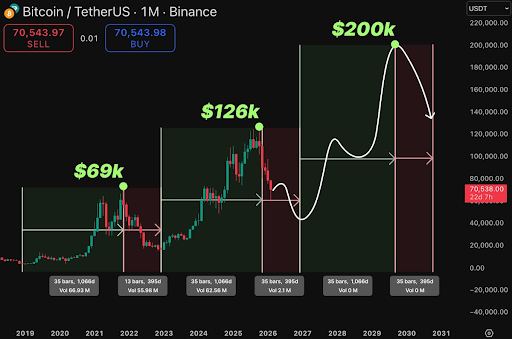
Keeping this cycle of bull and bear periods in mind, the subsequent bear phase, he suggests, should run from October 7, 2025, to October 5, 2026, completing another 365-day correction. This means Bitcoin could continue to trade in corrections of lower highs and lower lows until early October 2026. However, the timing is not perfect to the exact day, and there can be a 10- to 20-day variance to the predicted date.
The chart attached to his post, shown below, divides these cycles into green expansion zones and red correction phases. Previous peaks around $69,000 in 2021 and $126,000 in 2025 are marked clearly, with the projection being a MOVE to $40,000 and another return to $200,000 before the next red correction zone takes over.
Final Capitulation Could Still Be Ahead
In a separate post, Tony warned that the next major Bitcoin bottom may not yet be in place. The analyst projected further declines until Bitcoin enters into a strong support region between $40,000 and $50,000, with a potential bottom forming between mid-September and late November 2026.
He contrasted two emotional extremes in the analysis: early buyers celebrating perceived bargains during a falling market and later participants paralyzed by fear as the price reaches deep support.
At the time of writing, Bitcoin is trading at $66,950, sitting 47% below its October 2025 all-time high but still significantly above the $40,000-$50,000 identified as a potential final bottom zone. This projection means that Bitcoin could still fall further by 50% to 40% before it establishes a bottom.
