Bitcoin Realized Losses Dominate – Bear Market Pressure Intensifies

Bitcoin's realized losses are dominating the market—and the pressure is mounting.
When Paper Losses Become Real
Forget the paper hands. This is about cold, hard realized losses hitting the books. The metric that tracks the actual value of coins when they last moved is flashing red, signaling a wave of capitulation that's washing over the market. It's not just sentiment turning sour; it's capital walking out the door.
The Capitulation Engine
Every sell order at a loss fuels this engine. It creates a feedback loop of declining prices and eroding confidence. Long-term holders are starting to crack, and short-term traders are getting obliterated. The market isn't just correcting; it's purging excess from the last cycle—a painful but necessary reset. Volatility isn't a bug here; it's the main feature.
Navigating the Pressure Cooker
This intensity separates the speculative noise from foundational value. Projects without real utility won't survive this squeeze. For the rest, it's a brutal stress test. Infrastructure gets stronger, use cases get sharper, and the market's focus shifts from moon-shot promises to tangible progress. The hype cycle is officially over.
Remember, in traditional finance they call this 'price discovery.' In crypto, we just call it Tuesday. The bear market isn't whispering anymore; it's shouting. The only question left is who's still listening.
Realized Losses Signal Ongoing Market Stress
On-chain analysis shared by Darkfost highlights a notable deterioration in Bitcoin’s profit-to-loss dynamics. The realized profit-to-loss ratio currently stands near 0.25, meaning that for every $1 of profit realized on-chain, roughly $4 in losses are being locked in. Such a skewed balance reflects a market still processing recent drawdowns, where a significant portion of participants are exiting underwater positions rather than securing gains.

The seven-day moving average of this ratio is now approaching levels typically associated with bear market conditions. This shift suggests that short-term sentiment remains fragile and that selling pressure continues to dominate recent transaction flows. For context, the annual average ratio sits around 6.33, indicating that, over longer horizons, profit realization still outweighs losses due to the inertia embedded in yearly data.
Importantly, realized profits have recently begun to slightly exceed losses after several weeks of persistent deficit, hinting at tentative stabilization rather than confirmed recovery. Historically, periods characterized by panic selling or capitulation can extend for months, particularly during broader bearish phases.
For a durable recovery to emerge, this ongoing purge of weaker hands must likely conclude, allowing unrealized profits to rebuild and restore investor confidence.
Bitcoin Price Tests Key Support After Sharp Breakdown
Bitcoin’s recent price structure reflects a clear deterioration in momentum, with the asset now struggling around the $68,000–$70,000 region after a sharp decline from late-2025 highs. The chart shows a decisive breakdown below intermediate support levels that had previously held during consolidation phases, confirming a transition from corrective pullback to a more pronounced bearish trend.
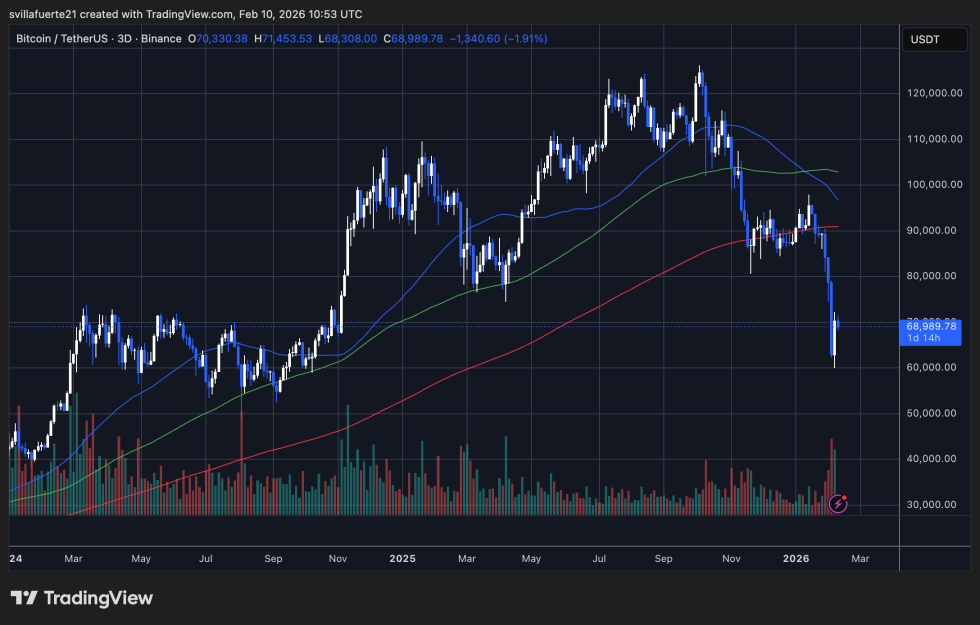
Price action has also slipped below the short- and medium-term moving averages, both of which are now sloping downward. This configuration typically signals sustained selling pressure rather than a temporary retracement. Meanwhile, the longer-term moving average continues to flatten, suggesting that macro trend support has not yet fully failed but is increasingly under threat.
Volume behavior adds another LAYER of caution. The latest selloff was accompanied by a noticeable increase in trading activity, often interpreted as distribution rather than passive drift lower. Such spikes frequently appear during liquidation cascades or institutional repositioning.
From a technical standpoint, the $60,000–$65,000 range now stands out as the next critical demand zone. Holding above this region could stabilize sentiment and allow for consolidation. Failure to defend it, however, WOULD likely confirm deeper bear-market continuation rather than a simple correction phase.
Featured image from ChatGPT, chart from TradingView.com
