Solana’s Fee Advantage Crushes Base, BNB, and Polygon—And It’s Launching SUBBD to New Heights

Transaction costs are collapsing across the blockchain landscape, and one network is leading the charge. Solana's relentless drive toward near-zero fees isn't just a feature—it's a strategic weapon. Layer-2 solutions and established alt-L1s are now scrambling to justify their own cost structures as users and developers vote with their wallets.
The Fee War Heats Up
Forget incremental improvements. The competition is now a bare-knuckle brawl for the lowest possible cost-per-transaction. This isn't about shaving pennies; it's about creating an economic environment where micro-transactions, high-frequency trading, and massive scalability aren't just possible, but trivial. Networks that can't keep up risk becoming digital ghost towns—expensive relics in a cheap-compute world.
Fueling the Next Wave
This low-fee environment acts like rocket fuel for new tokens and ecosystems. Projects built on cost-efficient chains gain an immediate adoption advantage, bypassing the friction that has stifled innovation elsewhere. It turns speculative assets into usable tools, fostering utility that outlasts mere hype cycles. The narrative is shifting from 'number go up' to 'costs go down, usage goes up.'
A New Breed of Competition
The old guard can't rest on their laurels. When the baseline cost of operation approaches zero, the competitive battlefield changes entirely. It's no longer just about security or decentralization on paper—it's about delivering those things at a price point that doesn't make users wince. The race is won by the chain that makes its technology feel invisible and its economics irresistible.
In the end, the market has a cynical way of cutting through the jargon: the best technology is often the one you can afford to use without thinking about it—a novel concept in an industry that loves to overcomplicate and overcharge. Solana's push is forcing everyone else to either adapt or watch their margins—and their relevance—evaporate.
 Solana’s sub-cent transaction fees are forcing competitors like Base and Polygon to accelerate efficiency upgrades to retain retail liquidity.
The market demand for low friction is shifting from DeFi trading to the $191B creator economy, where Web2 platforms charge up to 70% fees. SUBBD Token leverages AI and Web3 infrastructure to minimize platform fees and automate creator workflows, having raised over $1.47M in its ongoing presale. The convergence of AI tools (voice cloning, assistants) with crypto payments represents the next evolution of digital content monetization.
Solana’s sub-cent transaction fees are forcing competitors like Base and Polygon to accelerate efficiency upgrades to retain retail liquidity.
The market demand for low friction is shifting from DeFi trading to the $191B creator economy, where Web2 platforms charge up to 70% fees. SUBBD Token leverages AI and Web3 infrastructure to minimize platform fees and automate creator workflows, having raised over $1.47M in its ongoing presale. The convergence of AI tools (voice cloning, assistants) with crypto payments represents the next evolution of digital content monetization.The battle for blockchain dominance isn’t just about theoretical throughput anymore; it’s about the tangible reality of user costs. And right now, solana is dictating the pace.
Recent on-chain data shows that Solana’s average transaction fee remains consistently below $0.001, often hovering NEAR $0.00025 for non-priority transactions. That creates immense pressure on competing ecosystems like Base, BNB Chain, and Polygon. It’s essentially forcing a ‘race to the bottom’ regarding cost efficiency.
Sure, Base (Coinbase’s Layer-2) saw fees drop significantly following the ethereum Dencun upgrade. But network congestion can still spike costs to $0.05 or higher during peak retail activity.
Similarly, while BNB Chain and Polygon are cheap compared to Ethereum mainnet, they often struggle to match the sub-cent consistency of Solana’s monolithic architecture. Why does this matter? Because retail liquidity flows where friction is lowest. If a user can swap a token for a fraction of a penny on Solana versus paying five to ten cents elsewhere, those aggregate savings drive volume.
But the demand for reduced friction extends beyond simple token swaps. We’re seeing a capital rotation toward utility-driven platforms that solve ‘fee fatigue’ in other sectors, particularly the digital content economy. Just as traders flock to Solana to escape DeFi gas fees, content creators are hunting for alternatives to Web2 platforms that charge exorbitant commission rates.
This search for economic efficiency is driving interest toward decentralized apps merging AI utility with better monetization. That’s creating a serious tailwind for new entrants like SUBBD Token ($SUBBD).
Read more about $SUBBD here.
AI-Driven Monetization And The Fight Against 70% Fees
The disconnect between creator output and income retention has hit a wall. Legacy Web2 platforms frequently deduct between 20% and 70% of a creator’s earnings.
That’s a ‘platform tax’ making blockchain gas fees look negligible by comparison. SUBBD Token ($SUBBD) aims to disrupt this $191B industry by applying crypto’s low-friction philosophy to content monetization.
Operating as an ERC-20 token on Ethereum, SUBBD uses EVM-compatible smart contracts to replace intermediaries with code. But it’s not just a payment rail. The platform integrates proprietary AI models, including automated personal assistants, voice cloning, and object recognition, to streamline workflows.
The project offers a tech stack allowing influencers to create ‘AI versions’ of themselves to interact with fans 24/7. It effectively solves the scalability problem for humans (who, unlike bots, need sleep).
From a tokenomics perspective, integrating AI represents a major shift. By allowing creators to token-gate exclusive content and use AI tools for optimization, SUBBD lowers the barrier to entry while raising the revenue ceiling. Of course, the risk is execution; the platform must ensure its AI tools are intuitive enough for non-crypto natives.
But the value proposition is clear: creators keep more of what they earn, mirroring the efficiency users seek in high-performance blockchains.
Check out the $SUBBD presale here.
Presale Data Signals Appetite For Creator Economy Disruption
Traders are watching the SUBBD Token presale as a gauge for sentiment on the AI-Web3 convergence.
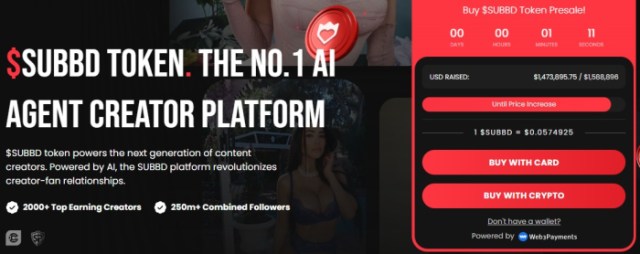
According to live data, the project has raised exactly $1.47M, a sign of steady accumulation despite broader market volatility. With tokens priced at $0.057495, early participants are positioning themselves before the platform fully deploys its mainnet features.
The staking architecture seems designed to encourage long-term holding rather than mercenary capital rotation. SUBBD offers a fixed 20% APY for the first year to users who lock their tokens. But it’s not just about yield.
Staking unlocks tangible utility: access to exclusive livestreams, ‘behind the scenes’ (BTS) drops, and XP multipliers that enhance platform standing. This gamified approach to liquidity retention suggests the team is prioritizing community stability over short-term hype.
In previous market cycles, utility tokens launching with functional ecosystems, rather than just roadmap promises, have tended to outperform during recovery phases. With the presale progressing, the focus shifts to the rollout of the ‘HoneyHive’ governance features and onboarding the first cohort of AI-driven influencers.
For investors tired of high-fee structures in both DeFi and Web2, SUBBD presents a logic-driven alternative.
Buy $SUBBD here.
This article is for informational purposes only and does not constitute financial advice. Cryptocurrencies are high-risk assets. Always perform your own due diligence before investing. The views expressed here are those of the author and do not necessarily reflect the official policy of any financial institution.
