Bitcoin’s Macro Cycle Durations: The Critical Timelines Every Investor Must Master

Bitcoin's clock ticks differently. Forget quarterly earnings—this asset dances to a rhythm measured in years, not fiscal periods. Understanding its macro cycles isn't just smart; it's survival.
The Four-Year Halving Pulse
Every 210,000 blocks—roughly four years—Bitcoin's code executes a programmed scarcity event. The block reward halves. New supply gets cut, historically igniting a new macro uptrend. It's a schedule written in cryptography, bypassing central bank printers and boardroom whims.
Bull Market Runway: From Accumulation to Euphoria
Post-halving, markets don't flip a switch. A prolonged accumulation phase—often 12-18 months of sideways grind—builds the foundation. Then the breakout. The ensuing bull run typically lasts a similar duration, climbing a wall of worry before peaking in a frenzy of mainstream headlines. Timing this isn't about day-trading; it's about recognizing seasonality.
Bear Market Contraction & The Crypto Winter
Peaks are followed by steep corrections. Drawdowns of 70-80% are not bugs; they're features of this volatile asset class. The subsequent bear market or 'crypto winter' can last over a year, shaking out weak hands and resetting leverage. This is where portfolios are truly built—while traditional finance pundits write their obituaries for the thousandth time.
Full Cycle Symphony
String these phases together. A complete macro cycle—from one halving to the next, through bull and bear—spans that pivotal four-year duration. It's the master timeframe, the metronome for strategic capital allocation. It demands patience most Wall Street funds don't possess, locked as they are in their own cycles of bonus chasing and window dressing.
Master these durations. They won't give you a perfect entry, but they'll frame the war, not the battle. While traditional markets obsess over basis points and Fed whispers, Bitcoin's epochal clock keeps ticking—offering a stark, volatile, and potentially generational alternative to the endless treadmill of fiat finance.
Bitcoin Macro Cycles Reveal Recurrent Pattern
Bitcoin’s macro cycles have often served as a historical blueprint for a typical 4-year cycle. Over the years, BTC has formed key patterns and cyclical movements that serve as a foundation for interpreting current market conditions and, to some degree, tracking future price action. Against this backdrop, pseudonymous crypto analyst Rekt Fencer has unveiled a chart analysis, highlighting historical Bitcoin macro durations that reveal a consistent repeating structure that could help anticipate the cryptocurrency’s next major move.
Rekt Fencer’s analysis dates back to the 2015-2017 bull cycle, when Bitcoin experienced its first major expansion phase, driven by global awareness and growing participation among early investors. The chart showed prices accelerating steadily over 1,064 days from January 12, 2015, before reaching a euphoric peak on December 11, 2017. Bitcoin had risen from roughly $160 to over $12,500 at the time, setting the stage for the market’s first large-scale bear trend.
The 2017- 2018 bear market reflected the aftermath of speculative excess, as investor sentiment shifted rapidly from Optimism to caution. Over roughly 364 days, Bitcoin retraced much of its gains, dropping below $3,950 and hitting a bottom.
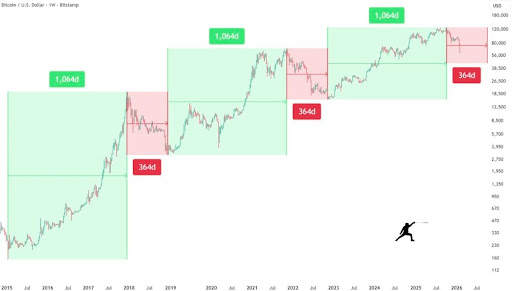
During the 2018 to 2021 bull cycle, Bitcoin experienced a more mature, institutionally driven rally lasting approximately 1,064 days. This period saw the leading cryptocurrency gain mainstream financial recognition and widespread adoption. The HYPE during this cycle had pushed BTC’s price from under $3,950 on December 10, 2018, to a former ATH of over $60,000 on 8, November 2021.
The bear market that followed this cycle lasted approximately 364 days, from November 8, 2021, to November 7, 2022. This downturn followed a series of high-profile crypto company failures and a shift in sentiment that led to Bitcoin declining below $18,500 from its ATH.
The major factor that stands out in Rekt Fencer’s analysis is the consistency in the duration of Bitcoin’s market phases. Each bull cycle ran for 1,064 days, followed by a 364-day correction. Building on this pattern, the analyst suggests that the current cycle may unfold along a similar timeline.
Where The Market Is In The Current Cycle
Based on Rekt Fencer’s chart, the 2022 to 2025 bull cycle has officially ended and is now in its bear market phase. The cycle also lasted 1,064 days, with the BTC price crossing $126,000 on October 6, 2025. Now that the cryptocurrency is in a bear market, Rekt Fencer predicts it could also run for 364 days from October 6, 2025, to October 5, 2026. During that time, BTC is projected to reach a bottom near $38,500, marking a roughly 40% decline from current levels above $69,000.
