Bitcoin Hyper Could Conquer 2026: The Comeback Narrative Takes Hold

Bitcoin's next act isn't about recovery—it's about conquest. The narrative has flipped. After a brutal cycle that saw the flagship asset shed trillions in market cap, the stage is set for a hyper-charged resurgence. Forget regaining lost ground; the focus has shifted to capturing new territory entirely.
The Engine of Speculation
Institutional pipes laid during the last bull run are primed. Spot ETFs, once a regulatory pipe dream, now funnel traditional capital directly on-chain. This isn't 2021's retail frenzy. It's a more calculated, capital-heavy inflow that bypasses the old gatekeepers—a direct shot to the heart of legacy finance, which is still busy rehypothecating the same tired assets.
Network Fundamentals Hit Hyperdrive
The underlying protocol didn't sit still. Layer-2 solutions slashed settlement times from minutes to milliseconds. The hash rate, that relentless metric of network security, printed new all-time highs even during the bear market's depths. Developer activity never waned. The infrastructure built in the quiet years now forms a launchpad capable of supporting velocity previously thought impossible.
A Macro Powder Keg
External catalysts align. Persistent inflation erodes faith in central bank balance sheets. Geopolitical fractures push capital toward neutral, borderless networks. The debt ceiling? Just another political football in a game of monetary musical chairs. Bitcoin's fixed supply schedule starts to look less like a quirky feature and more like a life raft in a sea of currency debasement.
The Path to Conquest
Conquering 2026 doesn't mean a simple return to an old price peak. It means establishing a new, higher baseline of utility and valuation. It means on-chain activity sustaining levels that validate the 'digital gold' and 'global settlement layer' theses simultaneously. Watch for derivatives markets maturing, physical asset tokenization ramping up on Bitcoin-based protocols, and that cynical old metric—adoption by nation-states—moving from novelty to trend.
The window is open. The infrastructure is live. The monetary policy is immutable. All that's left is for the market to realize the ground wasn't lost—it was merely preparing for a larger war. The old guards of finance are placing their bets on a rigged table; Bitcoin is building a new one.
 Bitcoin Hyper combines Bitcoin’s security with the speed of the Solana Virtual Machine (SVM), addressing the critical need for scalable Bitcoin DeFi.
The project has demonstrated massive market interest, raising $31.3M in its ongoing presale with tokens priced at $0.0136754. On-chain data highlights significant whale accumulation, including a single $500K purchase on Jan 15, 2026, signaling institutional confidence. By solving the “programmability gap,” Bitcoin Hyper aims to recapture capital that has historically migrated to Ethereum and Solana.
Bitcoin Hyper combines Bitcoin’s security with the speed of the Solana Virtual Machine (SVM), addressing the critical need for scalable Bitcoin DeFi.
The project has demonstrated massive market interest, raising $31.3M in its ongoing presale with tokens priced at $0.0136754. On-chain data highlights significant whale accumulation, including a single $500K purchase on Jan 15, 2026, signaling institutional confidence. By solving the “programmability gap,” Bitcoin Hyper aims to recapture capital that has historically migrated to Ethereum and Solana.Bitcoin is fighting a multi-front war. While institutional flows via ETFs have stabilized the asset class, the battle for dominance in 2026 is being fought on entirely different terrain: utility.
As of late 2025, bitcoin is struggling to reclaim the critical $98,000 level after a sharp correction, leaving traders questioning if the cycle has peaked. But price action only tells half the story.
The real ‘lost ground’ isn’t just market cap. It’s the hundreds of billions in decentralized finance (DeFi) activity that has migrated to ethereum and Solana because of Bitcoin’s inherent programmability limits.
This matters (a lot) because history suggests capital rotation follows innovation. When Bitcoin stagnates, liquidity hunts for yield in high-performance ecosystems. But a new infrastructure layer is emerging to challenge that dynamic. By bringing smart contract capabilities directly to the world’s most secure blockchain, Layer 2 solutions are attempting to unify Bitcoin’s liquidity with Solana’s speed.
Leading this charge is Bitcoin Hyper ($HYPER). By integrating the solana Virtual Machine (SVM) as a Layer 2 on Bitcoin, the project aims to recapture the market share Bitcoin has historically ceded to faster chains. With over $31.3M raised in its presale, the market is signaling a serious appetite for this hybrid approach.
Read more about $HYPER here.
The SVM Advantage: Why Smart Money is Watching
The core value proposition of Bitcoin Hyper lies in a specific architectural choice: utilizing the Solana Virtual Machine (SVM) for execution while relying on Bitcoin Layer 1 for settlement. This isn’t just a technical upgrade; it’s a fundamental shift in how capital can be deployed on Bitcoin.
Traditional Bitcoin transactions are secure but notoriously slow and expensive, often costing upwards of $5–$10 during congestion. In contrast, the SVM architecture allows for sub-second finality and transaction costs that are fractions of a cent.
For developers, this solves the ‘scalability trilemma’ without abandoning Bitcoin’s security guarantees. The project features a Decentralized Canonical Bridge, allowing users to transfer $BTC seamlessly into a high-speed environment for DeFi protocols, NFT platforms, and gaming dApps.
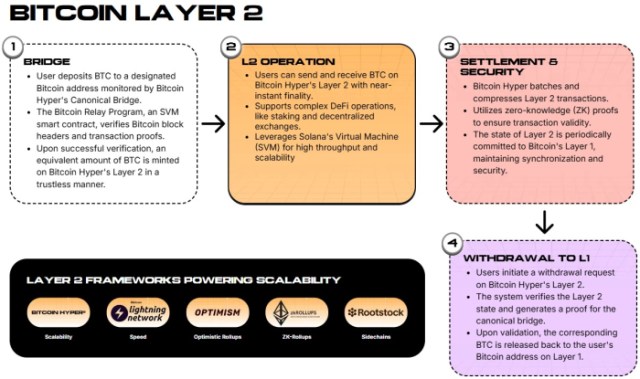
Unlike previous attempts to scale Bitcoin that relied on complex sidechains, Bitcoin Hyper offers a developer experience compatible with Rust, the language powering Solana’s thriving ecosystem.
The risk? Execution. Bridging assets between a Turing-incomplete chain like Bitcoin and a high-performance environment is technically demanding. However, if the team pulls it off, this modular blockchain approach, separating execution (L2) from settlement (L1), could unlock trillions in dormant Bitcoin capital.
As technical analysts have noted, this infrastructure is critical for Bitcoin to MOVE beyond a ‘store of value’ and become a productive asset in the 2026 economy.
Check the $HYPER presale.
Whale Activity Signals Confidence in the $HYPER Presale
While the broader market remains cautious, specific smart money actors are taking aggressive positions in infrastructure plays. On-chain data reveals significant accumulation for Bitcoin Hyper (view whale transaction).
According to recent records, two whale wallets have accumulated a total of $1M+ in $HYPER tokens. The biggest splash came on Jan 15, 2026, when a single wallet executed a purchase of $500K. This suggests high-net-worth individuals are positioning themselves ahead of the token generation event (TGE), likely anticipating the demand for a functional Bitcoin L2.
The financial metrics back up this bullish outlook. The project has raised an impressive $31.3M to date, a figure that stands out even in a crowded market. With the current token price set at $0.0136754, the valuation remains accessible compared to established L2s like Stacks or Optimism.

For retail investors, the staking incentives offer an additional LAYER of yield. Although the specific APY fluctuates, the protocol offers immediate staking after TGE with a short 7-day vesting period for presale participants. This structure encourages long-term holding rather than quick flips.
Investors should watch the timing here. As Bitcoin attempts to regain its lost ground above key resistance levels, the narrative is shifting toward ‘Bitcoin DeFi.’ Projects that can successfully deploy high-speed applications on Bitcoin are poised to capture the overflow of liquidity.
Bitcoin Hyper is positioning itself not just as a participant in this trend, but as the primary infrastructure layer enabling it. Join the $HYPER presale here.
Buy $HYPER here.
The content provided in this article is for informational purposes only and does not constitute financial advice. Cryptocurrency investments carry inherent risks, including market volatility and regulatory uncertainty. Always conduct your own research before investing.
