Bitcoin’s Quantum Risk Is Smaller Than Feared, New Research Reveals

Forget the quantum doomsday scenarios—Bitcoin's armor might be tougher than we thought.
Quantum computers are coming. That much is certain. Wall Street quants and crypto skeptics alike have long pointed to these machines as Bitcoin's ultimate kill switch—a technology that could crack its cryptographic foundations like a walnut. But fresh analysis suggests the alarm bells are ringing too soon, and too loudly.
The Real Timeline for a Quantum Threat
It's not that the threat isn't real. The SHA-256 and ECDSA cryptography securing Bitcoin today would, in theory, be vulnerable to a sufficiently powerful quantum machine. The key word? Sufficiently. Researchers are now arguing that the computational power needed to mount a practical attack is staggeringly high—far beyond what's on any near-term horizon.
By the time quantum tech advances to that red-alert level, the Bitcoin network won't be sitting idle. Expect a coordinated, community-driven cryptographic upgrade—a 'fork' to quantum-resistant algorithms. The network has performed similar emergency surgeries before. It's built for this.
A Network, Not Just a Codebase
This is where critics often miss the point. They see a static protocol. Practitioners see a dynamic, adaptive organism. The true security of Bitcoin lies as much in its decentralized human network as in its mathematics. That network has billions in economic incentive to protect itself. Talk about skin in the game—try the entire market cap.
The bigger, more immediate risk isn't a sci-fi computer. It's the same old human frailties: poor key management, centralized exchanges acting like casinos, and the endless parade of 'trust-me' altcoins that wouldn't need a quantum attack to collapse—a stern tweet usually does the trick.
So, while traditional finance dabbles in quantum-resistant blockchain pilots for settlement (a solution in search of a problem, some might say), Bitcoin's path is clearer. Adapt, upgrade, and continue bypassing the middlemen. The quantum scare is just another bump on the road to digital sovereignty—and a handy reminder that in crypto, the loudest fears are often the most profitable to sell.
Public Keys Expose A Small Slice
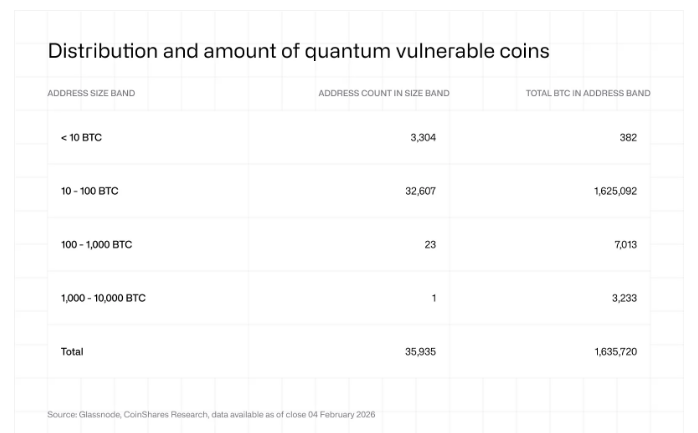
Reports say that only 10,230 BTC sit in addresses where public keys are already visible, and that changes the math. Those coins WOULD be the easiest targets if a powerful quantum machine appeared.
Around 7,000 BTC sit in mid-size wallets holding between 100 and 1,000 coins. About 3,230 BTC live in larger addresses holding between 1,000 and 10,000 coins.
At today’s values that stake is worth several hundred million dollars. That’s big money, but it’s not the same as a collapse of the protocol. An aggressive theft of that size would look like a heavy trade or a major security incident, not a network failure.
Quantum Hardware Still Falls Short
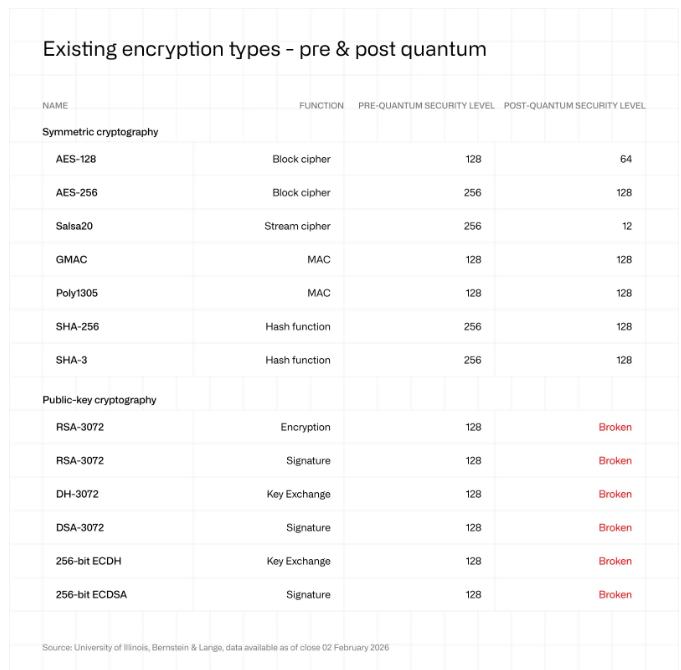
According to experts, the algorithmic threat is straightforward: Shor’s algorithm would attack elliptic-curve signatures and Grover’s algorithm would weaken SHA-256 hashing.
But reports note a huge gap between experiment and attack. Current machines run at a little over 100 qubits in experimental setups. An effective break would need millions of stable, error-corrected qubits.
That kind of hardware has not been built. In short: the math shows a possible route, but the engineering is far from ready.
Many of the more exposed addresses date back to Bitcoin’s early days and contain coins that have never moved. That makes them special. When those keys were first used, best practices were different.
Now, those same keys are a known point of weakness if quantum computing power ever arrives. Movement of those coins would be messy. Custodians, exchanges, and individual holders would all need to coordinate.
A technical fix could be proposed and adopted. The hard work would be getting people to update software and migrate keys before any real danger materializes. That is a logistics problem more than a cryptography puzzle.
According to Andreas Antonopoulos, a well-known Bitcoin and cryptocurrency expert, the threat is real but distant; he urges preparation rather than alarm.
British cryptographer Adam Back has said planning can happen in an orderly way, and panic is unnecessary so long as steps start now.
Those views line up: upgrade paths should be designed, wallets must discourage key reuse, and the community should test migration procedures.
If action is taken early, there’s ample room to make the shift without rushing or breaking systems.
Featured image from Crypto Valley Journal, chart from TradingView
