Bitcoin Miners Breathe Easy: 13% Difficulty Drop Incoming - Major Relief Ahead

Bitcoin's next adjustment isn't just a tweak—it's a lifeline. The network's mining difficulty is poised for a significant downward shift, slashing the computational effort required to secure new blocks.
The Mechanics of Relief
This isn't random generosity from the protocol. It's a core feature of Bitcoin's self-regulating design. When miner participation drops—whether from energy price spikes, hardware obsolescence, or pure profit squeeze—the algorithm responds. It cuts the difficulty to keep block times near that sacred ten-minute target. This time, the cut is a hefty 13%.
Implications for the Hashrate Landscape
For miners on the edge, this adjustment transforms the economics. Operations that were barely breaking even suddenly see margins expand. It incentivizes older hardware to stay online and can lure back sidelined capacity. The network's total security—its hashrate—finds a new, more sustainable equilibrium. Think of it as the protocol's version of quantitative easing for its workforce, minus the central bank theatrics.
A Cyclical Respite, Not a Permanent Fix
Don't mistake this for a permanent subsidy. The relief is real but temporary. As profitability improves, more miners jump back in, competition rises, and the difficulty inevitably ticks back up in the next epoch. It's a built-in boom-bust cycle for the infrastructure layer—brutally efficient and utterly indifferent to individual fortunes. It's the free market at its most visceral, operating on a two-week feedback loop that would give any traditional CFO heart palpitations.
The bottom line? The machines get a break, the network stays secure, and the show goes on. Just another day in the world's most unforgiving—and self-correcting—accounting system.
Bitcoin Difficulty Is Estimated To Go Down 13% During The Next Adjustment
The Bitcoin “Difficulty” is a metric built into the blockchain that controls how hard miners will find it to mine the next block on the network. This indicator’s value automatically changes roughly every two weeks, based on the speed at which miners performed their task since the previous adjustment.
The next such adjustment is scheduled to occur tomorrow, February 6th. According to data from CoinWarz, the network will reduce the Difficulty during this event.
How the blockchain determines whether to increase or decrease the Difficulty is simple: it tries to bring block time back to the standard 10 minutes that Satoshi coded in for the network to follow. Whenever miners produce the average block in a time faster than this, the network responds by raising its Difficulty just enough that miners take 10 minutes between each block again. Similarly, the validators being slow forces BTC to ease the metric.
Since the last adjustment, the average block time has stood at 11.52 minutes, which is much slower than the expected value. As a result of this, Bitcoin is estimated to reduce its Difficulty by a massive 13% during the Saturday adjustment.
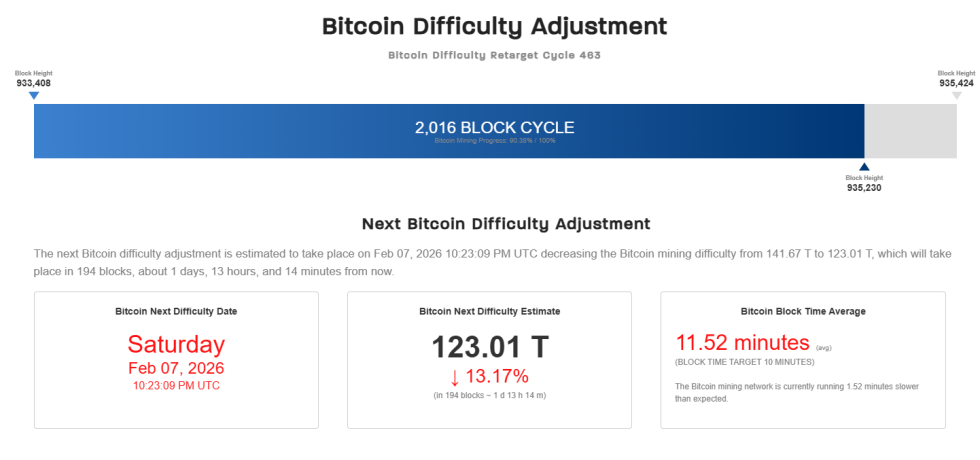
The reason for the drastic change in Difficulty lies in the crash that the Bitcoin Hashrate has witnessed recently. The “Hashrate” is an indicator that measures the total amount of computing power that miners as a whole have connected to the network.
As data from Blockchain.com shows, this metric’s 7-day average value has observed a sharp decline since January 24th.
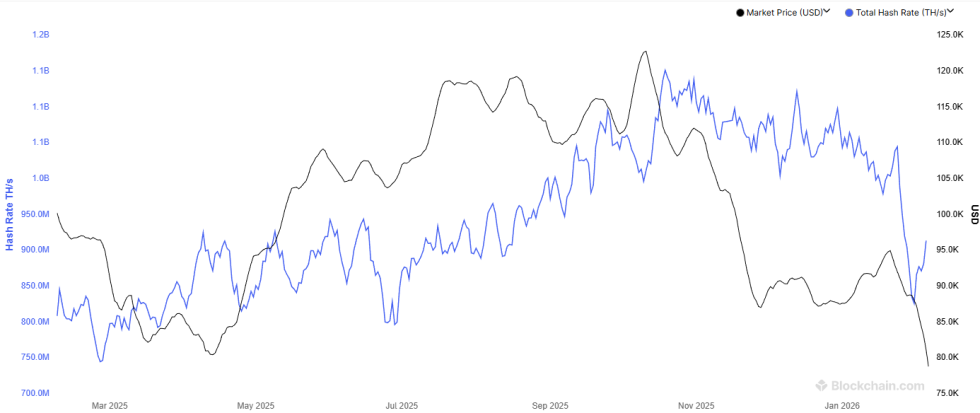
On January 24th, the 7-day average Bitcoin Hashrate stood at 1,044 exahashes per second (EH/s). By the end of the month, that value had dropped to just 825 EH/s. This was an unusually rapid drawdown for the indicator, and it indeed had an unusual cause behind it: the US snow storm.
The winter storm disrupted various parts of the nation’s infrastructure, including power. To ease pressure on the grid, American Bitcoin miners curtailed their electricity consumption, which led to Foundary USA, the largest mining pool in the world, witnessing a Hashrate drop of nearly 60%.
In February so far, the US miners have started to bounce back, with the global 7-day average Hashrate returning to 913 EH/s. The decline in the Hashrate only being temporary doesn’t matter to the Difficulty, however, since the network only considers the average block time from the last two weeks.
The fact that the miners produced blocks at a slow rate during this window is already set in stone, so the Bitcoin network has no option other than reducing the Difficulty in the next adjustment.
BTC Price
Bitcoin plummeted all the way down to $60,000 on Thursday, but the cryptocurrency has since bounced back as it’s now trading around $69,300.
