Analysts Warn Bitcoin May Face Further Downside After Major Sell‑Off - Here’s Why This Could Be Your Buying Window

Bitcoin just got rocked—and the charts suggest more pain ahead. A brutal sell-off slammed the digital asset this week, wiping out billions in market value and leaving traders scrambling for cover. Technical indicators flash red, sentiment tanks, and analysts whisper about deeper corrections. But beneath the panic lies opportunity.
The Fear & Greed Index Plummets
Market sentiment flipped from greedy to fearful overnight. Social media chatter turned doom-laden, leveraged positions got liquidated, and the usual chorus of 'to the moon' went silent. This isn't just a dip—it's a full-blown sentiment reset. Smart money watches these moments, knowing extreme fear often precedes major rallies.
Technical Breakdown Signals Trouble
Key support levels shattered like glass. The price sliced through moving averages that held firm for months, triggering automated sell orders and creating a cascade of downward pressure. Chart patterns now suggest a test of lower bounds is imminent. Every bounce gets sold—a classic bear market signal.
The Institutional Whisper: Accumulation Phase
While retail investors panic-sell, on-chain data tells a different story. Large wallet addresses—the so-called 'whales'—are quietly accumulating. Exchange outflows spike as coins move to cold storage, suggesting long-term holders see value at these levels. It's the old Wall Street playbook: buy when there's blood in the streets, even if that street is now digital.
Macro Winds Turn Chilly
Traditional finance tremors always ripple into crypto. Rate hike fears, inflation data, geopolitical tensions—Bitcoin hasn't decoupled from macro reality yet. When risk assets sneeze, crypto catches pneumonia. The sell-off wasn't isolated; it was part of a broader risk-aversion play that hit tech stocks and speculative assets hardest.
Why This Might Not Be The End
History rhymes. Bitcoin has survived worse drawdowns—80%, 90% even—and always found new highs. Network fundamentals remain strong: hash rate holds near all-time peaks, developer activity continues, and adoption metrics tick upward. Price action is emotional; the protocol is mechanical. They rarely stay disconnected for long.
The bottom line? Volatility isn't a bug—it's a feature. Today's panic creates tomorrow's profit. Just ask anyone who sold during the last 'crypto winter' only to watch prices 10x during the next cycle. The herd is usually wrong at extremes. Sometimes the best trade is to do the opposite of whatever CNBC anchors are hyperventilating about.
Crypto Winter Fears Grow
In comments shared with Fortune, Jefferies analyst Andrew Moss, the downturn is being fueled largely by selling from major holders. In a note to clients, Moss said that large bitcoin investors, commonly referred to as whales, have been offloading their positions into market weakness.
He noted that these holders shifted to net sellers over the weekend after steadily accumulating Bitcoin since early January, suggesting a significant change in market behavior at the top end of ownership.
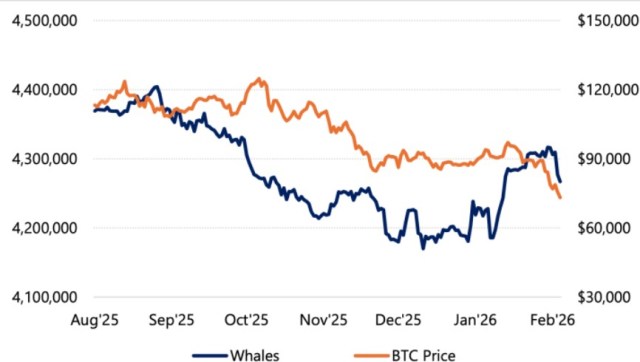
Selling pressure has also emerged from retail investors who gained exposure to Bitcoin through spot exchange‑traded funds (ETFs). Moss pointed out that net outflows from spot Bitcoin ETFs during the weeks of January 19 and January 26 ranked as the second‑ and third‑largest since those products were launched.
Those withdrawals were followed by another wave of substantial outflows on February 4, adding to downward pressure on prices, which coupled with ETF outflows, has reignited familiar concerns across the crypto market.
Moss said renewed talk of a “Crypto Winter” is spreading, warning that there are few convincing signs that Bitcoin is nearing a bottom. He added that the lack of buying activity from small‑ and medium‑sized holders suggests that dip‑buying sentiment remains weak, a factor that often signals further downside risk.
Analysts Divided On Bitcoin’s Next Move
Other analysts echoed the cautious outlook. Deutsche Bank strategist Henry Allen noted that Bitcoin’s recent drop marked its worst single‑day decline since November 2022.
That period coincided with the collapse of Sam Bankman‑Fried’s FTX exchange, an event that wiped out billions of dollars in customer funds and sent shockwaves through the digital asset industry.
Chevy Cassar, author of the Milk Road newsletter, described the current environment in stark terms, acknowledging that the downturn is painful and warning that conditions could deteriorate further.
Based on historical patterns, Cassar said crypto markets often take anywhere from one month to nearly a year to reach a true bottom after major declines.
Still, not all observers see the current moment as purely negative. Fabian Dori, chief investment officer at Sygnum Bank, said the market may be approaching a point of exhaustion.
Dori said sentiment appears to be entering what he described as “peak fear territory,” a phase that has historically preceded stabilization or recovery in past cycles.
At the time of writing, BTC has recovered to its current trading price of $70,667 and has seen a 10% surge within the last 24 hours.
Featured image from OpenArt, chart from TradingView.com
