Bitcoin ETFs Bleed $434M as BTC Battles $60K – Is This the Hyper-Bitcoinization Tipping Point?

Capital flees regulated crypto products while the original digital asset fights to hold critical ground.
The Great ETF Unwind
Institutional floodgates swung the other way this week, with a net $434 million exiting U.S.-listed Bitcoin exchange-traded funds. The outflows hit as the spot price of Bitcoin itself tested the psychologically crucial $60,000 support level—a line in the sand for many traders and analysts.
Spot vs. Synthetic: The Real Battlefield
The divergence paints a stark picture. While paper Bitcoin products see redemptions, on-chain activity and direct spot market buying tell a different story. It's a classic case of Wall Street's synthetic version losing favor while the underlying, bearer asset demonstrates its inherent resilience. Another reminder that financial intermediaries often create more problems than they solve—for a modest fee, of course.
Beyond the ETF Narrative
The real question isn't about weekly fund flows. It's whether this pressure accelerates a broader shift: the move towards hyper-bitcoinization. That's the thesis where Bitcoin transcends being just an asset and begins to function as the dominant global monetary network, bypassing traditional finance entirely. When ETFs stutter, do more users simply take custody? When a bank's ledger fails, does a immutable public ledger look more attractive?
Forget the short-term noise. The $60K test is a technical skirmish. The $434 million outflow is a sentiment check. The enduring trend is the relentless, protocol-level innovation that makes holding your own keys safer and easier than ever. The old system leaks; the new one awaits anyone with a smartphone and the will to opt out.
 U.S. spot Bitcoin ETFs saw $434 million in outflows as BTC price weakness drove institutional de-risking.
Investors are rotating from passive ‘paper Bitcoin’ products toward on-chain protocols that offer yield and programmability. Bitcoin Hyper is capitalizing on this shift by integrating the Solana Virtual Machine (SVM) to bring high-speed smart contracts to Bitcoin. Despite the market downturn, smart money has poured over $31M into the $HYPER presale, seeking early entry into BTC infrastructure.
U.S. spot Bitcoin ETFs saw $434 million in outflows as BTC price weakness drove institutional de-risking.
Investors are rotating from passive ‘paper Bitcoin’ products toward on-chain protocols that offer yield and programmability. Bitcoin Hyper is capitalizing on this shift by integrating the Solana Virtual Machine (SVM) to bring high-speed smart contracts to Bitcoin. Despite the market downturn, smart money has poured over $31M into the $HYPER presale, seeking early entry into BTC infrastructure.The numbers are stark. bitcoin is drifting dangerously close to the psychological $60,000 support level, and institutional investors are blinking first.
Data from the past week reveals a massive exodus from U.S. spot Bitcoin ETFs, with total outflows hitting $434M on Thursday, which, when combined with the rest of the week, takes the losses to over $1B and counting.
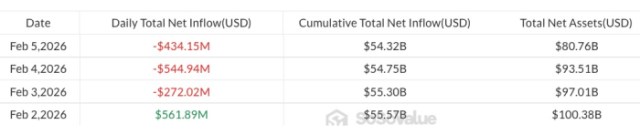
Fidelity’s FBTC and Grayscale’s GBTC led the retreat. It’s a clear signal: TradFi players are de-risking rapidly as macroeconomic uncertainty lingers.
That exposes the fragility of ‘paper Bitcoin.’ When price action stagnates, ETF holders, who pay management fees but earn zero yield, have little incentive to stick around. We’re seeing a rotation. Capital is fleeing passive, fee-bearing products to hunt for on-chain utility.
Let’s be honest: Bitcoin’s historic problem has always been inertia. It sits in a wallet (or a custodial vault) and does nothing. It yields nothing. It can’t easily execute smart contracts. And frankly, it’s notoriously slow compared to modern chains.
As the ETF sector bleeds, a divergence is forming. While retail panic sells and institutions hedge, smart money appears to be moving further down the risk curve into infrastructure that actually solves Bitcoin’s utility crisis.
The market is rewarding protocols that activate dormant $BTC rather than just storing it.
This sentiment shift has created a massive opening for Bitcoin Hyper ($HYPER), a project attempting to bridge the gap between Bitcoin’s security and high-speed decentralized finance.
Check out the $HYPER presale.
High-Performance Layer 2s Unlock Dormant Bitcoin Capital
ETF outflows expose a critical flaw in the current ecosystem: lack of programmability. Investors realize that holding an asset locked out of DeFi is a massive opportunity cost.
Bitcoin Hyper ($HYPER) tackles this by positioning itself as the first Bitcoin Layer 2 to integrate the solana Virtual Machine (SVM). That’s a technical leap, not just marketing fluff. By deploying the SVM, the protocol aims to deliver transaction speeds that rival Solana itself, bringing sub-second finality to the Bitcoin network.
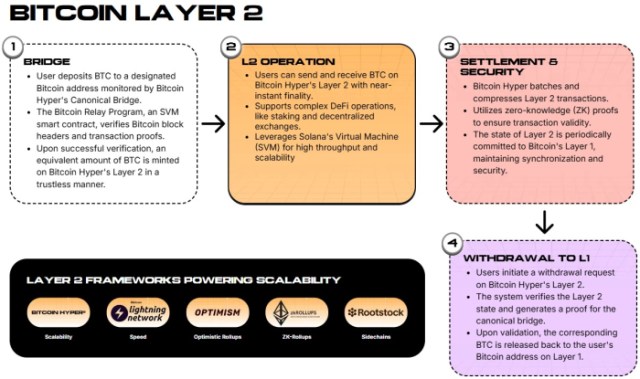
What most coverage misses is the modular architecture. Bitcoin Hyper uses Bitcoin L1 for settlement and security, but offloads execution to a real-time SVM LAYER 2.
This allows for high-speed payments in wrapped $BTC and complex DeFi applications, swaps, lending, gaming, coded in Rust. It effectively solves the blockchain trilemma by keeping Bitcoin’s trust layer while stripping away its latency.
For developers, this opens the door to building Ethereum-style dApps on Bitcoin without the congestion (or those painful $20+ fees) associated with the main chain.
The project relies on a Decentralized Canonical Bridge for $BTC transfers and a single trusted sequencer with periodic L1 state anchoring.
This ensures that while execution is rapid, the final truth always resides on Bitcoin. For investors tired of watching their $BTC sit idle in an ETF while the market dips, the promise of staking APY offers a compelling alternative to passive holding.
Get your $HYPER today.
Whales Rotate Into Bitcoin Hyper Amid $31M Presale Surge
While the broader market capitulates, on-chain data suggests sophisticated actors are accumulating $HYPER.
According to the official presale page, Bitcoin Hyper has defied the bearish trend, raising an impressive $31.2M so far.
The token is currently priced at $0.0136752, a figure attracting volume despite (or perhaps because of) the chaos in major crypto indices.

That divergence, ETF selling versus presale buying, suggests capital isn’t leaving crypto entirely. It’s merely rotating from over-saturated assets into early-stage infrastructure plays.
The tokenomics structure rewards that early conviction. Bitcoin Hyper offers immediate staking after the Token Generation Event (TGE), though presale stakers face a 7-day vesting period to prevent immediate dumps. This lock-up aligns with the project’s focus on long-term governance.
As Bitcoin struggles to hold $60K, the risk-reward ratio appears to be shifting toward protocols that offer yield and utility over mere price speculation.
Get your $HYPER today.
Disclaimer: This article is for informational purposes only and does not constitute financial advice. Cryptocurrencies, including presales and Layer 2 tokens, are volatile and high-risk investments. Always perform your own due diligence before investing.
