BBVA Joins Banking Consortium Launching Euro Stablecoin - Spain’s Giant Makes Crypto Move

Another brick-and-mortar giant dives into digital waters. Spain's BBVA just joined a banking consortium launching a euro-backed stablecoin—traditional finance quietly building its own crypto rails.
Why Banks Want Their Own Stablecoins
Forget waiting for regulatory permission to use existing tokens. This consortium lets member banks issue, trade, and settle using a shared euro-pegged digital asset. It cuts cross-border settlement from days to seconds, bypasses correspondent banking fees, and creates a closed-loop system they control. Old-school finance building new-school infrastructure—because if you can't beat the decentralized crowd, build a permissioned version and charge for access.
The Consortium Playbook
Multiple banks sharing a ledger means instant settlement between members. Need to move euros to another consortium bank in another country? The stablecoin transfers in moments, not days. It's wholesale finance first—big institutional transfers—with retail potentially later. They're not adopting crypto; they're co-opting its efficiency while keeping the gates firmly guarded.
What This Means for the Eurozone
A bank-issued euro stablecoin could become the dominant digital euro for institutional flows before any central bank digital currency (CBDC) launches. It gives the eurozone a digital tool for trade finance and cross-border payments without waiting for the ECB. It also lets these banks capture the data and fee revenue that currently leaks to fintechs and blockchain networks.
BBVA's Crypto Calculus
BBVA isn't new to this—they've explored blockchain for years. Joining this consortium is a hedge: if crypto becomes the plumbing of global finance, they own a piece of the pipes. If it fizzles, they lose little. Smart positioning for a giant with everything to lose by doing nothing.
The bottom line? When banks start launching stablecoins, it's not adoption—it's colonization. They're not embracing decentralization; they're building a faster, digital version of the same walled garden. The innovation is real, but the irony is richer: the very institutions crypto aimed to disrupt are now using its tools to reinforce their moats. How very... traditional.
BBVA Has Joined Banking Consortium Behind Qivalis
According to a website announcement, BBVA has joined a consortium of eleven European financial institutions that have created a joint venture to launch a stablecoin tied to the euro. This consortium was first formed in September 2025 with the goal behind it being the creation of a European alternative to the currently USD-dominated stablecoin market. Initially, it consisted of nine banks: ING, Banca Sella, KBC, Danske Bank, DekaBank, UniCredit, SEB, CaixaBank, and Raiffeisen Bank International.
In the months that followed the consortium’s inauguration, two more banks, BNP Paribas and DZ BANK, joined the fray. Now, it seems the group has gained a twelfth member with BBVA also signing up. Alicia Pertusa, head of partnerships & innovation at BBVA CIB, said:
Collaboration between banks is key to create common standards that support the evolution of the future banking model and deliver financial innovation to our clients in a consistent and practical way.
BBVA, standing for Banco Bilbao Vizcaya Argentaria, is a Spanish multinational financial services institution that mainly operates in Europe and South America. It’s Spain’s second-largest bank in terms of assets.
Previously, the bank has had involvement in projects related to digital assets, including a collaboration with SWIFT to develop a blockchain platform to serve as a shared digital registry for banks globally. With its entry into the consortium, BBVA is now also backing the euro stablecoin.
The consortium has created a new company called Qivalis to handle the issuance of the stablecoin. The firm is headquartered in Amsterdam and is currently waiting on approval from the Dutch Central Bank to operate as an electronic money institution.
Jan-Oliver Sell, Qivalis CEO, noted:
Having BBVA join the banking consortium marks an important step forward. With their addition, our network now brings together twelve European banks committed to building a secure, MiCAR‑compliant euro stablecoin framework.
Currently, Qivalis has slated the commercial launch of the euro-pegged stablecoin for the second half of this year, after the regulatory and technical hurdles are overcome.
Stablecoins have been gaining momentum around the world lately, with positive legislation related to them occurring in many jurisdictions. So far, however, users have shown a continued preference for USD-based tokens. As CoinMarketCap‘s stablecoin leaderboard shows, there isn’t a single non-USD coin inside the top ten.
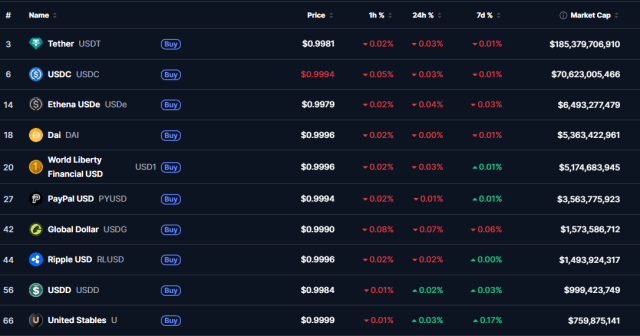
The largest non-USD stablecoin is Circle‘s EURC right now, but its market cap of $432 million is pretty small when compared to the USD stablecoins. For perspective, Circle’s USD token, USDC, boasts a market cap of more than $70 billion.
BTC Price
Bitcoin has continued to slide recently as its price has come down to the $69,400 level.
