Pantera CEO’s Bold Prediction: Governments Will Try to Buy 1 Million Bitcoin Each Within 3 Years

National treasuries are about to become the world's biggest crypto whales.
The Race for Digital Gold Reserves
Forget central bank digital currencies—the real scramble involves hoarding the original decentralized asset. One industry titan forecasts sovereign wealth funds making unprecedented moves into Bitcoin, with individual government targets hitting seven figures. That's not just diversification; it's a strategic shift in how nations store value.
Geopolitics Meets Blockchain
Countries that missed the early adoption wave now face a stark choice: watch competitors build formidable crypto reserves or enter the market at institutional scale. The mechanics alone—acquiring a million units without tanking the price—would require coordination usually reserved for currency interventions or bond purchases. Traditional finance desks would need to learn new tricks fast.
The Sovereign FOMO Factor
When one major economy makes its first official Bitcoin purchase, expect dominoes to fall globally. Reserve managers who spent decades optimizing bond portfolios suddenly face pressure to understand mining economics and custody solutions. The irony? Governments that once dismissed crypto as a fringe experiment might become its most powerful stakeholders—talk about regulatory capture in reverse.
Market Implications Beyond Speculation
This isn't retail-driven hype. Sovereign accumulation at this scale would fundamentally alter Bitcoin's liquidity profile, potentially locking up significant portions of the finite supply. Price discovery would increasingly reflect geopolitical maneuvers alongside traditional market forces. Forget hedge funds—the new volatility drivers might be parliamentary budget committees.
One cynical finance jab: Nothing makes bureaucrats embrace disruptive technology faster than the fear of another government department getting a bigger budget allocation from successful investments.
The clock starts now—three years to witness whether national treasuries transform from crypto skeptics to its most aggressive accumulators. When central bankers start quoting hash rates instead of interest rates, you'll know the transition is complete.
Morehead Stays Structurally Bullish On Bitcoin
After the arms-race thesis, Morehead stepped back to explain why he thinks recent market weakness fits a familiar pattern rather than a broken narrative. He admitted 2025 surprised him given what he described as a more favorable policy backdrop. “If you had asked me on New Year’s Day 2025… you would have said crypto up or down I would have said up and it was down 9% last year,” he said.
His takeaway: crypto still trades in HYPE cycles, and the psychology repeats. “This is actually our fourth cycle in 13 years of trading,” he said, describing the swing from “we all think we’re geniuses” in bull markets to “it’s failed” in down markets. The antidote, he argued, is time horizon: “five ten years down the road” and respect for bitcoin’s four-year rhythm.
Morehead pointed to a past Pantera call as evidence the cycle framework can still map price behavior. The firm projected bitcoin would hit $117,452 on Aug. 11, 2025—“and it did literally that day,” he said. He also acknowledged the usual temptation to declare an exception: “I was like, ‘Oh, no. This time’s different.’” Then he added: “and it wasn’t different.”
On demand, Morehead highlighted two relatively new channels that, in his view, pulled forward large amounts of buying: “publicly listed ETFs and then publicly listed digit[al] treasury companies.” He said investors “piled into them” and that “collectively they bought over a hundred billion of crypto,” before suggesting the market can cool once that first wave is absorbed.
Morehead’s longer-term case centered on monetary debasement and bitcoin’s fixed supply. “The willingness of all constituents just to print money is just off the charts now,” he said. He described steady erosion in fiat purchasing power as a rational catalyst for hard-asset allocation. “Paper money is being debased at 3% every year,” he said, arguing that it makes assets with constrained supply like gold or bitcoin structurally attractive.
He also addressed the gold-versus-bitcoin tug-of-war, saying rotations are normal and pointing to ETF flows as evidence both trades are now institutionalized. “The total inflows to ETFs for both gold… and digital gold, Bitcoin are about the same over the last couple years,” he said. Over a longer horizon, his conviction was explicit: “In 10 years from now, Bitcoin will massively outperform gold.”
On institutions, Morehead argued skepticism at the top remains a bullish signal because positioning is still light. “How can you have a bubble nobody owns?” he said, adding that “the median holding for institutional investors… is literally 0.0.” In his view, the list of reasons to avoid bitcoin has shortened dramatically, even if adoption at the largest firms is lagging.
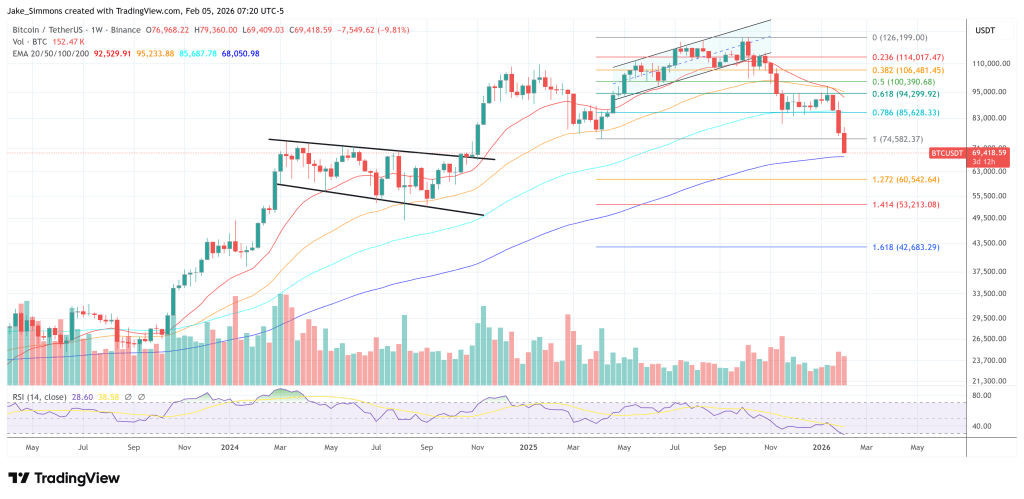
At press time, BTC traded at $69,418.