Vitalik Buterin’s Bombshell: Did He Just Declare War on Ethereum Layer-2s?

Ethereum's co-founder drops a truth bomb that's shaking the very foundations of the scaling narrative.
The Layer-2 Gold Rush Hits a Wall
For years, the mantra has been clear: Layer-2 solutions are Ethereum's salvation. Rollups, sidechains, state channels—the entire ecosystem bet its future on them scaling the network and slashing those infamous gas fees. Billions in TVL flowed in, promising a seamless, cheap future. Then Vitalik Buterin speaks, and the market holds its breath. His latest commentary isn't just a technical critique; it's a challenge to the core economic model of an entire industry built atop Ethereum.
Decentralization vs. The Profit Motive
Buterin's central thrust cuts deep. He questions whether the current crop of L2s, with their often-centralized sequencers and proprietary token incentives, are truly fulfilling Ethereum's ethos or just creating walled gardens for VC returns. It's a direct jab at the 'extract now, decentralize later' playbook that's fueled so much crypto construction. The implication is stark: are these projects building public infrastructure or just fancy toll booths? Another day, another narrative repackaged for retail liquidity.
The Road Ahead Isn't a Dead End
Don't mistake this for a death knell. Buterin's critique is a clarion call for evolution, not annihilation. He points towards a future of 'enshrined' rollups and more cryptoeconomically sound designs baked directly into Ethereum's protocol. The message for current L2 teams is brutal but simple: elevate your game or become obsolete. True scaling must be trust-minimized, not just marketing-minimized. The race just got real, and the finish line moved.
Ethereum Layer-2’s Need To Change
That’s not presented as an indictment so much as a categorization shift. If an L2 retains ultimate control, it may still be a valid product for its users, Buterin suggested, but it shouldn’t be marketed as “scaling Ethereum” in the strict sense envisioned by the rollup-centric roadmap. In that context, he argues, “we should stop thinking about L2s as literally being ‘branded shards’, with the social status and responsibilities that this entails.”
Instead, he sketches a spectrum model: some L2s can be tightly backed by ETH’s security guarantees, while others can be looser and more optional depending on user needs. That spectrum framing implicitly makes room for app-specific chains, different trust models, and non-EVM environments—without forcing them into a single “rollup as shard” storyline.
For L2 teams, Buterin’s guidance is straightforward: stop anchoring your identity on scaling alone. If you’re handling ETH or Ethereum-issued assets, he argues “stage 1 at the minimum” matters; otherwise, you’re effectively operating as “just a separate L1 with a bridge.” The real differentiator, in his view, should be features and properties that a larger L1 still won’t provide—whether that’s specialized execution environments, privacy, sequencing characteristics like ultra-low latency, or non-financial use cases.
Buterin says he’s become “more convinced of the value of the native rollup precompile,” especially once Ethereum has enshrined the ZK-EVM proof verification it “need[s] anyway to scale L1.” The idea is a protocol-level precompile that verifies ZK-EVM proofs and is treated as part of Ethereum itself, meaning it WOULD “auto-upgrade along with Ethereum,” and if it shipped with a bug, “Ethereum will hard-fork to fix the bug.”
That last point is the subtext: he wants a path where trustless verification and interoperability are easier to achieve without a “security council,” and where rollups can add custom features while still anchoring their EVM correctness directly to Ethereum. He also tied this direction to the prospect of synchronous composability: transactions that can safely span L1 and L2 liquidity with tight coupling, referencing ongoing research on combining preconfirmations with based rollups and real-time proving.
Buterin’s conclusion leaves room for uncomfortable outcomes. A permissionless ecosystem will produce chains with “trust-dependent, or backdoored, or otherwise insecure” elements, he wrote, calling that “unavoidable.” The job, as he frames it, is to make guarantees legible to users while strengthening Ethereum’s base layer, suggesting that the next phase of L2 competition may be less about who “scales Ethereum,” and more about who can credibly define, and prove, what they’re actually offering.
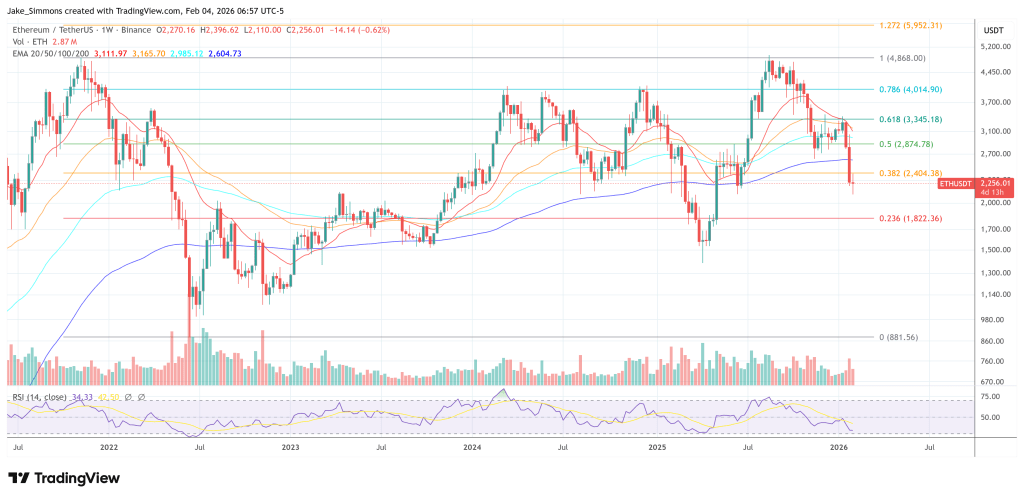
At press time, ETH traded at $2,256.